




What does it take for something to be considered a miracle?
How about a story that began more than 30 years ago, full of twists and turns and improbabilities every step of the way — which has picked up all these years later with more twists and turns and improbabilities?
How about a life that was changed, and like a pebble dropped in a pond, continues to change other lives in unending circles?
This is the story of James Badham — and no one will convince him it is anything less than miraculuous.
The Hospicio de San Jose Orphanage in Manila, Philippines, had a turning cradle. Families who could no longer care for their babies brought them there, placed them in the cradle and turned it to the inside of the door, rang the bell and ran away.
One can only imagine the feelings of the woman who placed her baby there late in 1970. Hope? Despair? A mixture of both?
The baby had been born Dec. 10, a note said, but he was sickly and the family could no longer care for him. The sisters at the Catholic-run orphanage took him in, but with so many babies needing their attention, so many children to care for, they could do little for him. They would be surprised, they told each other, if he survived the year. They named him James.
Switch now to Terri Badham. Terri and her husband, Dave, who was in the U.S. Air Force at the time, had been married for a number of years and had been unable to have children. They had completed home studies for adoption in both North Dakota and California but had been transferred before anything could be accomplished.
In the latest transfer, Dave was assigned to Clark Air Base near Manila. Terri was not allowed to go — until she found out she was pregnant. Then the rules changed, and she joined Dave. But shortly after arriving in the Philippines, she was hospitalized. The pregnancy was not a viable one, and despite all their efforts, they lost their baby on Dec. 10, 1970.
To handle the pain of the miscarriage, Terri began looking for a Philippine child to adopt. International adoptions were much different in those days, although it was still a complicated process.
She was finally referred to the Hospicio de San Jose, and Terri went for a visit. "I remember the sisters' warnings," Terri said in an adoption story she wrote for James. The sisters told her "Don't fall in love with the children. You must not. It will hurt too much to leave them." But, she noted, "It was already too late for that warning. We asked for a baby boy who had come to the orphanage on Christmas Day and was less than a week old." They already had a name picked out. John Chandler — Chad.
But it was not going to be that easy. For one thing, Hospicio de San Jose had never before allowed foreigners to adopt, especially non-Catholics. The Badhams were members of The Church of Jesus Christ of Latter-day Saints. But they continued to visit the orphanage, knowing the decision was out of their hands. Three months later, they were allowed to take Chad home.
But what of James? "I kept visiting the orphanage weekly," wrote Terri. "I knew there was another child for us." Her husband told her to look for a little girl. "That was the logical choice. It's a funny thing about logic and the heart. They don't necessarily function as a team. A baby boy, born on the same day my pregnancy ended, haunted me."
This baby was not thriving. He was not showing normal development patterns. The only thing he did was rock back and forth on his stomach. But when Terri asked about him, the sisters called the next day to tell her to come and get him.
Her huband was surprised that they were getting another boy, and such a sickly one at that. But he agreed they could keep him for a month, have his health problems checked out and see how things went.
And that's how James became part of the Badham family. Later on, Terri and David had four more children. So both Chad and James grew up in a happy family, which by then had settled in Bountiful.
James has suffered no lingering effects from his early health problems. "I had a normal childhood, no different from any other American child." He went to school, went on a mission for his church, married his high-school sweetheart, Jennifer, and had three children.
In 2002, two things happened: Jennifer was expecting their fourth child but suffered a miscarriage. And the company that James worked for at the time sent him to Asia on a work assignment. He decided to spend a few more days on a layover in the Philippines, so he could learn more about his heritage.
The only thing James had was a photocopy of a "birth certificate" from the orphanage telling of the turning cradle and with a black-and-white photo of the Hospicio de San Jose.
When the taxi pulled up in front of the building, an indescribable feeling came over him, he says. The building, built in 1810, was just like his faded photograph — except the turning cradle was no longer there.
"When I showed them my photocopy, they were shocked." He was introduced to a sister who had been at the place 31 years ago, and he spent the next two days learning about it and playing with the babies. "Don't fall in love with them," the sisters told him. But, of course, he did.
When he got home, he and Jennifer began to look into the process of adoption. They found they now needed to work with an international agency.
"But when we went to our first meeting and found it would cost about $15,000 to adopt a baby from the Philippines, we went home disappointed," says Jennifer. "We knew it would take us a few years to come up with that kind of money."
In the meantime, they wanted to do something for the children at the Hospicio de San Jose. They started a community fund-raising project involving a 5K run and donation jars and came up with $4,400 to provide a Christmas for kids at the orphanage.
"We wired the money to humanitarian missionaries serving in Manila. They took the children to a department store and let them pick out what they wanted most," says Jennifer. There was even enough money to get a DVD player, a refrigerator and two computers — and a Christmas party.
(This was so successful that they've continued to do an annual fund-raiser and have established a foundation and an account at America First where people can make donations.)
Just after Christmas, James was laid off. Family and friends were very supportive, says Jennifer, but the couple knew adoptions plans would have to be put on hold.
"One day James came in from getting the mail and called me down to the office. He handed me a check that had come in the mail anonymously for $10,000. As we added up the costs, this was the amount we needed for all the adoption fees."
Shortly thereafter, James found a new job, and the adoption went forward. "We were not allowed to pick a child," says James. "We sent in the paper work, and the Hospicio de San Jose matched it with the child." The whole process took slightly over a year.
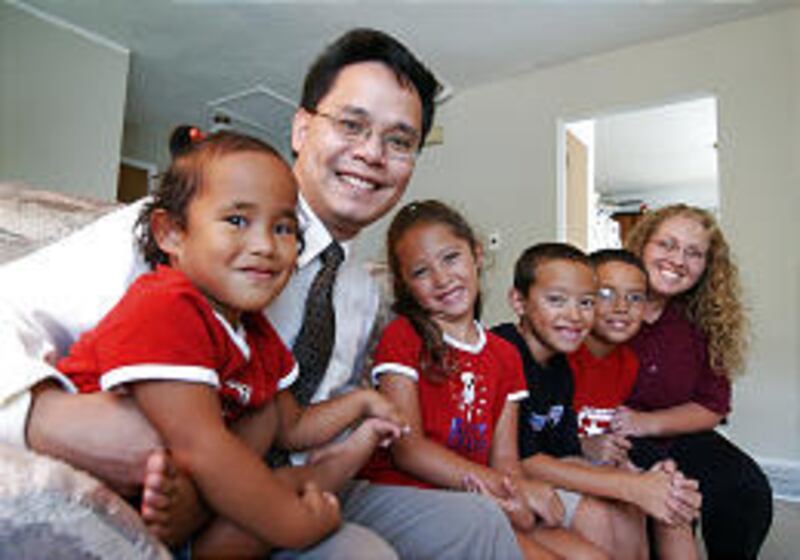
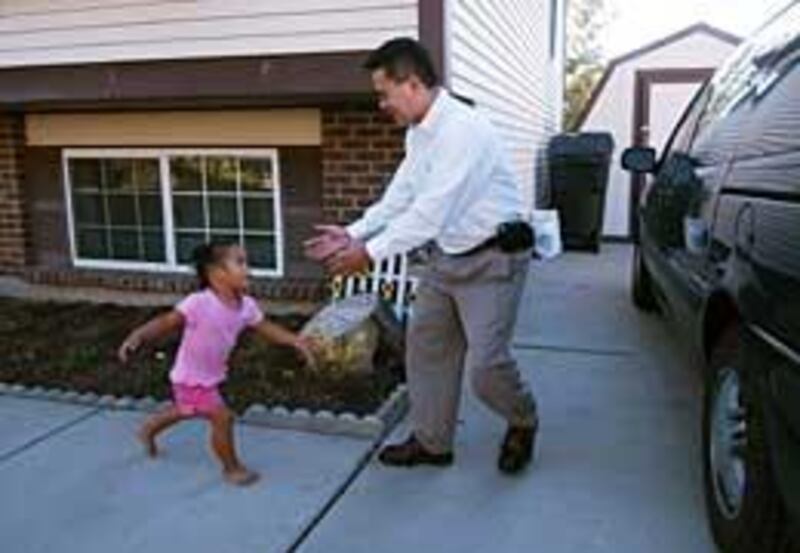
In June of this year, Divina, a 3-year-old who had been turned over to Hospicio de San Jose because she was malnourished and because her family was too poor to take care of her, came to live with the Badhams.
Three months later, says James, "it seems likes she's always been here.
"She's fun to play with," says her oldest brother, Tanner, 10. "But she tires me out when she runs." The family also includes Tyler, 8, and Marisa, 6.
"She's full of energy," says Jennifer. "All my other children have been mellow. People tell me every parent deserves one like Divina."
It has all been "an amazing, eye-opening process," says Jennifer. "Before this I didn't know anything about adoption."
"At the time," adds James, "it's hard to see the forest for the trees. You wonder why you have to go through so much, but you realize at the end that it is for the child's benefit." And if he had any advice for other adoptive parents it would be this: "You have to be willing to suffer through the process so you can find out if psychologically you can handle it. But the wait is well worth it."
James has since been downsized out of his job again, and he's doing private consulting while he explores other options. "Life is a learning experience," he says. "It has its ups and downs. But we have love. We have our family. And Divina coming to our family is a sheer miracle."
He and Jennifer have been invited to speak at a global adoption conference in October of 2005 about what they've learned, but also about the ways adoption touches lives.
Maybe, he says, someday Divina will want to adopt a child. Maybe someday that child, too, will come from the Hospicio de San Jose in the Philippines.
E-mail: carma@desnews.com