

The massive tsunami that struck the coastlines of Thailand and 10 other countries on Dec. 26 left thousands of unidentified bodies in its wake.
Now, two Utah companies, using DNA analysis, are helping the Thai government identify some of the estimated 5,384 people who died in that country.
Salt Lake-based Sorenson Genomics, owned by Utah billionaire James LeVoy Sorenson, together with Park City-based Pacific Rim Consulting Group have collected and are analyzing hundreds of tissue samples. Those samples, flown to Salt Lake City, are being matched against DNA profiles of survivors unable to find their loved ones.
David Rockwood, president of Pacific Rim Consulting, said he knew he had to help after learning of the disaster.
"I knew that Sorenson Genomics had the technology to do quick DNA pairing matching," Rockwood said in a phone interview from Bangkok. "So we called the head of Thai forensics, Dr. Porntip Rojanasunan, and asked her if she could use this technology if it was donated, and she said, 'You bet.' The next day I grabbed 500 of the kits and 1,000 swabs and was on a plane, and 24 hours later I was in the DNA testing center in the morgue."
Rockwood joined University of Utah professor Don Pedersen, director of the U.'s physician assistant program, at Yan Yao, a Buddhist temple about 70 miles north of Phuket.
Together, the two had the distressing task of sifting through hundreds of corpses, extracting samples of scalp, muscle, teeth and bone.
"My driver threw up the first day," Rockwood said. "No matter how well prepared you are for it, when you walk out there it is quite a shocking sight. However, after that first hour or so, you start realizing that you are involved in a worthwhile work, that the identification of these bodies is important for family members. I have five kids, and it gets quite personal, and you just kind of bear down to the work that needs to be done."
Sorenson's DNA analysis will act as a backup, Pedersen said, with its results compared against DNA work by other teams. Sorenson Genomics has sent an additional 1,000 tissue kits and 2,000 swabs to Thailand.
The 1,500 tissue kits and 3,000 swabs, along with the DNA analysis, are valued at $1.5 million.
Every two days Rockwood takes the extracted tissue samples — along with mouth swabs of survivors — from the morgue in Yan Yao to Phuket, a two-hour drive. From there, Rockwood catches a plane to Bangkok, the location of the nearest FedEx office.
"The things you think are important just kind of seem to pale in comparison," Pedersen said. "How quickly things can change. That place was beautiful, and in an instant it was transformed into a war zone."
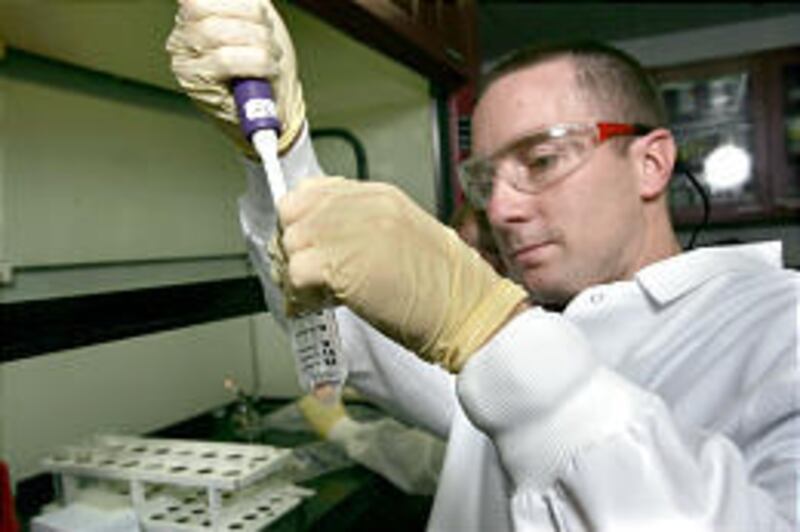
When the samples reach Salt Lake City, a team of 12 to 14 scientists at Sorenson Genomics begins the delicate work of isolating the DNA. Roughly 850 samples are currently under analysis.
"We were excited about being able to help," said Lars Mouritsen, chief scientific officer of Sorenson Genomics. "When the teeth arrived, knowing that each one of those represents an individual back in Thailand who's deceased, and a family who has lost loved ones, it brought a tremendous reality to it."
Mouritsen said the team has extracted a number of tissue samples. "Ideally, we would have wanted to do the extraction and all the testing in Thailand," he said, "but the facilities just didn't exist."
Following extraction, DNA amplification and sequencing begins, and the exact order of roughly 3 billion chemical building blocks unfolds. The information is stored in a computer database, where each sample is matched against others. About 1,200 of the 3 billion nucleotide bases are analyzed to make a match.
The team was hoping to capture genomic DNA, which is found in a cell's nucleus, making a match easier. However, Thailand's heat, humidity and saltwater degraded many of the genomic DNA samples.
"In those cases," Mouritsen said, "it makes it a little more difficult to make the identification."
That has led to testing of mitochondrial DNA, the genetic material found in mitochondria, which are located in the cytoplasm of a cell and inherited maternally.
"The mitochondria are much more abundant, and the DNA is really much more robust," Mouritsen said. "So it's still very possible for us to take the mitrochondrial DNA and be able to make matches of mother to children."
James LeVoy Sorenson said he wanted to help with the identification because he feels each person has an obligation to help others in need.
"The fact is we are all brothers and sisters," Sorenson said. "As I look at you and you look at me, we are closer than we think. We look at each other for differences, but really just look at the similarities."
In addition to his partnership with Sorenson, Rockwood has started his own fund to help in Thailand, online at www.thaitsunamihelp.org. Funds will be used to hire displaced resort workers to help in ongoing aid and reconstruction efforts.
"I've made a lot of money here (in Thailand), and this for me is to give something back," Rockwood said. "Anybody who's ever spent any amount of time with the Thai people know they're some of the most loving, caring people. It's infectious how wonderful these people are, and it is just so sad that most of the major victims here are poor people. These poor fishing villages that are right next to the water got hit the most."
E-mail: danderton@desnews.com