

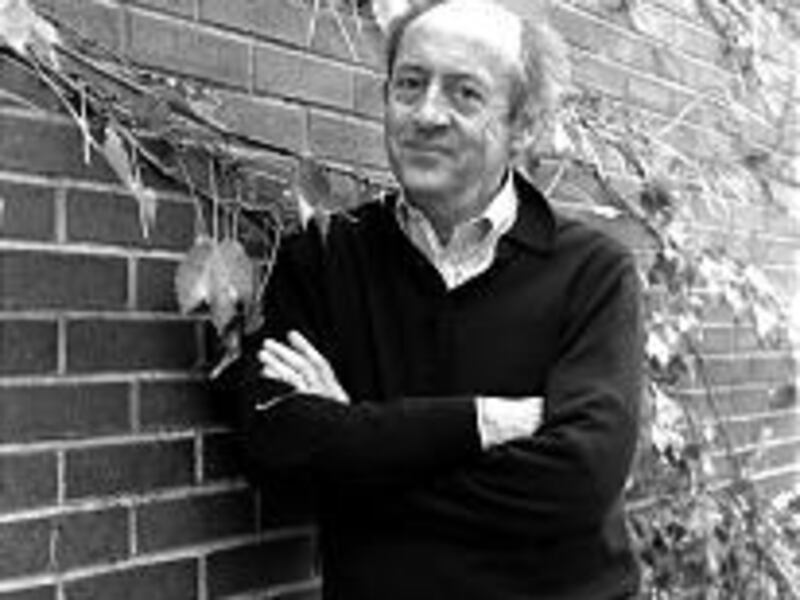
At 64, Billy Collins is on top of his game. He is quite possibly the most popular poet writing today — but he is hanging onto humility for dear life.
"Sales of my books continue to be a surprise," Collins said by phone from his home in Westchester, N.Y. "But if you start believing in your own persona, you're doomed.
"I tend to detach myself from that and don't quite believe it's happening. It's good for my self-esteem. But I have a wife, Diane, who is professionally trained to deflate the male ego. She's an architect. We have this little competition — I tell her I write poems that will still be read when her buildings have fallen down."
The often repeated reason for Collins' success is that his poetry is accessible — meaning that the average reader can enjoy it and understand it without a professor poised over his shoulder. Collins believes there is "a movement gradually moving away from 'the school of incomprehensibility.' Dozens of poets are writing approachable poetry that is reader-friendly — and readers are starting to reclaim poetry they think should not be kidnapped and held hostage by other poets."
Writing approachable poetry is nothing Collins set out to do. He just produces the best poetry he can.
"I've read some very simple-minded poems, but once you get inside them there's not very much going on. They're flat poems.
"On the other hand, other poems have a surface clarity, and when you gain entrance to the poem, then all sorts of imaginative things happen and it becomes more challenging as it goes along. For me, accessibility means I've gotten the reader into the poem."
The other question for every poet is how long will their poetry continue to be read? "I've found my way into a number of anthologies, so I have a place in the classroom for a while. That's important to me — it's good to get poetry in the hands of young people. But the view of posterity is something that is incalculable.
"Walt Whitman is a good example of the opposite. His poetry speaks to the future. He felt assured that his work would last for posterity, that he would be read hundreds of years from when he wrote — and he is."
For anyone to be able to write poetry, in Collins' opinion, he or she "should have a playful interest in language. It's more important than having something to say. At an early age, you need to be interested in playing with words. A person who spends time with the dictionary would be a good potential poet."
Collins doesn't pretend to be walking around all the time with a poem or two in his head. "My mind is sort of blank and unpoetic — too wrapped up in picking up dry cleaning or filling out insurance forms."
His main inspiration comes from other poems. "Writers are just readers moved to emulation or imitation. But my influences come from all sides and sources. The plays of Oscar Wilde have something to do with the tone of my speakers.
"Ernest Hemingway taught me and lots of other people how to write a sentence. He established a certain clarity of style. But Warner Brothers' 'Looney Tunes' has had an effect on my work, too — as well as movies, fiction and paintings. I take inspiration wherever I can get it."
The main problem for Collins is that after he writes a poem he's back to zero. "Some people are working on a novel and they continue the next day. I have nothing to wake up to — and I never know where the next idea is coming from.
"I just finished a poem before you called. The idea came from a lecture I attended where the speaker talked about a man who said he could read a book through a wall. As soon as I heard that I recognized an imaginative possibility — and that's what this poem is about."
Collins has never worked on one poem for more than two or three days. "At some point, the revising, critical mind begins to kill off the original genius — you can say, 'he said, laughing.' Or the original impulse that got the poem started. Like most poets I don't know what I will write until I begin. The real excitement of writing a poem is discovering the destination — the ending. It's a delightful kind of mysteriousness, a kind of birthing. You made something new!
"I tend to write most poems in one sitting — from 20 minutes to two hours. Then I revise for possibly days or weeks — I might think of a better word while driving, something that better addresses musical concerns or gives the poem a better cadence, changes the syntax or diction. There is a conceptual burst, then I go back and make usually minor adjustments. You really want it to sound like it popped out of your head."
Collins believes two ends comprise the continuum of poets — "The cult of spontaneity and the cult of craft. In the latter, a poet is unembarrassed that the poem is the result of hours of care. Most poets fall somewhere in the middle."
Although Collins never reads his poems out loud when he is writing — "I hear it in my head" — he recommends it for readers as a way to better understand them. When he reads his poems in front of an audience, he varies the content from serious to playful. He has a low tolerance for performance poets. "I do it completely deadpan. If you laugh at your own material, you're sunk. It's the kiss of death.
"I try to be a flesh-and-blood page, hoping the words speak for themselves."
E-mail: dennis@desnews.com