

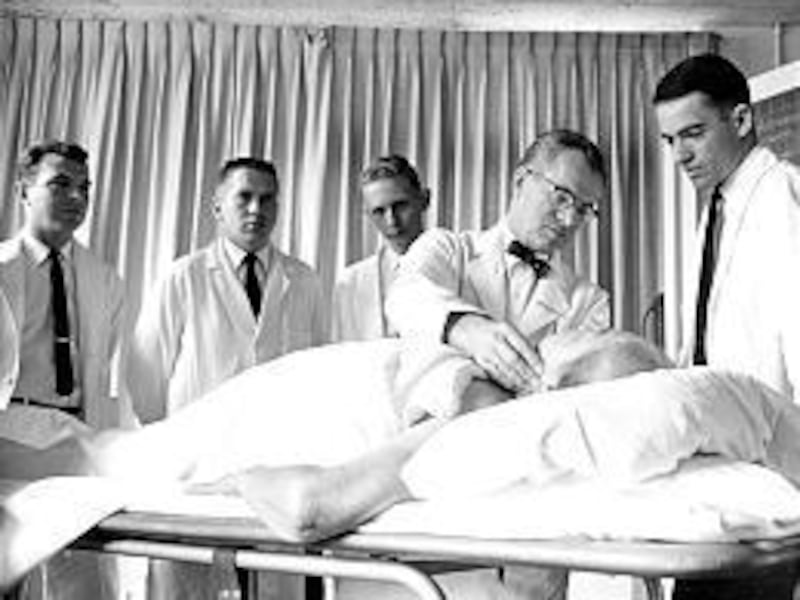
The University of Utah School of Medicine began as an offshoot from the School of Biology with 14 students, all of whom went on to become physicians.
There was no building and it was a two-year program. At the time, experts said Utah was too remote for a medical school to be practical. They said it was bound to fail.
That was 1905. On Friday, the school celebrated its 100th birthday as an internationally noted medical school. A centennial celebration was held in the Downtown Marriott.
Dr. James L. Parkin, chairman emeritus of the department of surgery, a member of the class of 1966 and chairman of the centennial committee, said the occasion "gives us the blessing of reflection and resultant gratitude to the many who have made our pathway through life more adventurous and fulfilling."
Participating in a program honoring the school's missions of education, research and patient care were Dr. Chase N. Peterson, professor of family and preventive medicine and former assistant U. president in charge of health sciences; Dr. Lynn B. Jorde, professor of human genetics; Dr. Susan E. Mango, associate professor of oncological sciences; and Dr. Jeffrey R. Saffle, professor of surgery and director of the center's burn unit.
Twenty-one distinguished professors, physicians and researchers from the past and present hosted receptions for colleagues interested in particular specialties.
Looking back, the school has had an interesting century. It wasn't until 1919 that the school gained its own building, moving into an old ROTC barracks that had been used to train cavalry. The school offered only a two-year program, so students were required to complete their last two years at another university to gain a degree. In 1942 it became a four-year school.
That same year, Dr. Louis P. Gebhardt moved to the University of Utah from Stanford as the new head of the Department of Bacteriology.
"The lab looked like the Stone Age variety," he said at the time. "There were only two cultures and both were contaminated."
The first kidney transplant at the hospital was performed in 1965. In 1979 conjoined twins were separated. In 1982 the world's first permanent artificial heart, designed at the university, was implanted. In 1996, Utah's first double lung transplant was performed.
The university treated its millionth patient in 1998.
In 1955, every $1 invested in the medical center generated $3.10. Today, for every $1, it generates more than $9.
E-mail: jgreaves@desnews.com