

No wonder it was such a shock when he died.
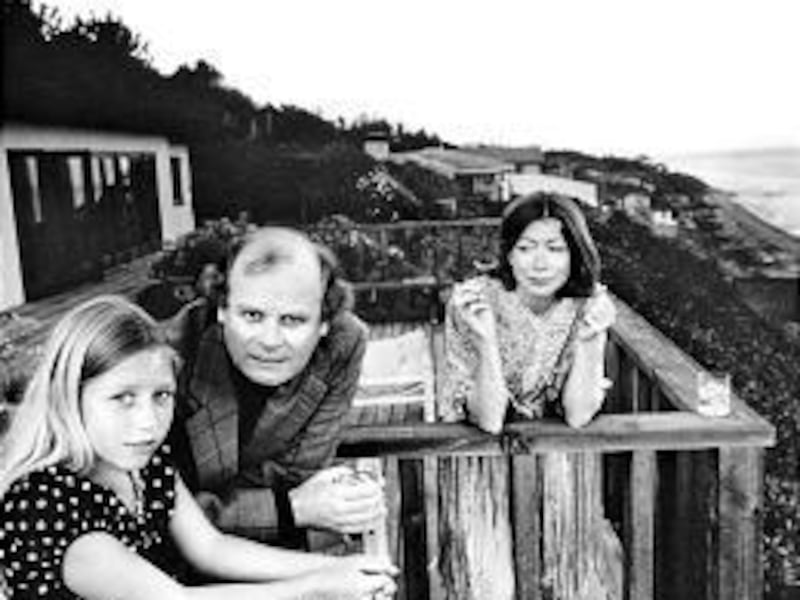
Joan Didion and John Gregory Dunne had enjoyed a deep soul connection since their marriage more than 40 years ago.
Not only did they spend virtually 24 hours a day with each other, they were both prolific writers and novelists. And each was the first reader of the other's work. They also wrote several plays together.
When, at 71, Dunne slumped in his chair and died of a massive coronary the night before New Year's Eve 2003, Didion was devastated. "He frequently said he thought he was dying," Didion said by phone from her home in New York City, "but I didn't pay much attention to it. He was Irish Catholic, and they think about death a lot. He had said it even when he was in his 30s."
She recalled that he had finished his last novel, "Nothing Lost," quite awhile before he died. "But he was depressed when he had a hard time finding the rhythm in his next novel.
"Doctors have told me that there is an apprehension of death among some people who will, in fact, die suddenly. There is something that warns people they are about to die. They look back and worry about not having accomplished more."
Didion's new book, a finalist in nonfiction for the National Book Award, is "The Year of Magical Thinking," a probing, analytical account of her struggle to come to grips with Dunne's demise. "It is the most personal book I've ever written. The language just came. It was a very fluent book to write. A lot of books are not fluent. I often have a hard time finding out what I think, and I find out what I think while I'm writing. But I knew what I thought on this one."
She considers herself an optimistic person, yet "John's death was entirely unexpected. I should have foreseen the possibility."
To make matters worse, Didion also coped with the continued illness of their only child, a daughter, Quintana, who suffered a serious infection that eventually led to her death at age 39 — after Didion finished this book.
During that illness, Didion tried to educate herself in medical science. "When you have a loved one who is not conscious in the hospital, someone has to look out for her. It seems important to represent the patient. To do that you have to try to learn the impossible — like neurosurgery."
In fact, Didion did so much research that some of the doctors became exasperated with her. "We all know more than we think and less than we think. Then there is a certain level at which medical treatment is intuitive. There is, of course, nothing intuitive about the way the heart works. It referred me back to my high school classes in chemistry — the ones I failed."
Yet she sometimes was so persuasive — as when she suggested her daughter had edema and may be "waterlogged" — that the doctor came the next day and presented her plan "as his own."
Immediately after her husband's death, Didion was unnerved when one of the doctors referred to her as "a pretty cool customer" — a surprisingly insensitive remark coming from someone accustomed to death. "It's remarkable," said Didion, "how difficult it is, even for a professional, to feel the nature of death for someone else."
The fact that Didion had so much trouble accepting Dunne's passing — to the point that she kept expecting him to return — is more common than most people realize. "It's part of the crazy part that no one talks about. You don't realize it when you're in its grip."
It was almost three months after Dunne died before Didion held a formal service in his honor. It took place at New York's Cathedral of St. John the Divine, which Didion called "the biggest Gothic cathedral in the world. You're surrounded by space above and behind you. Everything there is kind of theatrical."
There was a Gregorian chant for Dunne, Quintana read a poem she had written for her dad, and famed writers Calvin Trillin and David Halbarstam delivered eulogies. "It was very moving," said Didion.
Although she doesn't say so in the book, the friend who brought her — every day — the only thing she could eat during her mourning, "a quart of scallion-and-ginger congee from Chinatown," was Trillin, the renowned satirist. "It was just great — especially for someone to bring it unasked."
Leading up to her husband's death, Didion never could figure what he was thinking, so her only hint of closure was the autopsy report. "I thought his problem with arrhythmia was solved in the late '80s." When the autopsy said he died of a massive coronary, she remembered his cardiologist had said the left anterior descending artery was a "widowmaker."
One familiar quotation that Didion, her husband and her daughter would often repeat, symbolic of their mutual love, was, "I love you more than one more day." It came, Didion said, from Audrey Hepburn in the film "Robin and Marion," after she gave poison to both Robin Hood (Sean Connery) and her own character.
Once Didion decided to write the book, the important thing was "to get it down, to get done very fast so I could wallow in it. I'm glad it's selling well, but I'm looking forward to moving on to something else."
Didion will be traveling frequently from now until Thanksgiving, so she hopes that one day "on an airplane or in a hotel room, what I'm going to do next will come to me in secret and it will be thrilling."
E-mail: dennis@desnews.com