

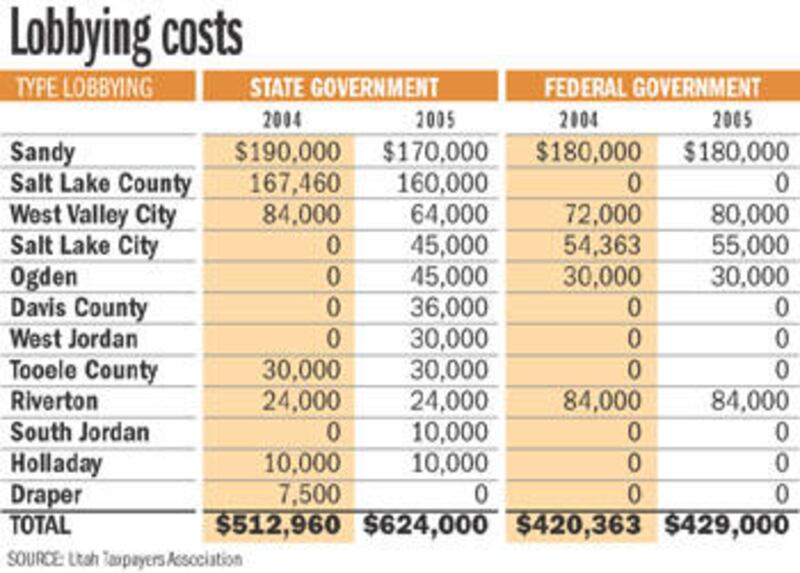
A report from the Utah Taxpayers Association, a lobbying group that favors government efficiency, shows that Sandy and Salt Lake County top the list of big spenders on lobbying Utah lawmakers.
The two governments hired outside lobbyists for the Legislature, seeking money for local projects and access.
Sandy also has paid $180,000 this year for federal lobbyists who tug on the ears of Congress members for city projects, according to the Taxpayers Association report.
Sandy Deputy Mayor John Hiskey said the city spent $170,000 on lobbyists for the 2005 Legislature and used the lobbyists' influence to gain millions of dollars for Sandy-specific projects.
Hiskey noted the parking structure for the South Towne Exposition Center — the Legislature agreed to allow Salt Lake County to collect special taxes that would raise money for that $20 million parking structure. Sandy officials then used the garage as a selling point to lure professional soccer team Real Salt Lake to their city with the promise of sharing the garage between the soccer stadium and the Expo Center.
The Utah Taxpayers Association said cities with full-time mayors already are paying those people to lobby for the city.
"I think our goal is to have them spend $0 on lobbyists because that's the mayor's job," said Andrew Stephenson, the research analyst who prepared the association's report. "To pay lobbyists when you have a full-time mayor doesn't make much sense."
Sandy, for example, employs full-time Mayor Tom Dolan, full-time Deputy Mayor Hiskey, a full-time city administrator and a full-time assistant city administrator. Additionally, the city pays around $47,000 in fees to the Utah League of Cities and Towns, a lobbying group specifically for Utah's municipalities.
Sandy has used the money lobbyists glean primarily to pay for road projects, from the reconstruction of State Street between 10600 and 9400 South to upgrading I-15 interchanges within the city's boundaries. Sandy also has used money secured by lobbyists to pay for storm drain upgrades, an urban fishery and protection for a historic neighborhood.
"Our people are state taxpayers. They are county taxpayers and they are federal taxpayers," Hiskey said. "If there is an ability through the state, county or the feds to properly support projects in the city, then I think it is appropriate that we advocate properly for those.
"From what we have seen with the millions of dollars in transportation improvements, to acquire parks, open space, to see the improvements on storm drainage and things, we believe those dollars have brought leverage and added to the community. It has been an investment that has brought added funds or prevented the loss of funds to the city."
Salt Lake County spent $160,000 on lobbyists to gain access to state lawmakers that the county would not have otherwise, said Karen Suzuki-Okabe, the county's deputy mayor who works on governmental relations.
"We'd love to tell you that it's a level playing field, and we have the same level of access to legislators, but that's not the case," Suzuki-Okabe said. Lobbyists "have influence with legislators, and that's not the same case with elected officials for Salt Lake County."
In West Valley City, where city officials doled out $64,000 for state lobbying and $80,000 for congressional lobbying in 2005, the money paid for lobbyists to find out what lawmakers were talking about, from sales tax distribution to redevelopment agencies. The lobbying tab is a bargain compared to what it would cost the city to hire a full-time legislative liaison, said Paul Isaac, assistant city manager.
Riverton spent $84,000 on federal lobbying, which city manager Marc Cram said has brought back nearly $2 million in projects ranging from a grant for water desalination to upgrades to the culinary water system to converting a school into city offices.
Contributing: Doug Smeath.
E-mail: kswinyard@desnews.com