

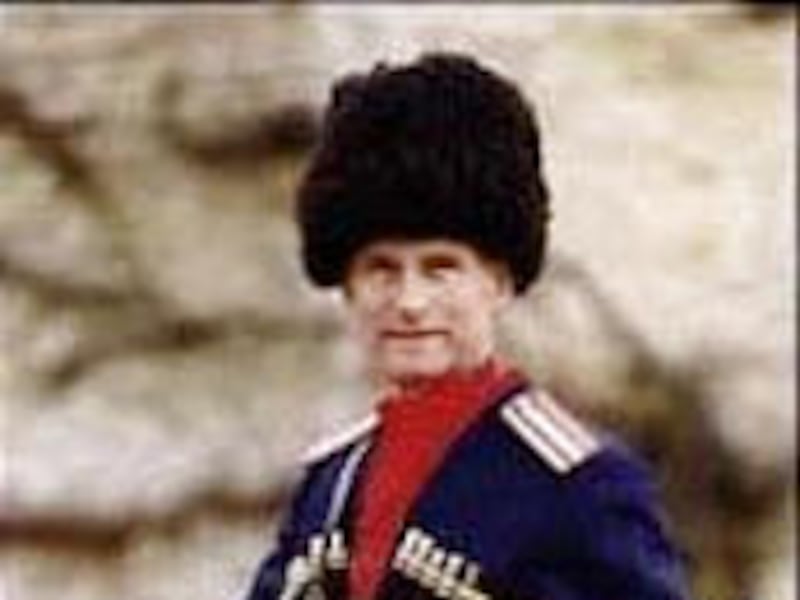
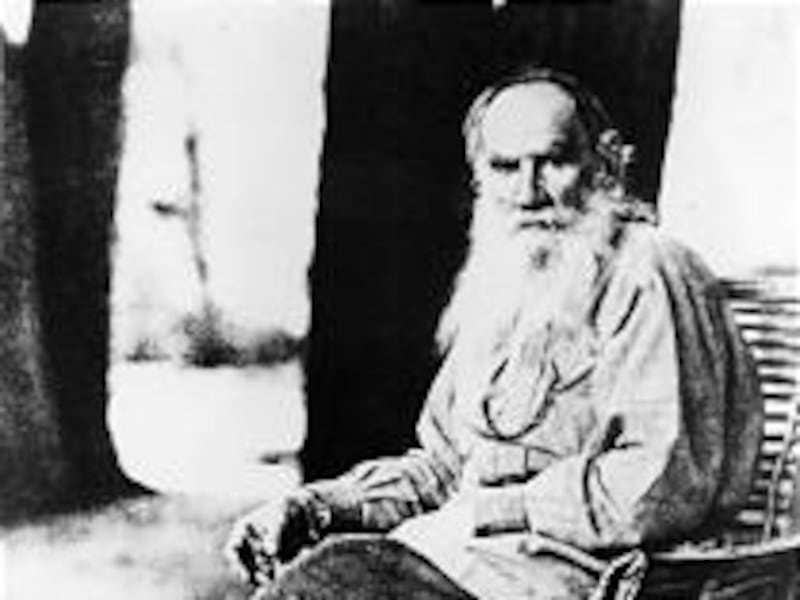
He's a Tolstoy. Like Shakespeare and Rockefeller and Huntsman, the name brings with it a certain cachet. And a certain burden.
If you're a Tolstoy, a distant cousin of the famous Russian author Leo, it's important to live up to the name, not just use it to your advantage, says Count Nikolai Tolstoy. If your name is Tolstoy and you're related to the long line of Russian aristocrats and artists, "you should earn your own way," he says.
Like his famous long-dead cousin, Count Tolstoy is a writer. Born and reared in England after his family was forced to flee the Russian Revolution, he is chancellor of the Monarchist League and a fellow of the Royal Society of Literature. In 1987 he received an International Freedom Award from the U.S. Industrial Council Educational Foundation for his "courageous search for the truth about the victims of totalitarianism and deceit."
All these honors, and more, are listed on Tolstoy's Web site, along with this surprising title: adjunct professor at Utah Valley State College. This past week he was in Orem as a visiting scholar in the college's Institute of International Affairs. He hopes to return next spring.
Tolstoy's association with UVSC began in the early 1990s, at the invitation of then-President Kerry Romesburg, who also offered to host Tolstoy's Web site — because at home in England, Tolstoy was embroiled in a fierce legal battle.
"Let an English judge try forcing an injunction on an American university," Romesburg told Tolstoy.
The legal battle, which Tolstoy describes in perfect British understatement as "some little problems," began when he was sued for libel by Lord Aldington and ordered to pay $1.5 million in pounds in 1989. Tolstoy had criticized the Harold Macmillan government for the forced repatriation of war prisoners after World War II, a move that had sent tens of thousands of Russians and Yugoslavians into Stalinist gulags (prisons.) Tolstoy also wrote a pamphlet specifically accusing Lord Aldington of war crimes, and it was this pamphlet that led to the libel charge.
Tolstoy contested the libel award, and in 1998, after the European Court of Human Rights ruled it was a violation of Tolstoy's freedom of expression, Lord Aldington agreed to a much smaller sum. The whole ordeal made Tolstoy a cause celebre, but it also has kept his book, "The Minister and the Massacres," off most British library shelves.
For a time during the protracted lawsuit, Tolstoy was too caught up in the legal fight to write books. Before then he had been a prolific writer of histories about World War II, Stalin, Arthurian Legends and 24 generations of Tolstoys. After the suit was finally settled, he took up writing again and recently published a biography of his stepfather, Patrick O'Brian, author of "Master and Commander."
The count is the heir of the senior line of the Tolstoy family in the male line and is related to the author of "War and Peace" through a common ancestor in the 1700s. It's a distant relationship, but, as Tolstoy says, "we're not a big family," so "we all regard each other as cousins."
He is British by birth and upbringing, but his heart is "always with Russia." Besides, he says, "it would be strange, or ridiculous, to be a Tolstoy and not a Russian."
His mother, who was British, divorced his father when Tolstoy was 4. His father then married a Russian woman of whom Tolstoy wasn't particularly fond. So it was kind of an unhappy childhood, he says. He can relate to his kin Leo's famous first line of "Anna Karenina," another of the Russian author's celebrated novels: "Happy families are all alike; every unhappy family is unhappy in its own way."
Still, he doesn't agree with his cousin's implication that happy families are dull. He and his own wife, Georgina, and their four children have been very happy, he says. "I'd say a happy family is much more interesting than an unhappy one. You're freer to develop your potential in a happy family. In an unhappy family you tend to use up so much of your energy."
E-mail: jarvik@desnews.com