




Long considered a basketball state, prep football in Utah is coming on strong like a running back loose in the secondary. Attendance and enthusiasm for the state football playoffs currently under way is running high.
Deseret Morning News reporters interviewed dozens of high school football players, parents, coaches, school officials, doctors, boosters and community leaders across the state to explain Utah's increasing fascination and sometimes obsession with high school football.
"Chasing Glory" is a four-day series that will examine controversial claims of "recruiting," the ever-increasing size of today's players, football dynasties, and a special visit to a distant Utah town where life is simpler and football the center of their universe.
Eight hundred milligrams at lunch. Eight hundred milligrams before the game. Chasing glory means having to chase away the pain.
Precious final weeks of Chris Laloni's high school football career hinge on a regimen of ibuprofen, an athletic trainer's care, a brace and half a roll of tape.
The Hunter High School senior has a partial tear to the main ligament that stabilizes his right knee. He needs surgery, but the doctor's repair will have to wait. Prep football playoffs have started.
So what is it with football? What is the draw to a sport that makes a kid like Laloni play through pain and risk permanent injury?
What is it about a sport that would drive a coach to tell his team on the first day of practice: "I'm going to win the state championship with or without you!"
What could possibly be worth getting up at 6 a.m. during the sleep-in days of summer and pounding out six hours of practice?
This is not Texas. Utah is certainly not a high school football mecca like Oklahoma or Florida, but in a state where basketball has always been king, high school football is picking up steam. It's no longer just something to do in the fall until hoops start.
"In the last eight to 10 years, football has caught up and maybe even surpassed basketball," said Evan Excell, Utah High School Activities Association executive director.
Consider this message on the Olympus High School Web site: "We are convinced that a well-administered football program contributes as much to the goals of general education as any other high school subject."
Consider how serious the sport is taken in Fillmore. The school has a long history of winning, including 13 state championships.
Millard High head coach Marshall Sheriff and his team had just lost a 2003 state semifinal playoff game when the "For Sale" signs showed up on his lawn.
"I was 11-1 when that happened," Sheriff said, noting his teams had lost only two games the previous two seasons and won the state championship in 2001.
Sheriff said the signs upset his wife, but he took it in stride. He knew what he was getting into when he took over as head coach six years ago.
"This community expects you to win," he said. "Parents expect you to win. Parents expect their kids to do well."
Sixty-one bleary-eyed members of the Lehi High football team sat in the commons area of a college campus dorm on a predawn summer morning.
"This is going to be the hardest practice," said coach Joe Hayes. "Let's get something out of it."
With that, the players wearing shorts, T-shirts and helmets file out of the building and jog to the practice field, their cleats clacking on the pavement in the darkness.
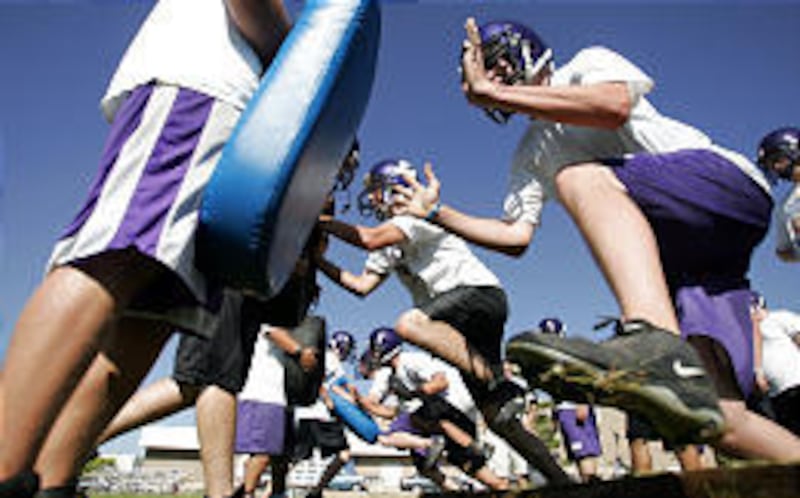
High school football practice officially begins in August with dreaded two-a-days. But teams start training and practicing long before then. Year-round weight lifting, conditioning and clinics and camps like this one are all but mandatory nowadays.
The Lehi players grunt and groan their way through pride jacks, crab crawls and monkey rolls on a soggy, wind-swept field. They run sprints and then run some more. They put their hands on their hips and bend over.
"This is wearing me out," senior fullback Tyler Berry said afterward. He and his teammates tell themselves it will be worth it when the season starts.
There is something about football that brings out community pride like no other high school sport. It's a phenomenon that involves neighborhoods and in some cases entire towns. Prep football is synonymous with Friday nights, cheerleaders and marching bands. Alumni return wearing letter jackets. Students paint their faces.
San Francisco 49ers linebacker and American Fork High graduate Derek Smith watched his first high school game in years when he returned to Utah to see his alma mater play Lone Peak this month.
"I could not remember being that small," he said. "It's not an insult. You think you're all big and everything (in high school). You go away for a while and realize, I wasn't so big."
The game brought back memories of what football was like before it became his job.
"The biggest thing is you're with all your buddies. It's so much fun. There's a lot of emotion in the game. You're playing with a lot of heart."
And everyone, it seems, hungers for that feeling.
"It's a grass-roots thing," Cottonwood High coach Tom Jones said. "I think people get a kick out of being connected to their school."
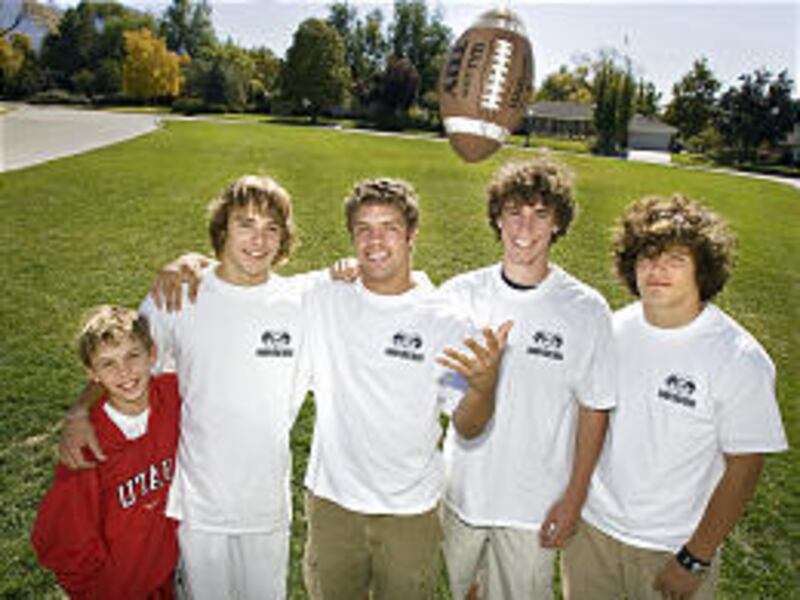
In a Highland High School neighborhood to the northeast, years of friends and brothers play football for the Rams. Someone made the team "Band of Brothers" shirts, and the ties between siblings and players are thick.
Last year's star quarterback, Bo McNally, is gone now — off to Stanford University where he is red-shirting. McNally's little brother Liam is lighting up the field as a sophomore linebacker and fullback.
This year's quarterback, Thomas Bradley, is one of Bo McNally's best friends from three doors down in the neighborhood. Bradley's older brother, Stewart, has been a starting linebacker at Nebraska since he was a red-shirt sophomore.
Wide receiver Jake Orchard is the primary target for Thomas Bradley's passes. Orchard's little brother, freshman Nick Orchard, might be the next in line for a starring Rams role. He has led his undefeated youth league team as quarterback.
"We really are all connected like a family or a village," said the McNally boys' mother, Cass McNally.
For 10 years, she has watched her boys trek to a neighborhood patch of grass called "The Triangle" to throw the ball around.
"They started heading there by themselves as a little band of boys by the time they were 4 or 5," she said. It is a picture of a way of life that is rare in this day and age.
By the time the kids get to high school, the camaraderie of football is still present, but the workload is much heavier.
This summer, a group of Provo High players took a break during preseason camp at the College of Eastern Utah in Price. A visitor wanted to know why they put themselves through torture.
Senior receiver Chad D'Haenens said he plays football to learn discipline. "You gotta be disciplined," he said.
"A lot of guys play to stay out of trouble," he added.
Others said football teaches them about life. Some said it keeps them in shape.
On this particular day, not one of the eight players mentioned anything about having fun. Of course, playing football hasn't been fun at Provo the past few years. The Bulldogs haven't won much.
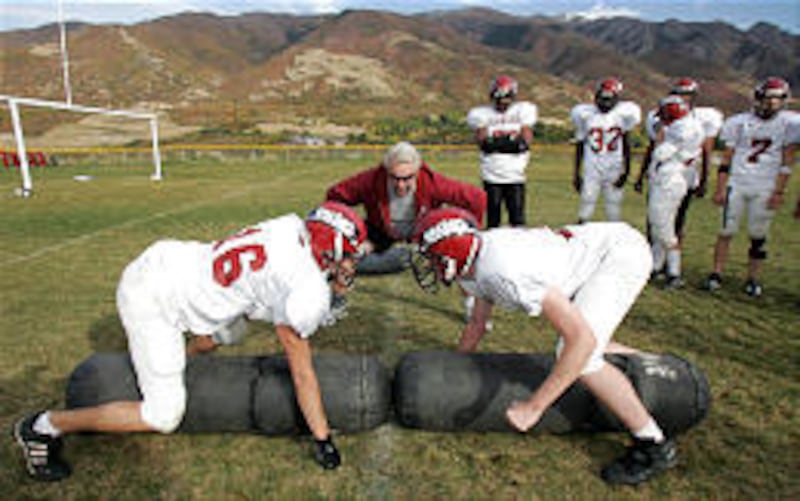
Coach Clint Christiansen turned that around this season, and the team seems to reflect its no-nonsense coach. Provo started preparing for this year last November. No player can start in August and be any good, Christiansen says. The hard work starts much earlier. "It's 10 months of busting your butt and two months that you can actually play."
It's another beautiful but painful autumn day on the football field at Layton Christian Academy in Davis County.
The Eagles can't field a full team on both sides of the ball for practice. Some kids are injured and others have quit the squad. The 19 remaining players are relegated to running skeleton drills over and over again to get their plays, kickoffs and punts down.
"We'd have to dress some girls" to have a full team, says head coach Sam Russell. Nearly half the team has never played organized football.
"It's been tough," Russell says of the program's second season. "We can't sharpen our skills except in a game."
The private high school is the smallest school in the state to have a football team. Despite being trounced often, Layton Christian has still managed to win two games — double the victory total of last season.
School officials are banking on the football program to pump up school spirit and serve as a magnet for new students. "We need to get students," administrator Greg Miller explained.
"Football is a high school tradition," he said. "It legitimizes your school by having a football team."
High school coaches attribute football's rise in interest to past success at BYU and more recently at the U.
"The popularity of the college game has been so high I think it has filtered down into the high school ranks," said Jordan High coach Alex Jacobson.
In terms of participation, football has always topped basketball, because squads carry more players and coaches rarely make cuts. Last year, 7,698 ninth- through 12th-graders played football. Boys basketball players numbered 3,248.
"Whether you're 115 pounds or 280 pounds, it's a chance to be part of something," Excell said.
That means kids like 4-foot-9-inch, 84-pound Craig Strasser of Olympus can don pads just like Cyprus' 6-foot-9-inch 360-pound Matt Tafaoialii.
Football has also closed a long-standing attendance gap with basketball in state playoff games — the only games for which UHSAA keeps statistics. Total attendance for semifinal and final football matchups in all five classifications over the past five years averaged 52,312. In basketball, it was 56,498.
The 2001-02 football playoffs attracted 72,038 spectators, more than any other high school athletic event the past five years.
The little guy trying to kick field goals after games caught then-Olympus High coach Mike Miller's eye.
"I noticed him there every week," said Miller, who has since moved on to head coaching duties at Riverton High School. "I started talking to him and pretty soon asked him if he wanted to come into the locker room with us."
"One overlooked side of all this is that we are so lucky to have him, too," Miller says. "A lot of times in sports we end up promoting an elitism. You've got to keep the kids a little bit humble."
That day marked the beginning of Craig Strasser's football career and is an example of the profound brotherhood that can grow among young men playing prep football.
Strasser was born with a genetic disorder called Williams syndrome. He is intellectually delayed and has had three heart surgeries. His motor skills give him trouble. Yet he attends nearly every practice, does what he can to help while he's there, rides the bus with the team and suits up for every game.
"It's so fun," Strasser says from his Millcreek home. "I play hard and I get energy from running. I like being with the guys."
Olympus players have certainly taken Strasser under their wing.
A few weeks ago, Strasser came home and announced to his mom, Debbie: "I'm going to the homecoming dance with No. 30."
And when Debbie called Olympus senior wide receiver Spencer Smith (No. 30), he told her, "Yep. We're picking up Craig at 5:30. He's coming with us." Olympus principal Paul Hansen is one of Strasser's biggest advocates and now Strasser plays on other sports teams, too.
The UHSAA is working hard to keep sportsmanship under control. The group has tight restrictions on taunting and other showboating often seen in the pros and highlighted on SportsCenter. It's an uphill battle, says Excell. "Everything trickles down, including sportsmanship."
It is one of many growing pains Utah is experiencing as high school football matures.
"We are at an age and a stage where we've got to make a decision. Can we have excellence without excess?" said Dave Wilkey, UHSAA assistant executive director.
Kids and parents spend thousands on camps, training and equipment. Football practices pre-empt summer vacations. Some young athletes are burned out and injured. Many complain about the pitfalls of young people caught up in the obsession that is high school football.
"It is a huge concern that it not dominate their whole life," Wilkey said.
But in an increasing number of cases, it seems OK with parents if it does.
Wilkey tells a story about a dad who called asking about the state's steroid policy. Wilkey said it became clear the father was considering whether his son should use steroids to increase chances to play football in college or the pros. Wilkey explained the dangers.
At the end of a long conversation, Wilkey posed a question. If your son would only live for four years, would you take this risk?
"Sir," the father said, "it would be worth it to me."
Many coaches and the UHSAA see trouble in growing numbers of student athletes who live and train the whole year to play one sport.
"I do see a trend of kids specializing, and it's not good," said Mike Morgan, football coach for the West Jordan Jaguars. Students should participate in as many sports as they can — it's better for the school, better for the teams and better for a young person's development, he says.
Look at Notre Dame leading wide receiver Jeff Samardzija. He's also a standout on the baseball team. This is the way it should be.
At West Jordan, all of the offensive linemen, with one exception, are wrestlers, he says.
"I think these kids and their parents have unrealistic expectations," Morgan said. "They make other choices instead of just enjoying the experience and doing the very best that they can."
Pressure on kids is enormous. There is always the push to be bigger, stronger, faster. The UHSAA is working hard to stay on top of issues like recruiting, unhealthy dietary supplements and steroid use.
That effort is at a constant tug of war with parents, coaches and trainers pushing the players who are chasing glory on the football field. Coaches can encourage illegal or unethical behavior even unintentionally, Wilkey said.
"What about this?" Wilkey offers. "What if a coach says, 'John, you've had a great junior year. If you come back 15 pounds heavier, you could be my starting linebacker.' What did that coach just tell that player?"
Senior Chris Laloni is the fourth boy in his family to play Hunter football. He lives a block from the school and remembers walking to a Hunter game when he was 8 years old. He remembers the crowd, the lights, all the noise.
"My dream since I was a little kid was to play Hunter football." says Laloni, 17. "And this dream means a lot to me."
So he says he talked his parents into letting him play with the tear in his knee. Coach Wes Wilcken isn't willing to dash his player's hopes by keeping him out of play if Laloni and his parents are willing to take the risk of further injury, which they are.
He's been playing through the pain every game. By mid-October, Laloni had rushed for 535 yards and 12 touchdowns.
Consequently, he's had 22 or 23 contacts from colleges. He hopes to play for the U. Surgery can wait.
"It's my senior year, and I can run on it, so I'm gonna play," Laloni says. "That's what I gotta do."
Only a handful of Utah high school players ever go on to play in college. About one athlete in every 10 high schools will play college sports. Less than 1 percent of high school athletes receive college scholarships.
But on hundreds of fields around the state, hope springs eternal for a Kevin Curtis-type fairy tale.
Little Kevin Curtis weighed only 110 pounds as a sophomore at Bingham High School. He was 5-foot-11 and 150 pounds of skin and bones when he graduated in 1996. He was not a high school standout. In fact, he wasn't much good at all. He caught 11 passes for the Miners his senior year. He didn't make All-State. Second-team All-Region as a defensive back was the most acclaim he earned.
"I never did do anything that would catch anyone's eye," Curtis said recently.
Today he's one of the top wide receivers for the St. Louis Rams and a rising star in the NFL. Last Sunday he had four catches for 90 yards and scored a touchdown — his fourth of the season — in the Rams' 28-17 win over the New Orleans Saints.
His career reads like a Cinderella story.
He walked on at Snow College. After graduating with a marketing degree, he went on an LDS mission to London and returned to walk on at Utah State University. He led the nation in receiving his junior year. He was voted third team All-American after that season and made the second team his senior year. The Rams drafted him in the third round in 2003, and he worked his way up the depth chart. When St. Louis' All-Pro receiver Isaac Bruce went down with an injury earlier this season, Curtis replaced him and has shined.
"I have to make things happen," Curtis says. "Because nothing was ever given to me."
Of course it doesn't end that way for the vast majority of high school football players.
They typically must put up with some lingering physical wear and tear, which most consider a fair exchange for their memories of glory days.
Tomorrow: Building a powerhouse program.
E-mail: lucy@desnews.com; romboy@desnews.com