

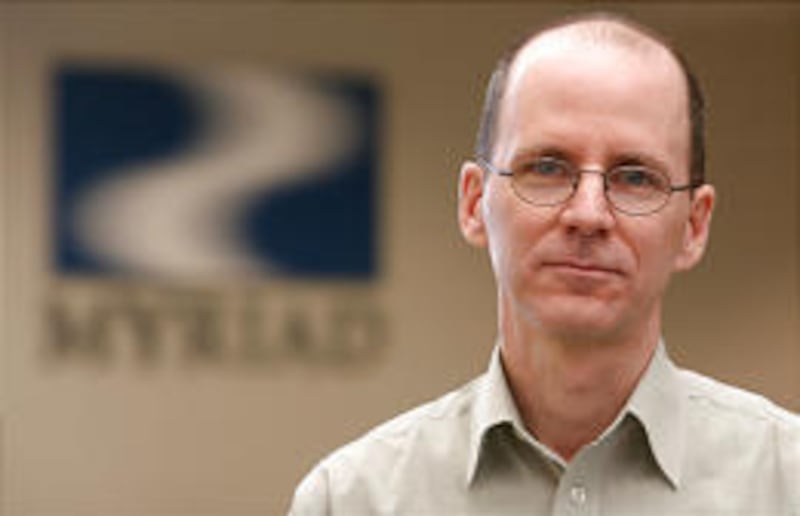

A Utah researcher was part of a team that helped bring closure to the families and friends of many hundreds of World Trade Center victims.
Benoit Leclair, who works for Myriad Genetics at Research Park, was a member of the World Trade Center Kinship and Data Analysis Panel. After terrorists destroyed the giant buildings using hijacked airliners on Sept. 11, 2001, the number of dead and the fragmentary state of many of the remains made standard identification procedures impossible.
The panel was brought in by the New York State Police and the New York City Office of Chief Medical Examiner to help with DNA analysis. The panel's report, authored by Leclair and 21 others, is in the Nov. 18 edition of Science, published by the American Association for the Advancement of Science.
The journal's Web site is www.sciencemag.org.
Many of those killed will never be identified. In July 2004, the National Institute of Standards and Technology calculated the total dead from the WTC attack at 2,749.
The Science journal report states that further advances "would lead to more rapid and efficient identifications in the event of future mass disasters or terrorists attacks."
Leclair had experience in computerized DNA analysis of remains, including work on the Swissair Flight 111 crash that killed all 229 aboard on Sept. 2, 1998. But, he said in a telephone interview, the WTC victims' remains showed "levels of degradation that we never did see before."
While a few bodies were nearly intact, facilitating identification, many were fragmented. Some were commingled with building material in the rubble.
He said fires in the rubble exposed many remains to temperatures of 1,000 degrees C. (1,832 degrees F.) for months. "This is extremely damaging for biological material," he said.
"In the case of fire that has been raging for months and months, it's like cremation. At one point you end up with carbon-based matter and not much help. It all depended where the victims were in the buildings. . . . Some remains were out there for eight months."
DNA can deteriorate in eight months. "Also, the fire department was pouring millions of gallons of water on those fires to put them out." The water didn't only cool the rubble so it could be moved, it contributed to the remains' deterioration. More than 1,000 victims will never be identified.
But team members knew it was vital to identify whomever they could. As the report says, after many deaths, particularly with a mass fatality, "there is an element of disbelief." Survivors need some tangible remains for burial, to help them cope and process their grief.
"Enabling family participation in some of the identification decisions was a critical component of the effort," the report says.
Eventually, 20,120 fragments or remains were identified. DNA profiles were taken when possible. "Although many CODIS (Combined DNA Index System) genotypes originally failed, technical improvements leading to better DNA yields from damaged samples gave useful DNA profiles in 40 percent of the samples for which standard procedures failed," the journal article says.
To make identifications in such cases, the team used DNA samples from victims' belongings, such as toothbrushes and combs, and profiles from relatives of victims. These were compared with DNA profiles from remains.
With mass fatalities, personal effects aren't available from each victim, so kinship analysis becomes especially important. Leclair was asked to be part of the effort because he worked with the Royal Canadian Mounted Police on the Swissair investigation.
"I wrote codes to speed up the process," he said. It could make thousands of comparisons of 26-number sets. "So in a matter of minutes, you come up with the right answer," he said.
His contribution to the WTC project was to update the software. He wrote one of three software pieces used. Checking three different ways, the programs had to concur in order for an identification to be established.
Fortunately for Leclair, his part was "mostly computer work," he said. But people like co-author Robert Shaler, the head of the Biology Section of the Office of Chief Medical Examiner, New York City, had a sadder experience. Shaler "met with the families on a regular basis," Leclair said.
The panel worked on a volunteer basis, without special compensation as consultants. For example, Myriad paid Leclair's normal salary, while hotel and transportation costs were paid by the National Institute of Justice.
"We had to turn people away. There were many more people who wanted to participate," he said.
The panel met 10 times in the past three years, either in Washington, D.C., or New York City. Shaler would bring examples of the sort of problems they were facing and ask for advice.
"The idea here is to come up with the most conservative approach so as to reduce the possibility of making a misidentification to almost nothing . . . to not make a mistake," he added.
In the end, the team came up with criteria guaranteeing that "without a shadow of a doubt" it was the right identification, Leclair said.
"We wanted to spare grief to the family."
Their success is spelled out in the numbers.
Remains of 1,594 victims have been identified. Of these, about 850 could not have been known without DNA technology.
E-mail: bau@desnews.com