

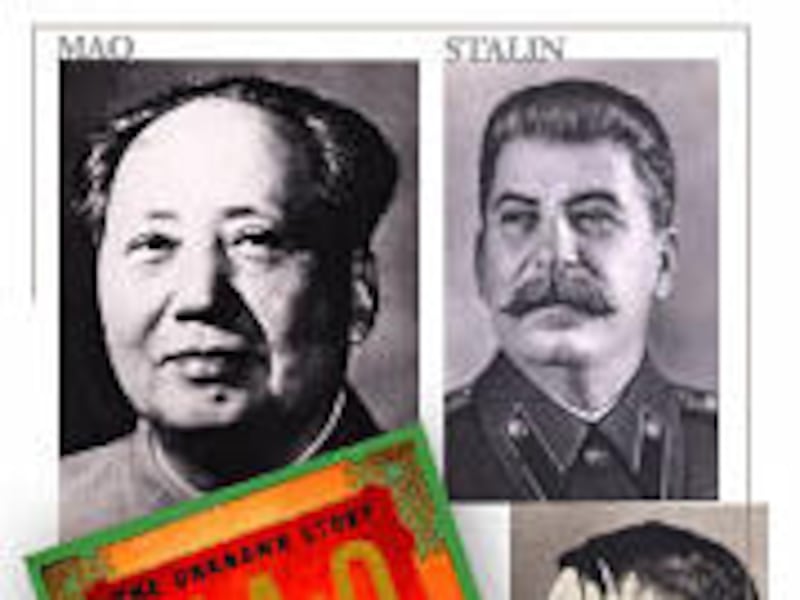
Although it is doubtful that most Chinese citizens will ever learn about it, Mao Tse Tung may have been even more vicious than Adolf Hitler and Joseph Stalin in his determination to kill his own people. From the time he conquered China in 1949, Mao caused the deaths of more than 70 million Chinese in peacetime.
So claim two historians, Jung Chang and Jon Halliday, who have published a magnum opus, "Mao: The Unknown Story."
During a conference call from California, the authors expressed pride in finishing what they are not shy to call the definitive work on Mao's life.
Chang is a native of China, having been a Red Guard briefly at the age of 14, and then he was a peasant, a "barefoot doctor," a steelworker and an electrician before becoming a university lecturer. Her previous book, a more personal one about life under Mao, is called "Wild Swans."
Halliday, a Russian historian formerly on the faculty of King's College, University of London, has written or edited several books, including a biography of filmmaker Douglas Sirk.
Chang and Halliday are married, and their talents complement each other. She dealt with all the Chinese sources, while Halliday speaks six languages and is fluent in Russian. So "95 percent" of what he contributed to the book came from Russian sources.
Mao was "worse than Stalin two ways," Halliday said. "Whereas Stalin used elites to torment or torture people in secret, Mao pushed torture into the public domain to terrorize the whole population. So most people saw his atrocities. He got the larger part of the population to participate in the torture. Mao brutalized the society more than Stalin. He also threatened people's private lives — with respect to sex and information, especially — more than Stalin did. In terms of fear and horror, life for the Chinese was more horrific than for Russians under Stalin."
In addition, Chang asserts that "Mao destroyed more culture in China than Stalin did in Russia. Mao criticized Stalin for allowing the classics to be read. Books were burned in China on a large scale. I grew up in China and we had virtually nothing to read. The only thing we could read were the quotations of Chairman Mao."
Halliday said that it was clear early on that Mao had ambitions to lead the entire world. "Most people don't know the extent to which Mao destroyed the visible signs of Chinese culture — the walls, the city gates and numerous monuments — so that the cities look completely different. Mao wanted to destroy everything that was old. In doing so, he cut modern China off from its past. He visually brutalized the landscape of China."
Chang added that "in the so-called 'leap forward,' Mao bought nuclear technology from Russia and Eastern Europe at the expense of the starvation and overwork of his own people. He imported huge industrial products and used food to purchase it, leaving his people to die. He wanted China to be a military superpower so he could himself dominate the world."
And how does the current Chinese regime deal with Mao's considerable legacy? In Chang's view, current Chinese leaders "choose to perpetuate the myth of Mao, in part to enforce their own legitimacy. Chinese leaders have made it an offense to criticize Mao. The Chinese banned my first book, and they are banning this one as well. People may only read things praising Mao. The generation growing up today have no idea what Mao was like."
Chang is now immersed in the translation of "Mao" into Chinese. It will be published next year by a Taiwan publisher. "Many people in China have heard about this book," said Chang, "and some will find ways to read it. As the truth about Mao trickles into China, pressure will build to reject Mao and his legacies, many of which still dominate the country."
Although Mao was never known for charismatic leadership, he may not have needed it. Halliday said: "He never had to run for election or consult with the people. When he came to power, there was no uprising. Mao had the skills to operate in a room with a few people who would turn out the vote. He hardly ever appeared in public. Most people never heard his voice."
On the other hand, Mao was also haunted by fear, causing him to build an enormous security network, including numerous guards, underground tunnels and bomb-proof shelters. Halliday said: "He was a fanatic — he knew that there were people who wanted to kill him."
It is essentially unknown in the West that Mao wrote poetry, "very good poetry," in Chang's opinion, "until he took power, then the quality went downhill. He lost his flair. But he was educated in the Chinese tradition, in which poetry played an important role."
That doesn't mean Mao would have become a great thinker had he not chosen government, Halliday said. "When you examine his statements philosophically, they were pretty empty. If you ask people to provide one good idea Mao had, most would have a hard time coming up with anything."
While one of Mao's most important means of control was the use of torture, Chang said, "He depended on terror and torture. He gave instructions about how to apply torture and when to stop it. He said if you stop it too early, it defeats its purposes. But it you apply it too late, the subject might be dead. Mao was a torture artist."
E-mail: dennis@desnews.com