

Consumer surveys are showing that three in every four holiday shoppers plan to give at least one gift card as a present this year and will spend a total of $18.5 billion nationwide on what is the third-most-popular item on their list.
If you are one of those buyers, beware: Many cards have hidden charges or other traps that could unexpectedly drain the cards' value.
A review of the fine print in the terms of usage for dozens of gift cards by the Deseret Morning News shows that while most offer full value without expiration dates or hidden fees, about a third had potential catches.
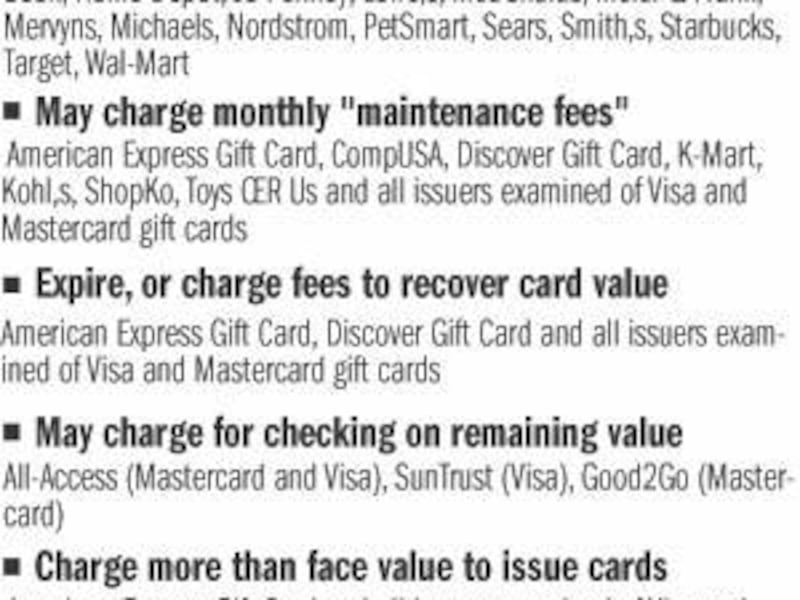
Some charge up to $6 a month in "maintenance fees" until a card is drained. Some charge up to $1 as a service fee every time the card is used. Some charge up to $1 to check how much value remains on a partially used card.
Some charge up to $19 more than the face value of the card as a start-up or processing fee. Some cards will expire, and the company may charge up to a $15 fee to recover any value that was left on an expired card. Some companies will replace lost or stolen cards, while some will not. Some will do it only for a fee.
Cards from banking companies — such as prepaid Visa or Mastercard gift cards — tend to have more hidden fees than cards from retailers. And while such companies advertise their cards are good anywhere that Visa and Mastercard are accepted, fine print shows they might not be easily usable at many restaurants, gas stations or ATMs.
Also, some companies do not disclose terms and hidden fees easily. To find some, customers must remove cards from packaging in order to read the fine print on the back, or they must call the company by telephone for terms. Some also do not list terms on Internet sites for cards sold online.
"We encourage folks to look very, very closely at the terms for usage of gift cards, including the rates charged, maintenance fees, whether they have an expiration date. Some will devalue your card over time," warns Francine Giani, executive director of the Utah Division of Consumer Protection.
Following are some of the traps the Deseret Morning News found that could drain gift card values.
Maintenance/dormancy fees
If gift cards are not used quickly, many companies charge such fees until the value of a card is depleted.
For example, the fine print online about ShopKo's gift cards warns, "After 24 consecutive months of non-use, a $2.50 per month dormant fee (retroactive to the beginning of the 24-month period) will be deducted from the balance until the card is used or depleted, except where prohibited by law."
In plainer terms, that means if a ShopKo card has not been used in two years, the company will impose a $60 fee and then continue charging $2.50 a month until the value of the card is drained. Some states ban such fees, but Utah is not among them.
Examples of maintenance fees charged by others include: iCard Gift Card (Visa), $25 fee every six months beginning six months after card issuance; All-Access (Mastercard), $5.95 a month after 90 days of inactivity until active again; and All-Access Visa Gift Card, $4.95 a month after six months.
GiftCards.com and MBNA Gift Card (Visa) charge $2.50 a month beginning six months after activation; Discover Gift Card or Wells Fargo (Visa) gift card, $2.50 a month after 12 months of non-use; Kmart, $2.10 per month after 24 months of non-use; Toys 'R' Us, $2 a month after 24 months of non-use; and Kohl's, $1.50 a month after 24 months of non-use.
The Montgomery County, Md., Division of Consumer Affairs, which conducts annual studies on gift cards, notes in its report this year that while some such companies advertise that their cards "never expire," their "dormancy fees ensure that an unused card will eventually expire."
Expiration and fees
Some gifts cards, primarily those from banking companies, come with expiration dates, generally one to three years after activation. That means if the gift money is not used quickly, it could disappear.
However, all such cards evaluated by the Morning News do allow recovering unused funds from an expired card — for a fee.
For example, the newspaper found six companies offering Visa gift cards (AAA, Giftcards.com, MBNA, Wells Fargo, SunTrust and Simon Malls) that charge a $15 fee to issue checks for the remaining value on unused cards. (Some also offer the option of renewing cards for less money.)
Discover Gift Card and American Express Gift Card charge $10 for such a check, but American Express offers the option of a free replacement card and Discover offers to transfer unused value to a new card for a $5 fee.
Service fees
Most retailers charge no more than the face value of a gift card. In other words, $25 will buy a card that can be redeemed for $25 worth of goods. But bank cards tend to charge more up-front than face value for "processing fees."
Such fees for Visa gift cards (available through financial companies listed online at visa.com) ranged from $2.50 (at Wells Fargo) to $9.95 (from All-Access). Rates for gift Mastercards online ranged up to $19.95 (from All-Access). The processing fee for American Express gift cards online is $3.95. Shipping often costs extra for such cards.
Only gift bank cards from Discover come with no up-front processing fee.
Why do financial companies charge such fees, while retailers do not?
ICard says at its Web site that the "fee covers our expense for the following: order processing, card personalization . . . toll-free account inquiries, Internet account inquires, load fees, card account management, transaction processing fees at the point-of-sale and customer service."
Besides origination fees, some financial companies charge a service fee each time a card is used. All-Access Visa, for example, charges $1 per signature-based transaction.
Also, some companies charge people to see how much value is left on a partially used card. For example, All-Access charges 50 cents per inquiry. SunTrust (Visa) charges $1 per inquiry, beginning on the third inquiry made. (Most companies offer the service free.)
Acceptance problems
A major advertising point for gift bank cards is that they can be used anywhere that Visa, Mastercard, American Express or Discover are accepted, and not just at one retailer. But fine print in their terms sometimes warns that is not always the case.
For example, most gift card companies warn people not to use the gift cards, or at least to be careful, for pay-at-the-pump gas purchases or at restaurants.
They warn that many pay-at-the-pump stations are programmed to pre-authorize purchases of at least $75, even if much less is actually purchased. If a card is not worth that much, it may be denied. If it is worth that much, a hold may be placed on at least $75 for three to seven days until the merchant sends the final amount for processing.
They say much the same can happen at restaurants where tipping is expected. They warn many restaurants pre-authorize amounts for meals plus 25 percent, which could lead to some gift cards being denied or having such amounts put on hold for days.
Some gift bank cards are accepted at ATMs, but most companies impose a fee for that use. The Morning News found that fees of $2.25 per $2.50 off the value of the gift card are common. And that does not include extra fees that the owner of the ATM may impose.
Loss, theft fees
Most retailers say they will replace remaining value on a lost or stolen card if people have an original receipt or other proof of purchase. Some will not, and warn users to treat gift cards like cash. Among them are Albertsons, Barnes & Noble, Kmart, Michaels and ShopKo.
Most gift bank cards can be replaced, but for a fee that usually ranges between $5 and $10. However, Discover offers free replacement cards.
Terms not easy to find
A few merchants make it difficult to find terms of use for their cards. For example, Meier & Frank says on the backs of its cards that it is subject to terms and use, but it does not list them. It has a phone number customers must call for them. The operator said that currently, new cards do not expire, and they carry no maintenance fees.
Kmart offers gift cards online but did not list terms. It also offers them in stores, but terms could not be read until the card was removed (temporarily) from cardboard backing. \The store does charge some maintenance fees after two years of non-use.
Cards at Toys 'R' Us also had to be removed (temporarily) from paper backing to see fine print warning of maintenance fees.
Giani said not disclosing to consumers the terms of usage could violate state and federal law. That might allow consumers the right to recover undisclosed charges, but likely not without a hassle.
The National Retail Federation says most retailers "are moving away from expiration dates and depreciation fees in response to their customers' requests." The federation says its surveys show gift cards are becoming more popular than ever.
A survey it released last month said three of every four consumers planned to buy at least one gift card this holiday season, and were expected to spend on average $88 for the cards.
Gift cards trailed only books/CDs/DVDs and clothing as preferred gifts.
Also, the survey found that more than half of consumers (52 percent) said they want to receive gift cards this year.
"Once seen as a quick solution to a last-minute present quandary, gift cards have moved to the forefront as a holiday favorite to both give and receive," said Phil Rist, vice president of BIGresearch, which did the survey for the National Retail Federation.
The Consumer Federation of America, however, is not content to let consumer demand be the sole pressure to remove hidden traps from gift cards. The federation has called for legislation to regulate or eliminate cards that carry expiration dates and service fees.
E-mail: lee@desnews.com