

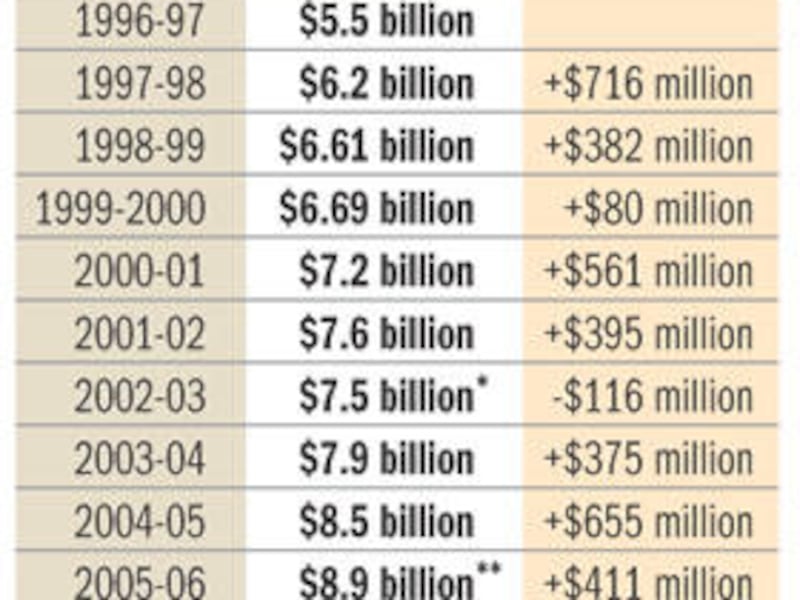
Gov. Jon Huntsman Jr. will call Friday for $60 million in tax cuts next year as part of "reforming" the state's income tax and removing or reducing the sales tax on food.
Top aides said Wednesday that specifics of Huntsman's recommended 2006-07 budget — which will push state spending to more than $9 billion for the first time — will come with the governor's budget press conference Friday.
"Our feeling is a tax cut comes as they (lawmakers) tie into income tax reform and as they tie into (reducing or eliminating) the sales tax on food," said Mike Mower, deputy chief of staff and Huntsman spokesman.
Mower declined to give a number, but Huntsman is expected to earmark $23 million for the so-called H3 income tax reform plan that establishes a lower rate — 5 percent — for most Utahns while allowing tax credits for charitable giving and home mortgage interest.
The rest of the money set aside for tax cuts in the governor's budget — about $37 million — will go toward giving taxpayers a yet-to-be determined break on the sales taxes they pay on food.
That likely means Huntsman, who campaigned on taking the sales tax off food, will end up backing either reducing the state sales tax rate on unprepared food or offering an income tax credit or rebate to low-income Utahns for the food tax they pay each year.
Utah House Speaker Greg Curtis, R-Sandy in Chicago this week for national legislative meetings, said GOP House leaders want a bigger tax cut than what Huntsman will suggest. "I don't think that ($60 million) is sufficient tax relief. We think it should be more like $100 million, with half going to removing the sales tax from food."
Curtis has proposed removing the food tax completely, then raising slightly the state and local sales tax rates on non-food items to make up all but $35 million of the lost revenue. If $100 million in tax cuts is given, Curtis' non-food sales tax rate could be lower, with $50 million "going to some business tax relief" and income tax reform.
Senate President John Valentine, R-Orem, who has called for getting rid of the food tax, said "a more cautious approach might be better than a more aggressive approach" because he believes the growth in tax revenues might be slowing.
"It's not storm clouds yet," Valentine said. "It's just to a point where I'm a little nervous."
Even though the Senate leader said he wanted the sales tax taken off food, he said it might be better to make a start with, say, a tax credit for low-income Utahns. "If we can't take it all the ways off, maybe we can make a down payment with the tax credit," Valentine said.
Record surpluses
Utah is seeing near-record tax surpluses this year — perhaps as much as $300 million by the time the state's fiscal year ends June 30. In the first four months of this fiscal year, taxes are already coming in $90 million above estimates.
Last year the state took in $400 million more in revenue that it had budgeted, much of it spent during the 2005 Legislature. But no tax cuts were given as lawmakers tried to make up for slow growth in critical budgets during the down-turn in the early 2000s, give decent employee pay raises and funnel $90 million more into road repairs and construction.
Over the past 10 years, the state budget has grown by 62 percent. And conservative legislators want tax cuts to slow the growth of government.
GOP legislative leaders are uniformly now calling for a tax cut next year, which is an election year for all of the 75-member House members and half of the 29-member Senate.
Republican senators are believed to be looking more favorably on Huntsman's $60 million tax cut. But as Curtis said, House GOP leaders want more.
The burgeoning surplus has clearly changed Huntsman's tax cut ideas. Even as the surplus grew this summer and fall, Huntsman said repeatedly he wasn't ready to support general tax cuts.
The governor did, however, promise to "remain open-minded" on the issue and backed a plan to help low-income Utahns with the sales tax on food. Despite his campaign pledge to remove the unpopular tax entirely, he never put forward his own plan.
In a campaign questionnaire handed in to the Deseret Morning News last year, then-candidate Huntsman advocated taking increased sales tax collections from catalog and Internet sales to make up part or all of the $166 million the state would lose by removing the food tax. Huntsman has not pushed that method since, however, although leading legislators are now considering it.
Huntsman's own effort at reforming the state income tax, a "flatter, fairer" plan that established a single, lower rate for taxpayers and eliminated several deductions, would have reduced revenue collections by around $10 million dollars. That plan has been morphed by legislators into a $23 million tax cut, and Mower says Huntsman is "very happy" with it.
'Unmet needs'
Utahns polled for the Deseret Morning News and KSL-TV in June said they'd rather see the record surpluses spent on state programs than used to fund a tax cut. The survey by Dan Jones & Associates found then that only 29 percent wanted tax cuts.
But tax surpluses have grown since — and GOP lawmakers clearly will pass some kind of tax relief in the 2006 general session, which starts Jan. 16.
This will be Huntsman's first budget with his thumb print. Although he took office this past January, by far most of the 2005-06 budget work was done by former GOP Gov. Olene Walker's budget staff.
A special bipartisan Tax Reform Task Force has already approved a variety of proposed bills/tax reform ideas that in total could — depending on how final bills are drafted — result in more than $100 million in tax cuts.
The task force backed a 5 percent flat-rate income tax with tax credits for charitable and mortgage home interest (a modification of what Huntsman proposed). It also supports removing the state and local sales taxes from unprepared food, although there are several plans to do that.
Even with all the tax surpluses likely to come this year, Mower said the state has gone through some tight revenue years in the early 2000s, with only small, or no, pay raises for state employees and little growth in vital state programs.
"We recognize that because of recent lean years there are some unmet needs" in state programs, like Human Services, public and higher education.
"And we'll focus (more spending) on those areas," said Mower, adding, "we are for a responsible tax cut, while taking care of needs in education, economic development, transportation and public employee pay raises."
Worker pay
Just how much more Huntsman will recommend for state workers remains to be seen. The state Department of Human Resources proposed the governor include a 5.5 percent raise in his budget, including 2.5 percent for merit and 2 percent for cost of living. The price tag for that size of state employee raise is about $28 million.
Last year, state workers saw a 2.5 percent pay increase plus 2 percent in benefits.
Huntsman may get more respect from legislative leaders on his budget plan than did former GOP Govs. Mike Leavitt and Walker. Previous Republican-controlled Legislatures didn't even pass out those governors' budget summaries during the lengthy, 10-committee budget hearings. Executive branch aides passed out the legislative staff/governor office comparisons, or the 104 part-time legislators and the public would not have even seen them.
Mower says Huntsman budget bosses have been talking to GOP leaders, asking them to include the governor's recommendations as part of the hearing process. "If they don't do that, you can be sure the governor's budget will be seen" by legislators one way or another.
E-mail: bbjr@desnews.com; lisa@desnews.com