

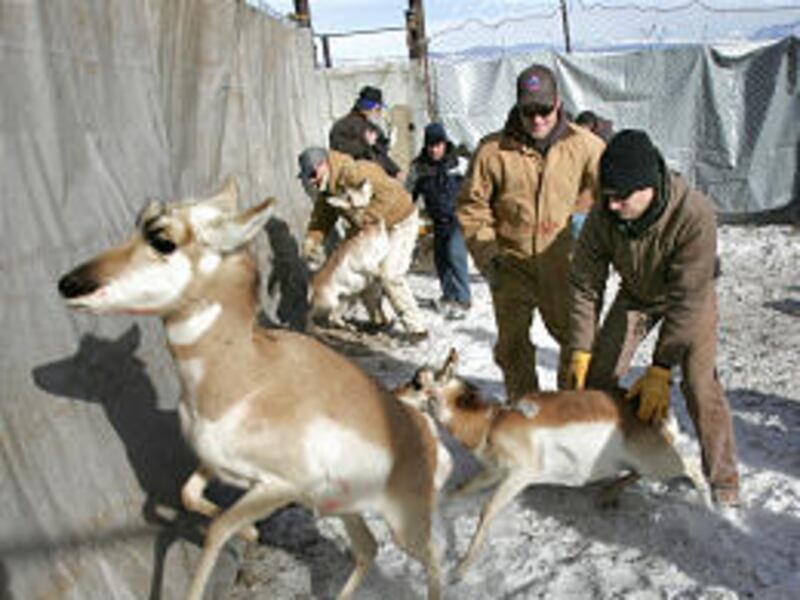

The instructions given to a large group of "muggers" were simple enough — get in, mug the captives and get out, embracing a captive, if possible, without suffering painful bumps, bruises or cuts.
So, who are these captives who can dispense such discomfort to their muggers?
Antelopes.
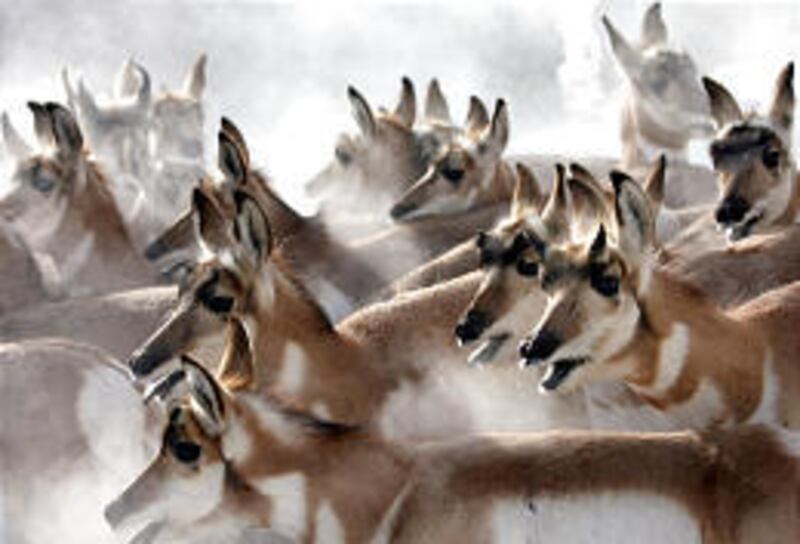
Often called pronghorns, they are rather small animals, white and light brown in color, with flashing hoofs, thrashing heads and, in the case of the bucks, sharp horns.
And, in this case, despite the fact their capture was in their best interest, they choose not to go willingly.
Early Monday, under clear skies and bone-chilling temperatures, a gathering of wildlife caretakers, land managers and those there simply to help, met near a bump in the landscape known as Jake's Knoll southwest of Loa, Wayne County, to begin a two-day antelope transplant.
It's part of an ongoing program within Utah's most productive antelope breeding ground to spread the wealth.
"To date," said Nile Sorenson, project leader for the Utah Division of Wildlife Resources, "we've taken about 5,000 antelopes from this unit to transplant in other parts of the state and to send to other states."
The Parker Mountain unit holds more than 2,500 pronghorns. The current management objective is to keep the herd to around 2,000.
"We should be at or near our objective after this project and this year's harvest," he noted.
The goal was to trap and move about 350 antelope, mostly does and fawns, with a few bucks interspersed to make a herd at their new locations.
Trapping is done in the winter because the animals are bunched together in large groups. During the summer months, the antelopes are "spread all over the Boulder Mountains," explained Sorenson.
There were two traps set up on the rolling knolls southwest of Loa — one at Jake's Knoll and the second, a new trap, near the Bicknell Reservoir.
Typically, a fixed-wing plane flies the areas the day before trapping and pinpoints herds. That was not possible this year because of bad weather prior to the Monday operation.
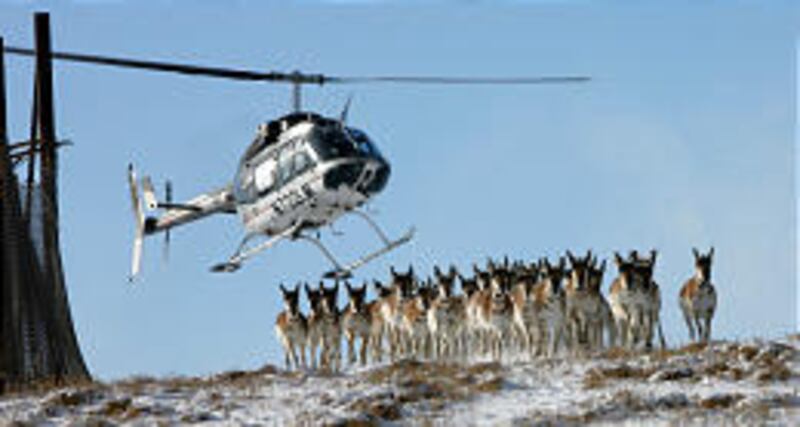
Instead, the roundup helicopter flew early Monday and spotted about 200 antelopes spread within a mile of the Jake's Knoll trap. The helicopter then flew out and pushed the animals toward the capture pen, which is nothing more than rope netting staked out in the shape of a funnel — the larger end at the entrance, then narrowing into a round enclosure.
Once in the pen, heavy tarps are hung from the netting to help calm the animals and block their view.
Then, in bunches of 10 to 15 animals, they are moved into a second enclosure where they are captured and carried out to waiting horse trailers.
Those bulldogging and carrying the antelopes to the trailers are called "muggers."
And just what's it like inside the pen with a couple of dozen muggers and a dozen running and dodging antelope?
"I guess I'd best describe it as bailing out of the back of a pickup at 35 miles per hour and tackling a mailbox," said Jim Lamb with the DWR, who has been involved in this project for eight years.
"The secret is to grab hold of the brisket on the neck so you can turn with them. This way you can spin to the ground and it doesn't hurt them, and it doesn't hurt you. It's important you don't hurt yourself," he said.
"You can't blame (the antelope). They're trying to kick to get away, so you find a safe way to get on the ground for you and the animal. Once they're on the ground they give up pretty fast."
Last year, captured antelopes were not only sent to other parts of the state but also to Idaho and Nevada. This year they went to Panguitch Valley and the Grand Staircase-Escalante National Monument, the Uintah and Ouray Indian Reservations and to Arizona.
The exchange of animals between states has been, over the years, a win-win program. In this case, for example, if Arizona does a bighorn sheep capture, Utah would be in line to get some of those animals. Along with bighorn sheep, Utah has also received a large number of turkeys over the years from other states to supplement its growing population.
As noted, the Parker Mountain unit is by far the most productive antelope breeding ground in the state.
"That's because of the higher elevation. It's not like the west desert. Even during the drought years we had 60 to 70 fawns per 100 does, and that's very good. On the west desert we're lucky to get 20 fawns per 100 does," Sorenson said.
This has also led to a higher-than-average number of bucks in this unit. To help balance the herd, the Utah Wildlife Board issued a higher number of buck-antelope permits on the unit this year.
Currently, Utah is also working with landowners, game managers and sportsmen to come up with a comprehensive antelope management plan. Sorenson said the plan should be out in a couple of weeks, "which will give us, for the first time, a management objective we can work towards."
In the meantime, wildlife managers will continue to monitor the herd and, allowing the muggers to heal, begin making plans for another relocation program in order to build Utah's antelope population.
E-mail: grass@desnews.com