


The state of Utah posted a huge sign on its border Tuesday: No B and C wastes.
Legislation spelling out the ban hasn't actually been approved by state lawmakers — yet. But it appears the radioactive material will not be allowed to reach disposal sites in the state.
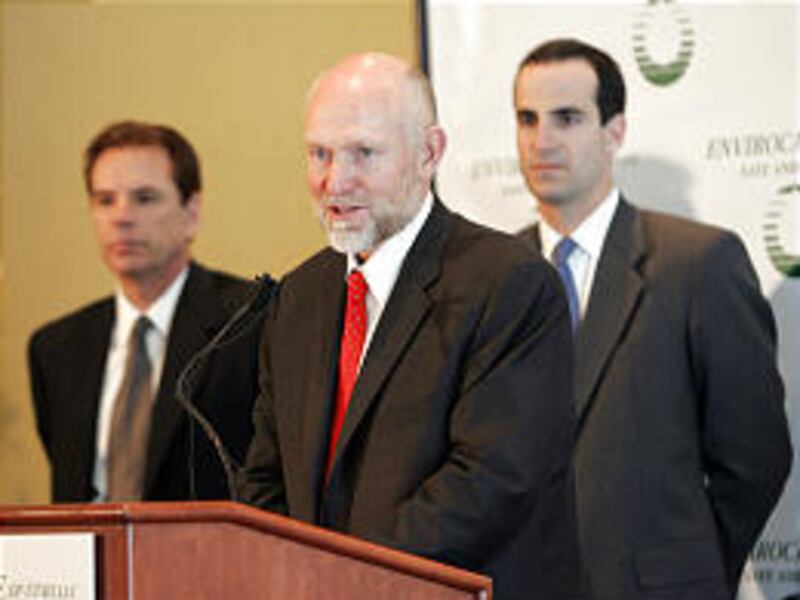
Leading the charge was Steve Creamer, one of the new owners of Envirocare of Utah, the state's only licensed disposal facility for such wastes. The purchase by Creamer and others was finalized Monday night. The company will continue to accept the lower-level Class A waste at its site near Clive, Tooele County.
"It's a very personal commitment to me on B and C wastes," said Creamer. "So you understand, I grew up in southern Utah. And there's not too many people who remember the green clouds of the 1950s, but I do."
The clouds were radioactive dust lofted into the atmosphere by atomic bombs detonated above ground at the nearby Nevada Test Site. The clouds drifted into Utah and exposed thousands of residents to radiation. Decades later, a federal judge ruled the exposure caused cancer among downwinders.
"My father actually died at my same age, of cancer," Creamer said Tuesday. "We were downwinders growing up in southern Utah."
Immediately after the announcements of bipartisan support for a law imposing the ban, substitute language was placed in SB24 to enact the prohibition. A final vote in the Senate on the bill, sponsored by Sen. Curtis Bramble, R-Provo, is expected today.
When the logjam broke on the state's biggest, recent environmental debate, it went with a crash. The governor, top officials of both houses of the Legislature from both political parties and Envirocare's new owners, all announced the material should be banned.
Among other developments:
Envirocare launched a charitable trust to improve Utah's environment, donating $1 million. Fraser Bullock, who helped run the 2002 Winter Games and presently is the managing director of Sorenson Capital of Lehi, will head the trust.
The new owners announced they had purchased an adjacent site from Cedar Mountain Environmental. The previous owner of that 315-acre site, Charles Judd, had said it might be used for B and C wastes. Envirocare bought the site to block that possibility, said speakers.
Judd faxed a press release to the Deseret Morning News confirming the sale (price not mentioned) and saying Envirocare's purchase "supports the idea that there is a need for additional radioactive waste cell space." He said his company is "currently in the process of securing other sites . . . both inside and outside the state of Utah."
Creamer dramatized Envirocare's current position during a news conference Tuesday in the Marriott City Center. He handed Gov. Jon Huntsman Jr. a letter officially ending the company's earlier pursuit of B and C wastes.
Because Envirocare had a license pending to import B and C waste, lawmakers expressed concerns about a lawsuit should they enact a ban. Now that possibility is gone.
Envirocare was purchased by a private investor group led by Lindsay Goldberg & Peterson Partners, New York City. Besides Creamer Investment, another local investor is Peterson Partners, 299 S. Main. The price of buying the company from founder Khosrow B. Semnani was not released.
Huntsman and the buyers made it clear the new owners had taken a stance against B and C wastes since long before the sale was completed.
"Since November, as Fraser mentioned, I've been briefed a couple of times on the potential sale of Envirocare," the governor said. While he wasn't involved with details of the transaction, "I was always assured that the new ownership intended to withdraw the B and C license.
"This is an important date for Utah, and I hope we all realize this. We are one step closer to banning the licensing and importation of B and C wastes."
Lance L. Hirt, partner in the Lindsay Goldberg firm, insisted Envirocare will do well without resorting to the B and C market.
"We would not be investing if we did not think this is a solid business with a nice future in terms of returns on our investment," he said.
Not pursuing B and C "really is the right thing to do for the state of Utah," he said.
That sentiment was repeated by Sen. John Valentine, R-Orem, president of the Senate, who said 22 of the 29 senators had already signed on as co-sponsors of the new language in SB24; and by Speaker of the House Greg Curtis, R-Sandy; Sen. Mike Dmitrich, D-Price, the Senate minority leader; and Rep. Ralph Becker, D-Salt Lake, the House minority leader.
Grilled about what Envirocare will ask in exchange for abandoning the push for B and C wastes, Creamer replied, "Not a thing. . . . We're not going to be back asking for anything else. We're happy."
Asked what he would say to skeptics, he replied, "Watch. We will work every day to gain the trust of the people. We feel it's very important."
Jason Groenewold, an anti-nuclear activist who kept up a drumbeat of demands for banning B and C wastes, said he was cautiously optimistic with the developments.
"The proof is in the pudding," said Groenewold, director of the Healthy Environment Alliance of Utah. "We have four weeks of an intense legislative session to make sure that a statutory ban is formalized by the Legislature and governor."
Contributing: Lisa Riley Roche
E-mail: bau@desnews.com