

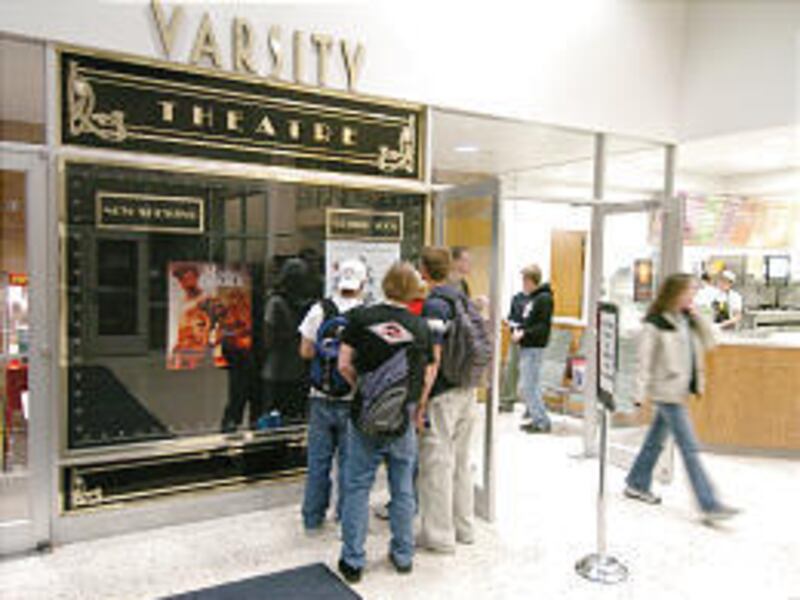

PROVO — Long lines for tickets were routine during the Varsity Theatre's heyday.
The Brigham Young University playhouse competed with Utah Valley theaters for moviegoers because of its fare — edited versions of R-rated movies such as "The Last of the Mohicans," "A Few Good Men" and "The Firm."
But the lines that snaked through the Wilkinson Student Center hours before tickets went on sale vanished in 1998 after movie studios and distribution companies pressured the theater to stop editing from the films what university officials and Varsity patrons considered objectionable content.
Hollywood hits are making a slow comeback at the Varsity this semester, but local theaters needn't feel threatened, and no one should expect watered-down versions of of R-rated epics like "Alexander," "Constantine" or even PG-13 smashes like "Million Dollar Baby."
"We received permission last fall from the administration to show movies again at the Varsity Theatre, but we will not accept any edited movies, we will not edit them ourselves and we must preview all the movies to make sure they meet BYU standards," said the man behind the renaissance, campus-involvement coordinator Ron Jones.
The theater has been mostly empty for the past seven years, first home to poorly attended movie classics and then to the university's International Cinema program.
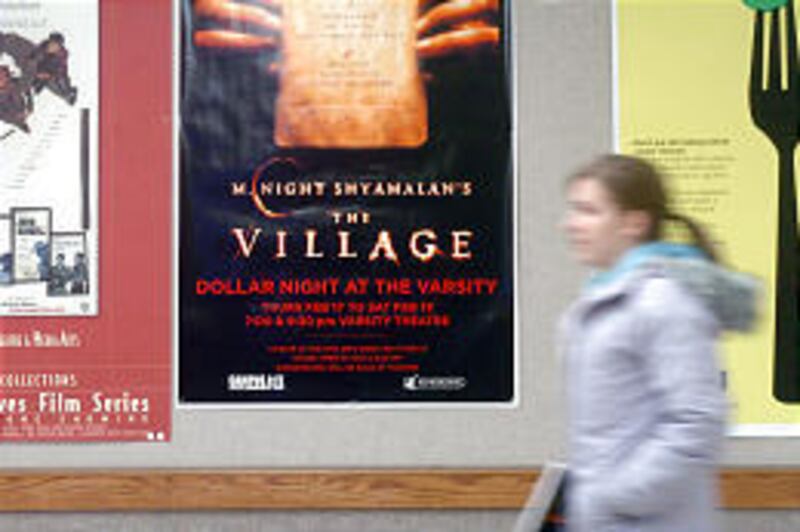
Jones is rolling out "Dollar Night at the Varsity" slowly, with a single movie just one weekend a month. "Spider-Man 2" produced a sellout of the Varsity's 794 seats when it ran for three days in January. "The Village" drew solid crowds last weekend.
Students appear interested in an on-campus dollar theater, but the crowds will depend on the movie, said Rob Hickman, a junior from Washington, D.C. Hickman bought a ticket to "The Village" because he considers director M. Night Shyamalan a "modern Hitchcock."
Jones doesn't anticipate the return of long lines, but he does hope to recapture some of the magic of the old on-campus haunt.
He began his quest to resuscitate big events at the Varsity this winter, when it became a popular home for sneak previews of a genre that hardly existed in 1998 — the Mormon-oriented movie. The house was packed for free sneak peeks of "Saints and Soldiers," "The Work and the Glory," "Baptists at Our Barbecue" and "Sons of Provo."
Utah distributor Halestorm will screen its next release, "Suits on the Loose," at the Varsity next month.
Jones said the Varsity will continue to show one Hollywood hit a month, with "Napoleon Dynamite" in March and "Hidalgo" in April, and then move to two weekends a month next fall, when "National Treasure" and "The Incredibles" make their BYU debuts.
"We're looking for movies that don't need to be edited, and we're finding some," he said. "Our purpose is to provide clean entertainment for our students. Rather than trying to make money with our films, we want to provide students with inexpensive choices for on-campus entertainment."
Jones said a committee will rule out movies with objectionable sexual content, "continued use of the Lord's name in vain that is demeaning to religion," other inappropriate foul language or issues of homosexuality.
"That limits what we can show, but we've found some pretty good movies," he said. " 'The Village' is a very innocent story. It has no swearing. It has no sex. It's just a very interesting story with a lot of twists and turns."
BYU might be sticking to its standards, but it took two key philosophical shifts to clear the way for any mainstream movies to return to the Varsity.
First, the administration dropped a requirement that the theater be profitable, Jones said. The goal now is to use it to enhance campus life. Jones also persuaded several administrators to let him deal with Swank Motion Pictures Inc., the company that distributes movies to colleges and universities in the United States.
"The only way to do this is with the distribution company BYU had a problem with in the '90s," Jones said. "Some didn't want to work with them because they felt the company hadn't supported us" during the fight over editing.
A Swank executive did not respond to a Deseret Morning News request for comment.
During the '90s, a BYU committee literally snipped out objectionable language, violence and sex to make R-rated and PG-13 movies fit the standards of the university and its owner, The Church of Jesus Christ of Latter-day Saints. Church leaders have advised members not to watch movies containing nudity or excessive violence and profanity.
Between 30 and 40 percent of movies at the Varsity were versions edited by the movie studios for airlines. BYU's movie committee edited the rest on campus.
"My parents went on dates to see those movies at the Varsity Theatre," said Shannon Wilde, a BYU junior from Orem. "My brother went to 'Jerry Maguire' and thought it was cool because he got to watch movies he couldn't see otherwise."
A battle began to brew in 1994 when Steven Spielberg refused to allow BYU to edit "Schindler's List." The university pulled edited movies from the Varsity for seven months, but they returned after a student-sponsored survey showed overwhelming community interest.
Then, in December 1997, Sony Pictures asked BYU to stop editing its films. Nervous administrators asked other movie companies for written approval to continue editing their pictures, without success.
The curtain fell on edited R-rated movies at the Varsity in August 1998. No longer able to offer unique edits of popular movies, the Varsity soon was an afterthought. Ironically, the theater's star waned just as the boom in edited videos began, allowing moviegoers who missed BYU's cleaned-up versions to watch edited shows at home.
Of course, editing companies and movie studios are deep in litigation over the issue, and Congress is even considering legislation.
"The end of that story isn't here yet," said Tom Lefler, an administrator in BYU's film department. "It's just kind of a messy place now."
It's a mess BYU will continue to avoid but at a price. Swank charges $721 to show a movie, plus 50 percent of the box office, Jones said. Sellouts won't produce enough revenue to offset the cost, overhead and the wages for several employees who sell tickets and inexpensive concessions from the BYU Bookstore.
"We're not in this to make money," Jones said.
E-MAIL: twalch@desnews.com