

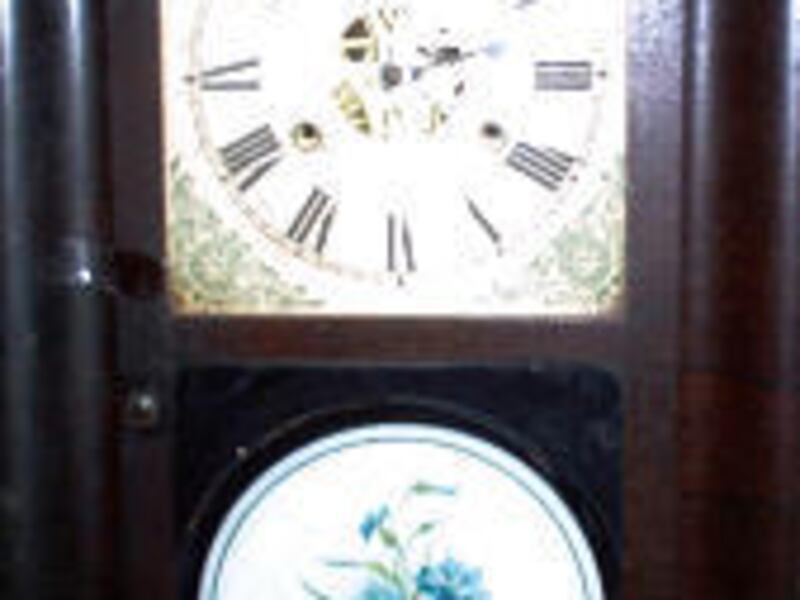
Dear Helaine and Joe: I have an old Seth Thomas clock. I cannot find a date on it, but inside is a paper that reads "Seth Thomas, Thomaston, Conn., U.S.A." It has two weights — one on each side — and needs to be rewound every 24 hours. The frame is in perfect condition.
It keeps good time and strikes on the hour. I would like to know how much it is worth. Thank you. — R.O., Carmi, Ill.
Dear R.O.: When it comes to clocks, Seth Thomas is a name that almost every American seems to know.
The type of clock in today's question is called an "ogee" because of the "S"-shaped double curve (or "ogee") that forms the front of the clock's boxlike frame. Ogee clocks such as this one first became popular in the mid-1820s and were still being made as late as the 1920s.
For the most part, most ogee clocks are not particularly rare, and we were in an estate recently in which the collector had 75 of these rectangular timepieces stacked up in his basement like so much firewood. In fact, these items are one of the most commonly encountered of all 19th-century clocks.
Seth Thomas was born in 1786, and in his teenage years he was apprenticed to learn how to be a cabinetmaker. Around 1808, he began working with Silas Hoadley under the supervision of Eli Terry Sr., considered by many to be the father of the American clockmaking industry.
Thomas and Hoadley bought Terry's factory in 1810 and began making clocks on their own until Thomas sold out his interest in 1813 and established a shop in Plymouth Hollow, Conn. In the early days, Thomas made clocks using wooden works, but he switched to 30-hour brass movements in 1839.
Thomas used weights as a power source for his clocks until around 1850, when he switched to springs, and that leads us to a bit of a conundrum concerning the clock that belongs to R.O. Through the round hole in the center of the clock's face we can see that the works are brass, and we can also see the lead weights on either side of the case.
That is OK in itself, but the mystery occurs because the clock papers inside this device give a Thomaston, Conn., location for the company, and Plymouth Hollow did not change its name to Thomaston until 1865, which is some 15 years after Seth Thomas supposedly stopped using weights in his clocks.
Unfortunately, we only have two small photographs so we do not know why this seeming discrepancy exists, but a clock specialist we showed these pictures to was not greatly discomforted by the presence of the weights in conjunction with a Thomaston address.
The real problem here is that the clock case is in terrible condition, with at least seven major hunks of the original mahogany veneer having been lost. In addition, the "tablet" — or the square bottom half of the door below the clock face — was originally decorated in some fashion. But that design has been destroyed and replaced with a very modern floral insert of a sort that would be jarring to the eye of any serious collector of antique clocks.
With all of its problems, the value of this clock is very modest, and for insurance replacement purposes is probably worth less than $125.
Helaine Fendelman and Joe Rosson are the authors of the "Price It Yourself" (HarperResource, $19.95). Questions can by mailed to them at P.O. Box 12208, Knoxville, TN 37912-0208.