

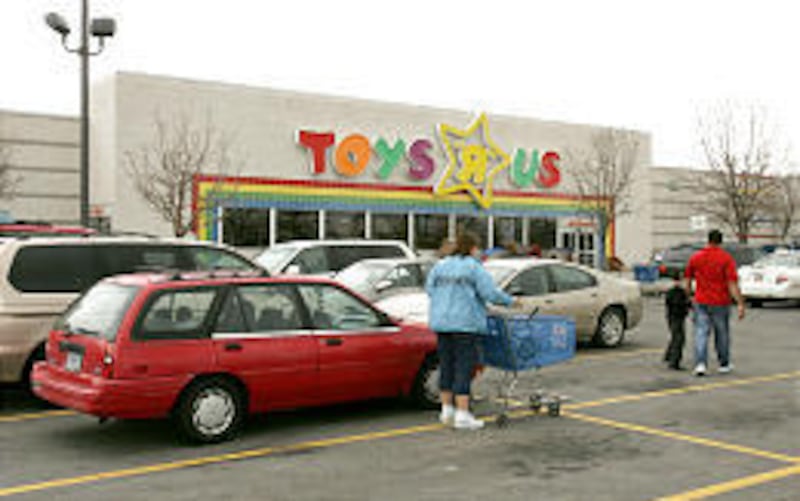
NEWARK, N.J. — Toys R Us Inc., the nation's second-largest toy seller, is staying in one piece after weighing a breakup.
The struggling retailer announced Thursday it had agreed to become a privately owned company in a $6.6 billion buyout deal proposed by a group that includes two equity firms and a real estate developer. The deal ended a seven-month auction that started as an effort to divide the sluggish toy business from the smaller, but more lucrative, Babies R Us segment.
Instead, the company agreed to be swallowed whole by Kohlberg Kravis Roberts & Co., Bain Capital LLC and Vornado Realty Trust, who will be equal partners.
There was no immediate word on the buyers' specific plans for the company's roughly 1,500 stores.
"We look forward to building on the many strengths of the company to make the stores a better place to shop and work," Michael M. Calbert, a director at the famed buyout firm KKR, said in a statement.
Toys R Us chairman and CEO John H. Eyler Jr. said it was up to the new owners to determine what stores, if any, would be closed.
But he noted, "The new owners paid a significantly handsome price, and the only way you can pay that price is if you believe in the future of the business, so I expect this business to be around for a very long time."
Chris Byrne, an independent toy consultant, said a privately run Toys R Us will free executives from the pressure of quarterly earnings reports and allow them to build a business that typically has the bulk of its sales around the December holidays.
"You have to expect that your second quarter is going to be slow and your third quarter is going to be slow, but that hopefully you're going to make it up in the fourth quarter," Byrne said.
Toys R Us has been losing market share in the toy business to industry leader Wal-Mart Stores Inc. and other discounters such as Target Corp. It announced in August it would separate its toy business from the Babies R Us segment, which sells children's apparel, furniture and accessories, but did not say how.
Some bidders reportedly wanted the whole company, though, rather than just part of it.
The deal comes amid gloomy prospects for the toy industry as discounters make the industry commodity-driven. Children are also growing out of toys faster, embracing high-tech gadgets like cell phones and iPod players, found at consumer electronics stores.
Many toy makers are fighting back by offering items other than toys, from children's furniture to child-friendly electronic gadgets. Still, analysts expect it will be another tough year for toymakers. Overall traditional toy sales fell 3 percent to $20.1 billion in 2004, from $20.7 billion in 2003, following a 2.9 percent drop in 2003.
The consortium will acquire all shares of Toys R Us for $26.75 a share, an 8 percent premium over Wednesday's close. The roughly 215 million Toys R Us shares outstanding account for $5.75 billion of the deal, with the remainder coming from outstanding options, nonvested restricted stock, warrants and convertible bonds, Eyler said.
The buyers are also assuming Toys R Us debt, which Fitch Ratings said totals about $2.3 billion. Fitch warned it might downgrade the debt to a B rating, three notches down from the current BB, because it appears the new owners will be taking on about $5 billion more in debt to finance the purchase.
Toys R Us shares jumped $1.23, or 5 percent, to close at $26 on the New York Stock Exchange.
Paramus-based Vornado and KKR representatives declined to comment on details of their plans, and a Bain Capital spokesman didn't immediately return a call.
Matt Levin, a managing director at Bain Capital, said in a statement that Toys R Us and Babies R Us "are premiere franchises with strong global brand recognition and a collection of high-quality product offerings."
Eyler said there are no immediate plans to move the headquarters from Wayne, or to lay off workers. The company has 65,000 employees, a number that swells to more than 100,000 during the holidays.
Toys R Us had been a public company since 1978. The deal, expected to close by July, requires regulatory review and approval, the company said.
Eyler, and analysts, saw no impediment on either front.
Shares were trading at $16.42 in August when Toys R Us announced it would study restructuring. The buyout price of $26.75 a share is nearly 63 percent above that. "It's hard to believe that Toys R Us share price would be anywhere near this level without this process," said Sean P. McGowan, an analyst at Harris Nesbitt.
He said regulators are unlikely to be concerned that Boston-based Bain is the largest shareholder of KB Toys, which has been under bankruptcy protection since last year. "KB's market share is lower than the amount of market share that Toys R Us has lost in the last three years," McGowan said.
The toy consultant Byrne saw little possibility of a Toys R Us and KB Toys merger, noting that KB Toys operates in malls, while Toys R Us has stand-alone stores. "There may be some synergies down the line, but I think it's premature to look at that," Byrne said.
Although Toys R Us has 681 toy stores in the United States, and 601 overseas, the 218 Babies R Us stores have been an increasing factor in profitability.
Babies R Us, which sells baby furniture, clothes and accessories, accounted for three-quarters of the company's operating income, despite logging just 15 percent of the company's $11.6 billion in sales for the fiscal year that ended Jan. 31, 2004.
In that fiscal year, sales at Babies R Us stores open at least a year rose 2.8 percent, while sales at domestic Toys R Us stores open at least a year fell 3.6 percent.
Results for fiscal 2005 were to be released Thursday, but the company on Tuesday said the figures would be indefinitely delayed to allow the company to compute changes in how it accounts for leases.