

PROVO — Heads up, stargazers.
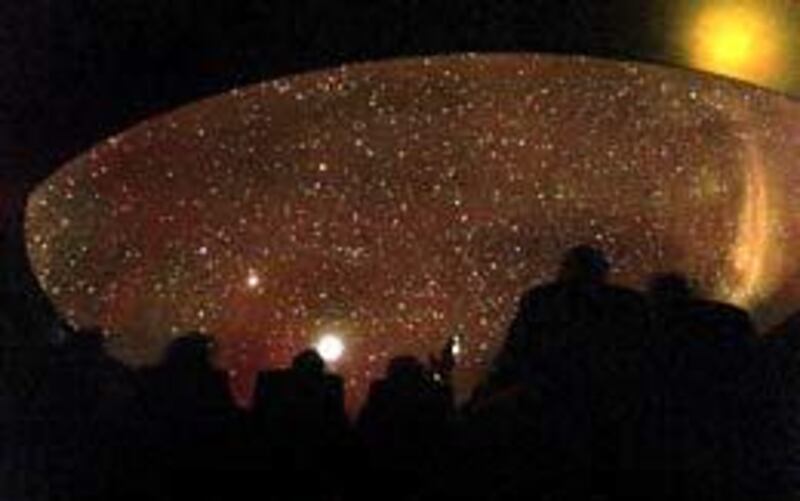
Brigham Young University opened a planetarium that can accurately project the beauty of nighttime sky — as it was centuries ago.
BYU physics and astronomy professors unveiled the newly remodeled and rebuilt Summerhays Planetarium Monday.
"This will give students an outstanding experience," says J. Ward Moody, professor of physics and astronomy.
While dome-like structures usually have echoes, this one was engineered to eliminate voice bounce, according to the professors.
"Any time you have a domed structure, you get focusing of sound and a whispering-gallery effect," said Timothy Leishman, BYU assistant professor of physics.
"Sound creeps along the dome and ends up on the other side, concentrating the sound in the middle," Leishman said. "We used a new type of treatment on the dome. It looks like plaster, but it has very fine pores. A good portion of the sound works itself into pores and gets absorbed by insulation."
The planetarium is the only one Leishman is aware of with this type of acoustic treatment.
Not many universities have new, state-of-the-art planetariums, Moody said.
"Most of them are very old," he said.
A specialized projector broadcasts the nighttime sky with a lot of detail, Moody said. Binoculars are required to pick up some of the detail. The projector can reproduce the positions of stars and planets as seen from any location on Earth at any epoch in time, Moody said.
"We can demonstrate what the night sky would have looked like from the Holy Land on the night Christ was born," he said.
The planetarium, in addition to being used for college classes, will be used for public demonstrations. Seating was expanded from 40 to 119.
"It was a major investment in teaching (and was) funded by donations," Moody said. The private university declined to release the amount.
Tom Balonek, a professor of physics and astronomy at Colgate University toured the facility.
"It is attractively, beautifully designed, but not at the expense of functionality," he said.
Moody foresees a time when the theater can be used in other disciplines, such as projecting the inside of an atom. "It can impact a variety of fields," he said.
The BYU Astronomical Society will begin giving public shows each Friday night beginning April 1. The cost will be $2 a person. This week, Astronomy Week, free public shows will be available.
For a complete schedule, visit: planetarium.byu.edu.
E-mail: rodger@desnews.com