

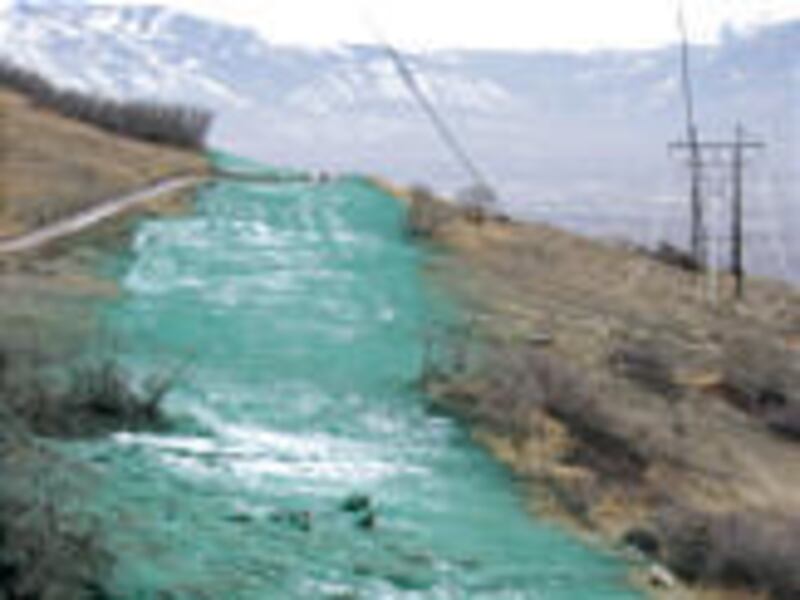
PROVO — A deep, miles-long cut in the foothills above Utah Valley has had residents asking questions about long term-impacts of the hillside scar.
But a Questar Gas spokesman said the trench had to be dug along portions of the Bonneville Trail east of Payson, Springville and Provo to replace an existing natural-gas line.
"The existing pipeline in the ground has been there since the '50s," said Questar's Steve Chapman. "It's just too small to accommodate the increased demand for gas that is being used by our customers."
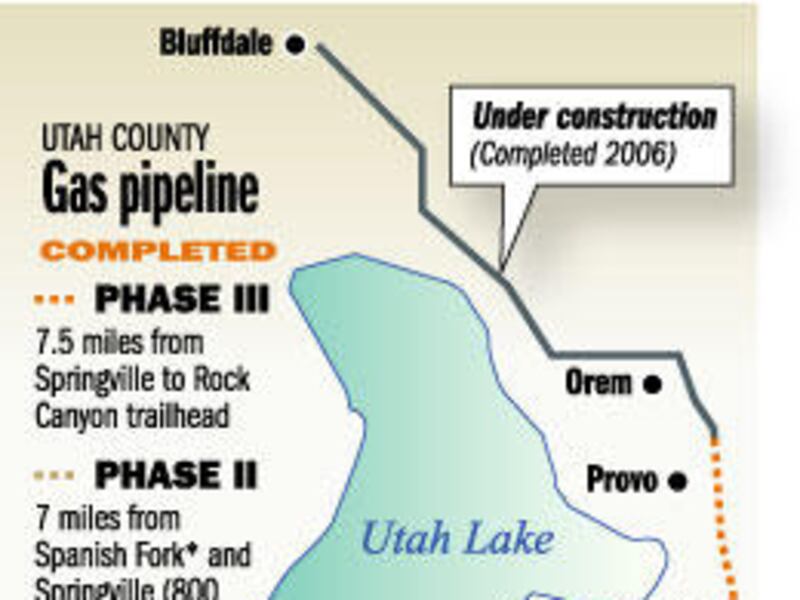
The sections that have been replaced are only half of the Feeder Line 26 replacement, a 40-mile pipeline improvement project stretching from Payson to Bluffdale. It began in 2002 and is expected to be completed in 2006.
Chapman said the trench currently is more visible because of a bright green reseeding material on its surface.
"Most of what you're seeing now is the color of the revegetation material that they've sprayed up there, which is a mixture including fertilizer and seeds that is sprayed on the right-of-way to affect the revegetation," he said.
Chapman said the scar in the foothills will eventually fade.
"It will probably take at least a couple of years for the seeds to take hold and return to some semblance of normalcy," he said.
"They're expecting within a couple of years, as the vegetation takes hold, that stripe that you see now will be somewhat lessened."
Chapman said Questar studied potential environmental impacts before starting the project and received approval to dig across some U. S. Forest Service lands the pipeline crosses.
"A little less than 12 percent of one section crossed Forest Service property, so we did have to perform an environmental assessment to obtain a permit," he said. "(The assessment) includes everything from repairing areas to seismic considerations, and also flood control drainages, vegetation and so forth."
The pipeline is near fault areas, which Barry Solomon of the Utah Geological Survey says can cause problems.
"There are two potential problems: One is if it's built across the fault line, it has the potential to rupture the pipeline," he said. "The other thing is, obviously, strong ground shaking."
But Solomon said pipelines usually are engineered to account for such risks.
"They probably did take that into consideration, and (the pipeline) probably isn't located right over the fault," he said. "And pipelines are generally designed to withstand a certain amount of offset (from ground shaking)."
Chapman said Questar takes steps to mitigate against damage from earthquakes and other disasters.
"In those trench areas, instead of backfilling with normal landfill, we can put in sand and so forth, so if there is ground movement, the sand will absorb most of the energy and will allow the pipeline to move if there is earth movement in that kind of an area," he said. "And the pipe is installed in sections and has some flexibility."
Chapman added that in the event of a line break or other emergency, sections of pipe can be cut off.
"We install these systems with a number of block valves and so forth, which, in the event of an emergency, we can isolate sections of pipe," he said. "So if there was a potentially devastating movement of earth that did cause a rupture, it would be a fairly routine matter to shut the gas off on both sides of the impact area and isolate it."
Questar also generally loops its pipeline systems to prevent outages.
"In most cases, our system is looped, which means you don't have gas going in from just one direction, the gas interconnects at various points," Chapman said. "So even if you did have to shut off the supply at one section in the case of an emergency, chances are, nine times out of 10, because the system is looped, you would hope that there wouldn't be a loss of service. That's kind of a built-in redundancy."
Solomon said that because of the proximity of cities to the Wasatch Fault, it would be nearly impossible to build pipelines in areas that would be unaffected by a possible earthquake.
"Strong ground-shaking, you're going to have that way out in the valley, too. Anywhere along the Wasatch Front has the potential for strong ground-shaking," he said.
Aside from increased capacity, the pipeline replacement project may benefit residents in another way. According to the Provo Parks and Recreation Department, plans are under way to improve access to the the Bonneville Trail running over the project, which the pipeline construction has, in some cases, widened.
E-mail: mdecker@desnews.com