



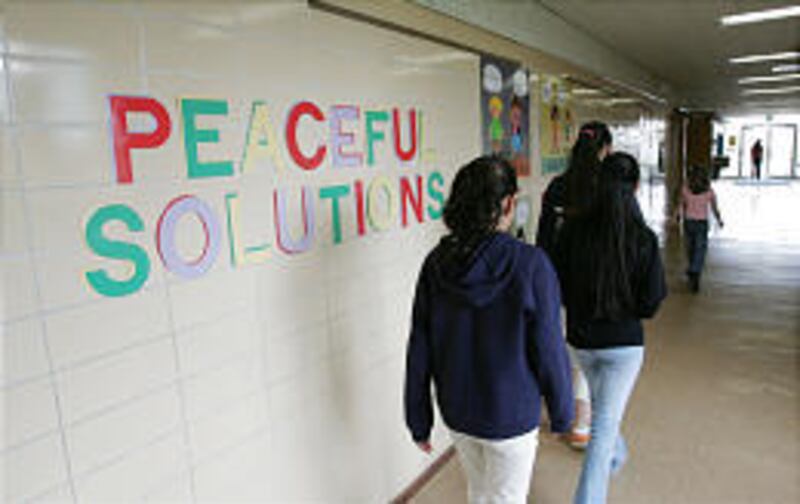
A cluster of Utah schools thinks it has found a way to change the way students behave and, in turn, improve academics, prevent bullying and possibly stave off the kind of violence seen in last week's deadly Minnesota school shooting.
The Utah Behavior Initiatives Project, implemented in 42 schools and grounded in research, aims to prevent bad behavior by teaching, demonstrating and rewarding the good. Schools track data, keep what works and throw out what doesn't.
It sounds pretty basic: Reinforce the behavior you want to see.
But schools often focus on disciplining students who get out of line — something some educators say is far easier than teaching a teenager what it means to be respectful, when his daily interaction is anything but.
"There's a higher percentage of kids who are coming to school that do not have appropriate behavior. Kids come to school and their natural way of . . . getting along with friends on the playground is actually bullying," said Mark Daines, principal of Park Elementary School in Cache County.
"So we find some kids don't want to go to recess because they're being bullied, being hurt emotionally, because other kids are bullying them with insensitive comments . . . not necessarily directed in a mean way, but that's the way society allows them to respond in today's world."
Student misbehavior has been an issue for years, said Pat Rusk, president of the 18,000-teacher Utah Education Association. And a few students are exhibiting violent tendencies.
This school year, a Granger High student was arrested and accused of having a "hit list"; a Northridge High student allegedly brought a gun to school; and four Uintah High students were charged in an alleged school bomb plot. Just last week, a girl attending Canyon View High School in Cedar City was arrested after a threatening note was found.
Earlier in the week, a student on a Minnesota Indian reservation shot and killed his grandfather and a female companion, five classmates, a teacher and a guard and injured others before turning the gun on himself. The boy, who reportedly smiled and waved as he gunned down victims, was described in media reports as a loner often teased by others.
The situation is reminiscent of other school shootings nationwide. And concerns over bullying are growing.
State Superintendent of Public Instruction Patti Harrington this month ordered a statewide report on bullying, what schools are doing to address it, and recommendations to make things better. The report will be issued at the May State Board of Education meeting.
"We're anxious, of course, that we ensure the safety of all children on our campuses," Harrington said.
Nearly four dozen Utah elementary, middle and high schools hope the UBI Project will do just that.
"I like this program because it teaches you don't have to be browbeat. You can speak up. And it teaches if you're hot and aggressive, you're not solving the problem; you're just creating another problem," said Joan Groves, a counselor at Academy Park Elementary in West Valley City. "I think it's made a big difference."
Schools in the UBI Project, federally funded in Utah since 2002, teach students how to behave and respond appropriately to peers' inappropriate behavior.
Leaders say it's a more positive, long-lasting approach to the problem. "When you negatively respond to a student's behavior, you change the behavior for the immediate," Daines said. "But is it going to change their behavior . . . tomorrow? The answer is no. They'll do it (when) they want to do it, and can see value to it."
The UBI is a three-year project. Schools apply to join and are re-evaluated before they can stay on all three years (half made the cut in 2003).
In the first year, schools set up UBI teams — which receive support from the UBI state support team — examine their climate, gather data and pinpoint where they want to improve. Then, they come up with their top three student behavior initiatives, create mottoes and mission statements — "Park Eagles are safe, kind and responsible," for example, at Park Elementary — and continually reinforce the mission statement with explicit instructions on how to behave, such as picking up after yourself in the lunchroom and not running in the halls.
Union Middle School in Jordan District has worked to halve the number of students sent to the principal's office. Leaders drilled behavior expectations into students and rewarded them for living up to them. They handle repeat offenders with "think time," where kids go to another classroom and fill out a behavior log on what they were doing, what they should have been doing, and whether they'll be able to do what they're supposed to when they return to class.
"Most of the referrals we were getting were the one-time-shot things . . . now, we're catching it beforehand before it gets to that escalation," said Vicky Ginsburg, science teacher and Union's UBI facilitator. "A lot of times, it's just getting the student to realize what they're doing, and that's half the battle."
Academy Park also reports a 35 percent reduction in behavior referrals between the 2001-02 and the 2002-03 school year. They fell again by 56 percent this past school year.
Cutting office referrals lets administrators turn attention away from discipline and toward instructional leadership. For example, one UBI school reported more than 5,100 office discipline referrals in a single year — that's 160 days worth of administrative time, UBI data shows.
The minimum school year is 180 days long.
Schools reach behavior goals by repeatedly teaching about and rewarding positive behavior, from following lunchroom rules — Park Elementary's lunchroom noise goal is monitored by a decibel meter disguised as a traffic light (red means it's too loud) — to being constructive in playground situations — "I feel bad when you call me stupid, please stop."
Kids might be rewarded with tickets, posted on a grid that when full brings, say, a pizza party. Some at Academy Park might receive play money, which is stuffed into classroom pinatas that children bust for rewards.
School behavior initiatives work on about 80 percent of the students, said Carol Anderson, a member of the UBI state support team and a specialist in emotional disturbance and mental health issues with the State Office of Education.
The remaining 20 percent are channeled into intensive programs that include daily tracking and, at Academy Park, academic testing, sometimes weekly. Several are found to be academically struggling, but get the help they need — sometimes, special education services — under the program. A couple of Academy Park students, once placed in the more targeted program, doubled their literacy skills.
"What we're wanting to show through our initiative is that . . . social behavior and academics are tied together to get the best student outcomes," Anderson said. "With No Child Left Behind . . . (some schools are) so wrapped up in the data that they forget: Unless you get them in their seats and paying attention, you're not going to get great academic outcomes."
Union's efforts have played well for ninth-grader Anthony Firkins, who says he used to end up in the principal's office "every other day.
"I just kept on not showing up to class, not doing the work in class, not doing what they told me," Firkins said. "But they always stayed on top of me, made me do the work."
Now, he's more than doubled his grade point average to a 2.0. He doesn't argue with teachers anymore. He's proud of his accomplishment, and received a most improved student award from his school.
"Everything's easier," Firkins said of his change.
As for high school?
"I think I can do it."
What kids are saying
Students at Granite District's Academy Park Elementary were surveyed about the Utah Behavior Initiatives program, which 95 percent said has helped them, school data show. Student remarks include:
"I have more friends."
"I get good grades instead of bad."
"I'm not as mad."
"The way I speak to myself is better."
"I have ways to control myself."
"I learned that emotional blackmail doesn't work."
E-MAIL: jtcook@desnews.com