

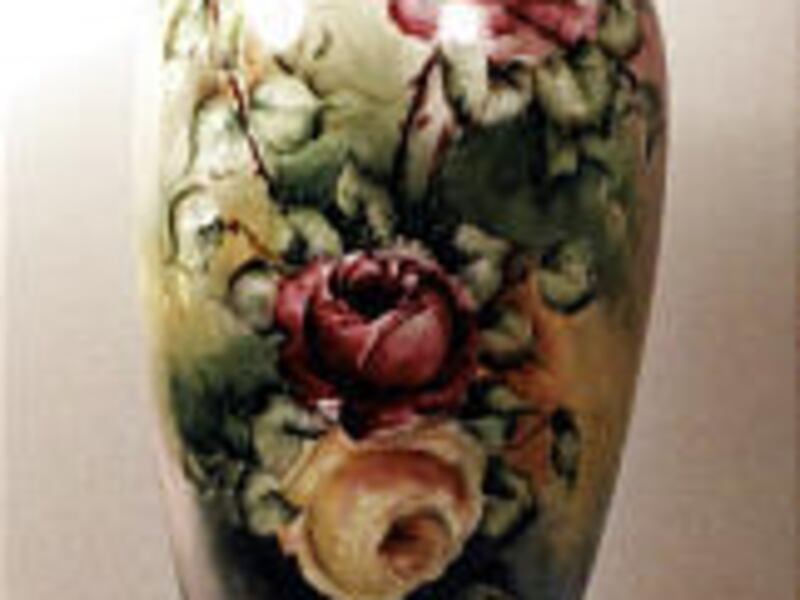
Dear Helaine and Joe: I am enclosing two photographs of a vase I own. It is 15 1/2 inches tall and is marked "Willets Belleek." Any information you can provide will be greatly appreciated.
Thank you, — B.R.M., Muscatine, Iowa
Dear B.R.M.: When people hear the word "Belleek" they generally think of Ireland and the fine porcelain made in the small village of Belleek, which is located in that country's County Fermanagh. This type of ware actually was made by David McBirney & Co. and it is based on the Parian porcelain made in William Henry Goss' factory, which was located in Stoke-on-Trent, Staffordshire, England.
Originally, the Irish company, which was founded in 1857, made rather ordinary wares, but McBirney and his creative partner and plant manager, Robert Armstrong, aspired to make fine porcelain.
In order to acquire the expertise needed, they hired Goss's manager, William Bromley Sr., and several other workers from the English manufacturer, and by 1863 had begun making small quantities of the Parian porcelain.
Unfortunately, it took another six years or so of experimentation to perfect the product, and Belleek china made its first international appearance at the Dublin Exhibition of 1872.
Four years later, Belleek was shown at the Philadelphia Centennial Exposition, and there it was seen by another exhibitor, the owners of the Trenton, New Jersey N.J., company, Ott and Brewer. This inspired them to try and make fine porcelain similar to Belleek, and they too hired William Bromley Sr. and William Bromley Jr. to help them master the process.
Ott and Brewer began producing Belleek style porcelain around the beginning of 1884 or perhaps the end of 1883, and they made it until they went out of business in 1893.
Meanwhile, in 1879, brothers Joseph, Daniel and Edmund Willets took over the old William Young and Sons pottery in Trenton, N.J., and founded the Willets Manufacturing Co.
They began by making rather ordinary wares, but in 1884, William Bromley Sr. came to them bringing the secret of making Belleek-style porcelain. Production of Belleek started at Willets in 1885 and continued until 1909, and during that time period, the company turned out rather large quantities of this high quality porcelain.
Much of it, however, was sold undecorated to china painters, who added the decoration outside the factory. Some of this work was very good, but a lot of it was mediocre to say the very least. The value of any given piece of Willets Belleek depends not only on its condition but also on the professionally quality of the decoration, and what the subject matter happens to be.
By far the most commonly seen decoration found on Willets Belleek is that of flowers, and because of this, collectors tend to prize examples that have portraits, images of putti, nudes, birds or some other unusual design that has been expertly and artistically executed. Collectors also like pieces that have lavish gold embellishment.
We believe that the vase in today's question was done by a professional decorator working outside the Willets factory. It has very little gold on it but the flowers are well executed, and for insurance replacement purposes, this large vase should be valued in the $500 to $650 range.
Helaine Fendelman and Joe Rosson are the authors of the "Price It Yourself" (HarperResource, $19.95). Questions can by mailed to them at P.O. Box 12208, Knoxville, TN 37912-0208.