

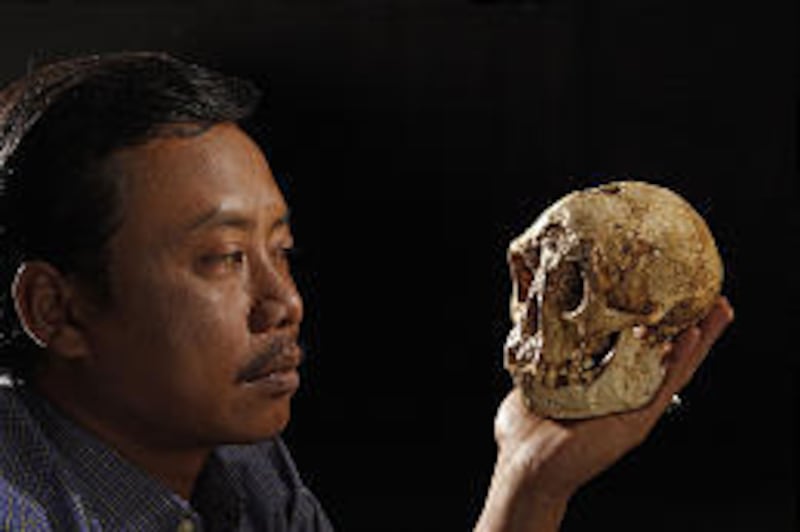
A peek under the skull of the 18,000-year-old fossil scientists have nicknamed "the hobbit" reveals the tiny being truly represents a separate human species, researchers reported Thursday.
The find counters suggestions that Homo floresiensis, the ancient human whose remains were discovered on the Indonesian island of Flores last year, was part of a known species. Indonesian anthropologist Teuku Jacob of Java's Gadjah Mada University and others had suggested that the diminutive creature was a pygmy who suffered from microcephaly, which causes small brains.
But "we found that generally the overall shape of the hobbit brain was unique," says anthropologist Dean Falk of Florida State University in Tallahassee, who led the team doing the brain analysis. While small, the brain resembles that of Homo erectus, a human species that preceded modern man, except with a few advanced traits that made it capable of deep thought, she says. It does not resemble a modern human's brain, diseased or not, she says.
A little over 3 feet tall, Homo floresiensis people flourished on Flores from 94,000 to 12,000 years ago, when a volcano did them in. They apparently hunted dwarf elephants with spears. Researchers had greeted the discovery with surprise because the creatures lived so recently and because they used axes, blades and other tools despite having chimp-size brains.
The analysis, released by the journal Science, of computer scans and inner skull molds shows that the hobbit's small brain, one-third the size of a modern human's, had enlarged regions associated with complex decision-making, name recognition and speech.
"I'm bowled over," Falk says. "I never thought I'd see these advanced features on such a small brain." The team compared the brain cast to a microencephalic patient's and found no similarities.
"Overall, this is a very valuable contribution to the understanding of this enigmatic, tiny hominid," says anatomist William Jungers of Stony Brook (N.Y.) University, who was not on the analysis team. Homo floresiensis is clearly not a pygmy human being because the brain is far too small, he says.
Archaeologist Michael Morwood of Australia's University of New England, who led the discovery team, said the analysis is consistent with his team's unearthing of stone blades, axes, awls and other hunting tools with the fossil, and the remains of seven other hobbit beings. He was a co-author of the report from Falk's team, whose analysis was supported by National Geographic.
"I would say that the suggestion that it is most closely related to Homo erectus appears the best hypothesis," agrees anthropologist Ralph Holloway of Columbia University in New York, who was also not part of the analysis team.