

WINDSOR, England — Thirty-four years after they first met and fell in love, Prince Charles and Camilla Parker Bowles are finally husband and wife.
The heir to the British throne and his longtime paramour were wed early Saturday afternoon in a sedate and unadorned civil ceremony behind closed doors at the local clerk's office. It was followed by a regal and solemn prayer service, broadcast worldwide, at St. George's Chapel inside the walls of the 1,000-year-old Windsor Castle, ancient home and symbol of the monarchy.
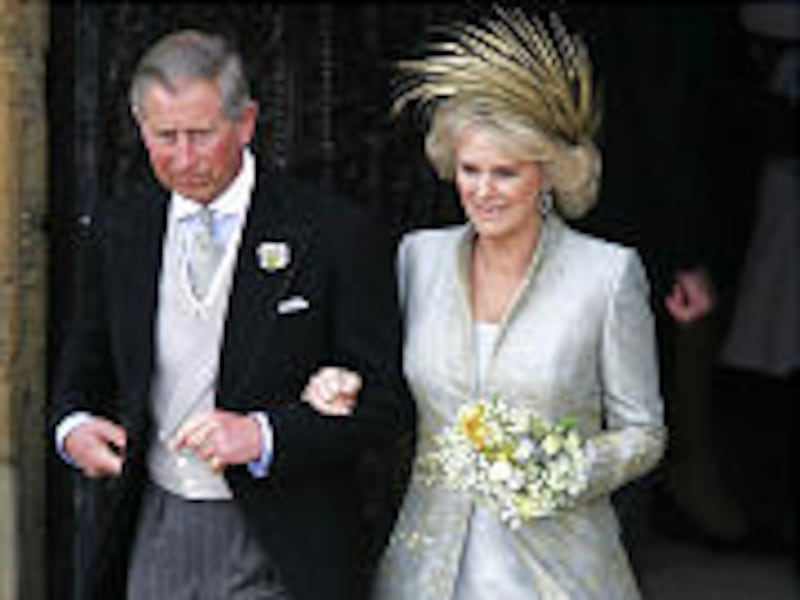
The two emerged from the chapel arm-in-arm and smiling widely, visibly relieved to have overcome a series of last-minute obstacles, confusion and parental disapproval that had threatened to undermine the day. In the end, the event was considerably less grandiose than the pageantry that surrounded Charles' wedding to Diana Spencer in 1981, but seemed far more in line with the reduced expectations of a middle-aged couple — Charles is 56, Camilla 57 — seeking a second chance at life and love.
For their friends and supporters, the ceremony marks the start of a new chapter in which Charles and Camilla — long cast by the glamorous Diana's acolytes as an adulterous couple who drove their beloved, despairing princess to an early and tragic death — would be given a fresh opportunity to endear themselves to the British public. It is also a chance for them to emerge at last from the shadow of Diana, who died in a car crash in 1997.
"It's the beginning of a new era," said Simon Sebag Montefiore, a historian who was one of the 740 invited guests at the church service and the reception that followed. "Everyone who knows Camilla personally knows she's a wonderful person, and they're an absolutely charming couple. She'll prove a great asset to the monarchy and the country."
Others were not so certain. It seemed unlikely that Britain's carnivorous tabloids — which have feasted off the Prince of Wales and Camilla in recent years like famished freeloaders at an all-you-can-eat buffet — would give the couple any more than the briefest of respites. Polls have indicated most Britons either approve of or are indifferent to the wedding, but a sizable majority does not want to see Camilla become queen.
"I think people are truly ready to give them a chance," said royal biographer Robert Lacey. "But of course it only takes one small mistake or act of extravagance to put them back in trouble."
"To be Prince of Wales is not a position — it's a predicament," playwright Alan Bennett once wrote, and the hurdles Charles had to overcome to reach this day ranged from the comic to the tragic. His original plans to hold a civil ceremony inside the castle had to be scrapped when the prince's advisers realized the rules would allow for members of the public to get married there as well.
Then aides to Charles's mother, Queen Elizabeth, announced that she and his father, Prince Philip, would not attend the ceremony. This was widely interpreted as a snub, despite the fact the queen still planned to attend the church service and host a reception for the newlyweds.
A senior bishop in the Church of England suggested the couple should apologize publicly for their past adultery before being allowed to celebrate their marriage in church. Then there was confusion over whether Camilla would automatically become queen if and when her new husband ascends to the throne. The rules of succession allow for it, but the couple has made clear she wants only to be called the "princess consort." For now she is Her Royal Highness, the Duchess of Cornwall — eschewing the title "Princess of Wales" out of respect to Diana's memory.
Finally, the couple was forced to set back the wedding date by a day after Pope John Paul II's funeral was set for the original date, April 8. "Can Anything Else Possibly Go Wrong?" asked the Daily Mail in one of its more restrained headlines. The change in date turned wedding souvenirs dated April 8 into instant collector's items.
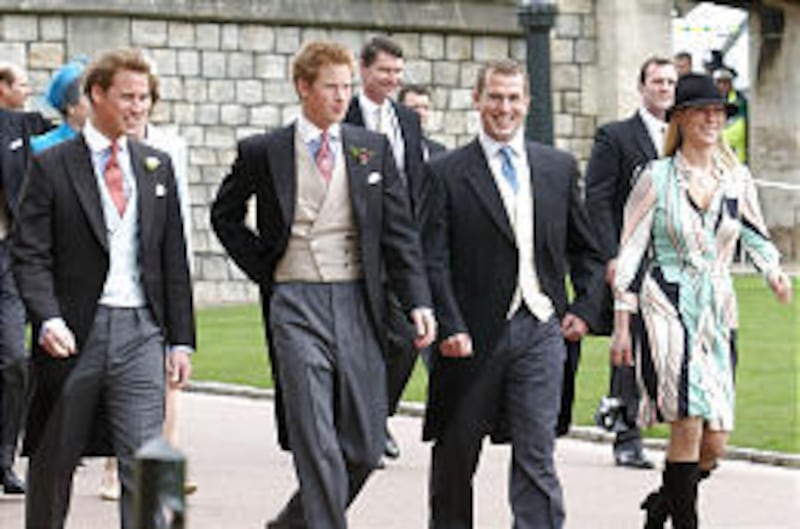
Still, shortly after noon on a cold and windy day, a white coach carrying Camilla's father, grown children and relatives pulled up outside the Windsor Guild Hall. They were followed minutes later by a second load with Prince William and Prince Harry — Charles's children from his marriage to Diana — plus his sister and two brothers: Princess Anne and Prince Andrew and Prince Edward, along with various spouses and children.
Then the queen's custom-built, claret-and-black 1962 Rolls-Royce emerged from the George IV Gateway bearing the groom and bride-to-be.
Camilla is known as a horse-riding fanatic who dresses in the informal uniform of Britain's rural aristocracy. But for her brief trip to the Guild Hall she was dressed like a future queen in a chiffon dress and oyster silk basket-weave coat, pale beige suede high heels and natural straw hat overlaid with ivory French lace. The wedding outfit took eight fittings over a six-week period. Charles was dressed in a morning coat and wide tie.
They emerged from the Rolls to many cheers and a smattering of catcalls. After they entered the Guild Hall, two men secured the red double doors. Only the royal photographer was allowed to record the event.
Twenty minutes later, after taking their vows, Charles and Camilla emerged as husband and wife. They waved shyly to the crowd and returned quickly to the castle. Those among the estimated 10,000 to 15,000 onlookers hoping they would walk the main street and greet the public were disappointed.
The religious ceremony began some 90 minutes later before dozens of politicians, celebrities, royalty from other countries and friends. The guests included Prime Minister Tony Blair, Prince Bandar and Prince Turki of Saudi Arabia, and actors Rowan Atkinson, Kenneth Branagh and Timothy West. Rowan Williams, the Archbishop of Canterbury, presided.
As Queen Elizabeth and Prince Philip looked on, the newlyweds knelt in front of the altar. The tabloids had made much of the fact that Charles and Camilla would acknowledge "our manifold sins and wickedness which we, from time to time, most grievously have committed." But in fact the entire congregation, including the archbishop, recited the passage together.
Then they headed back down the dark blue carpeted aisle and out the front steps of the chapel, to affectionate applause from hundreds of specially invited onlookers. As the couple stood on the steps, the queen and Prince Philip emerged and stood behind them. Everyone was smiling, but there were no royal hugs or poses for group photos.
Most of the guests then headed up the hill back inside the castle, while the prince and his bride lingered for some 20 minutes shaking hands and accepting greetings from the crowd inside the courtyard. Camilla had changed into a porcelain blue silk dress and a gold-leaf feather headdress.
The reception in the formal state apartments of the castle lasted for nearly two hours. There was no sit-down banquet, just finger food. Guests said that both the queen and Charles gave brief welcoming speeches and that the atmosphere was warm and friendly. Shortly after 6 p.m., a Bentley emerged from the castle with red, white and blue balloons and "Just Married" written on the back window. It ferried the couple to a nearby Royal Air Force base for a flight to Scotland, where they will honeymoon at a royal estate.