

BOSTON — After more than three years of frustration, false leads and a controversial dragnet for DNA evidence, prosecutors announced Friday that police have arrested a man in the slaying of fashion writer Christa Worthington on Cape Cod.
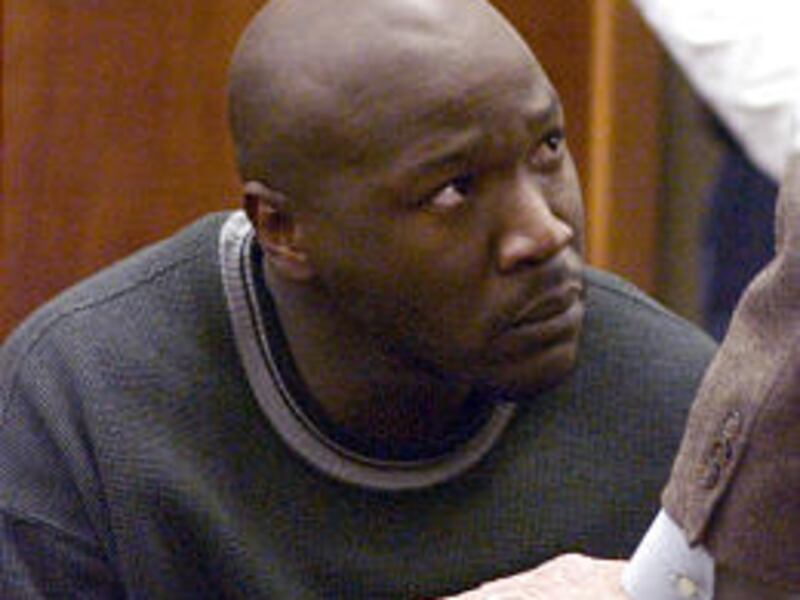
Christopher McCowen, 33, of Hyannis, Mass., was arrested Thursday evening and is accused of fatally stabbing Worthington in the sleepy town of Truro. He pleaded innocent to murder, aggravated rape and armed assault Friday in Orleans District Court.
Authorities determined last week that DNA McCowen willingly provided more than a year ago matched evidence found at the crime scene. District Attorney Michael O'Keefe said in a news conference that at the time of the \slaying, McCowen was working as a trash collector who made pickups at Worthington's home.
"There is no evidence whatsoever to suggest there was any relationship whatsoever between them, other than him walking up her driveway to collect her trash," he added.
Worthington, 46, was found dead Jan. 6, 2002, her 2-year-old daughter Ava, covered with blood but unharmed, at her side. The case, which spawned the first murder investigation in sleepy Truro since 1968, attracted widespread media attention and was the subject of a best-selling book, "Invisible Eden."
Authorities began gathering DNA evidence from the start of their investigation and used it to exonerate several of Worthington's close acquaintances.
Among those who initially drew suspicion were a former boyfriend, who discovered Worthington's body on the floor of her home, and another local man who is Ava's father.
The case went unsolved, despite a $25,000 reward offered by Worthington's friends and family. Then, in January, investigators stepped up their efforts by asking every man in Truro, which has a population of about 2,000, to voluntarily provide DNA samples, obtained by wiping a cotton swab on the inside of the cheek.
At least 75 men agreed on the first day of the sweep but the tactic drew criticism from the American Civil Liberties Union and other privacy rights advocates.
O'Keefe said that McCowen had been asked to provide a DNA sample four months after the murder, along with others who had business at Worthington's home.
He agreed, but did not come forward to give the police the sample until March of 2004. It was not until April 7 of this year that state police forensic scientists determined that his sample implicated him in the crime.
"It's a question of the resources that the lab has to work with," O'Keefe replied, when asked why it had taken more than a year to process the results. "You're asking the crime lab to work those into the rotation of current cases that they're doing all the time with very few resources."
Public records show that McCowen, who moved to Massachusetts from Florida in the mid-1990s, has a long criminal record, including prison terms for burglary, motor vehicle theft, and trafficking in stolen goods.
McCowen's attorney, Francis O'Boy, did not return a telephone call seeking comment Friday.
O'Keefe acknowledged Friday that law enforcement officials were fortunate McCowen had agreed to provide the DNA sample and that he had not fled the area.
Wendy Murphy, who spent five years as an assistant district attorney in the Boston area and now teaches a course on sexual violence at New England School of Law, said that investigations can be compromised by lengthy delays in processing forensic evidence.
"There was a time in Massachusetts when it was almost a comedy, you knew you'd have at least a six-month time lag because of how backed up the system was," she said. "Delay is always strategically advantageous to the accused. Evidence gets lost or tainted. Victims and witnesses get frustrated, or die, or move away. They got a real break that this guy was still around when they found a match."
Worthington had covered the fashion industry throughout Europe for several magazines, including Elle, Women's Wear Daily and Cosmopolitan. In 1998, she moved from New York to Cape Cod, where she had spent summers as a child.
Contributing: Meg Smith