

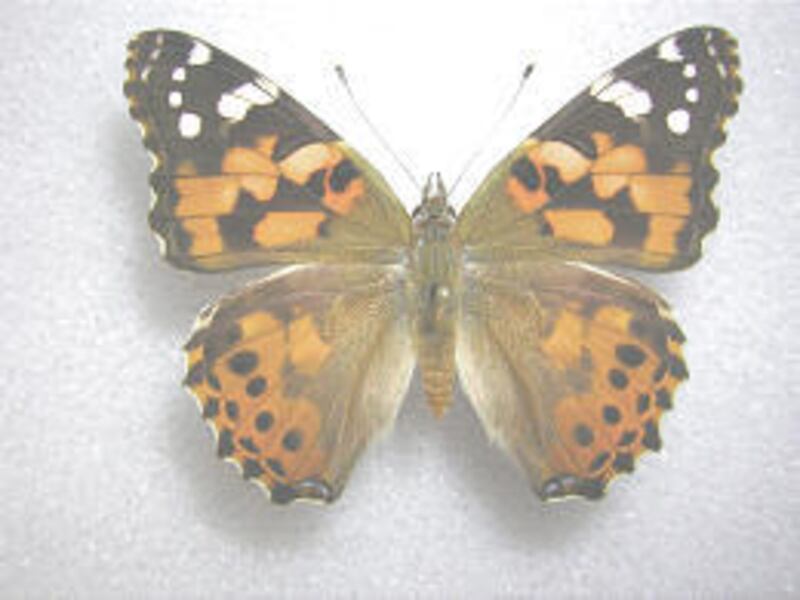

What's black and orange and, well, just all over? Painted lady butterflies.
Utah and much of the rest of the West are in the midst of one of the biggest painted lady butterfly migrations in years. Heading north from Mexico, swarms of the flying insects are fluttering past, stopping to feast on nectar from fruit tree blossoms or lounge around, building up energy before they take off again on their long trek.
"There's millions or billions, I don't know" how many, said Todd Stout, vice president of the Utah Lepidopterists Society. "They're in your yard right now . . . and your neighbor's yard. They're nectaring on the plum blossoms."
Spring rains were plentiful in Mexico this past winter, setting the stage for an enormous spring migration. Because of the rains, he said, "the host plants became much more plentiful, the butterflies became much more plentiful."
Every year painted lady butterflies, scientific name Vanessa cardui, migrate north from Mexico. But because they are especially multitudinous this year, the numbers crossing Utah and other states is amazing.
In a New York Times article published by this newspaper Sunday, a California expert, Professor Arthur Shapiro, said residents of that state, Nevada and Arizona may have seen the end of much of the migration. In California and Arizona, according to the Times, one estimate put the number of painted ladies at more than a billion.
But in Utah the mass migration is still going strong. It has been continuing for several weeks.
"I was out collecting last Thursday, and I must have seen 10,000 out in the west desert," said Stout.
He was in the House Mountain Range west of Delta searching for the Indra swallowtail butterfly, a far rarer variety than the painted lady happens to be right now. One might think it would be easy to distinguish the species because this swallowtail is largely black and the painted lady has a lot of orange coloration.
But a butterfly-catcher has eyes trained to detect the motion of the insect, not sort by color. And there were so many painted ladies in the area that trying to separate them from the few swallowtails was the type of visual task that can bring on a headache, he said.
"It was difficult to spot them (the swallowtails) because there were so many painted ladies," Stout added.
"I was climbing the mountains, and the butterflies were everywhere. They were landing on flowers, landing on rocks."
Although they are pressing on with their migration, he said, they will pause to "nectar or to dance around the flowers or to bask."
When he drove, the butterflies were splatting on the car.
Farmers don't need to worry that the painted lady will attack their crops. The larval stages don't feed on crop plants but on weeds like thistles. The adults simply feast on nectar from blossoms, helping pollinate orchards.
Stout has this advice for parents: If children are interested in butterflies, have them look in the yard now. They also can log onto the Web site the society maintains for its children's group, www.utahbugclub.org.
The society's main Web site is www.utahlepsociety.org. Stout is Web master for both. There, anyone interested in the beautiful insects can find information about meetings and field trips.
Utah Bug Club "teaches kids the basics about bugs," he said.
In about a month, children can carefully collect caterpillars from weeds (don't get scratched by thistles!). "They can raise them in a little jar or container and witness their life cycle, which is lots of fun for kids," he said.
E-mail: bau@desnews.com