

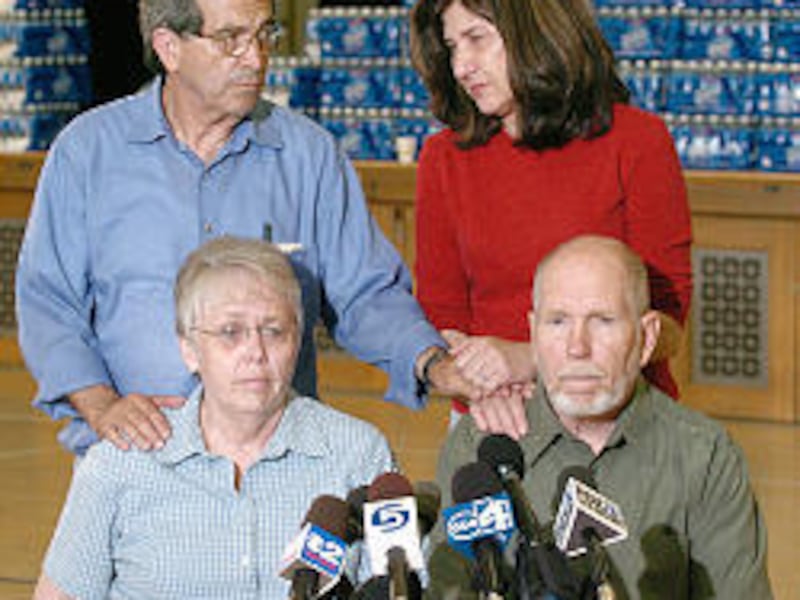
When Mark Hacking pleaded guilty April 15 to murdering his wife, it wasn't just her family that had to endure the wrenching courtroom confession.
Douglas and Janet Hacking also sat silently in the gallery, listening as their son admitted: "I intentionally shot Lori Hacking."
Mark Hacking initially reported his wife as a missing person to police, prompting a weeklong search by thousands of volunteers before he confessed the crime to his elder brothers. Lori Hacking's body was found 75 days later amid 6,000 tons of garbage in a west Salt Lake County landfill.
From the first days of the search, the Hackings were the public face of the tragedy, sharing a platform with Lori's parents at news conferences to thank and encourage volunteers.
But once Mark allegedly confessed the murder to his older brothers, public sympathy escalated for Lori's parents, Thelma Soares and Eraldo Soares.
The Hackings retreated into the background, asking for privacy as they attempted to deal with what had occurred. Their son, who does not face the death penalty, will be sentenced June 6.
Watching the story play out over the past nine months, Stella Archuleta's heart has been filled with empathy for the Hackings. "I've been there," the Salem woman said. "Your life is never the same.
In 1989, Archuleta's adopted son, Michael, was convicted of the tortuous beating death of a homosexual man near Cedar City. He is one of 11 men on Utah's death row.
Michael came to the Archuletas at age 5, with only a paper bag full of ill-fitting clothes. They adopted him at age 13 and hung on while he raged through life. School discipline problems grew into juvenile crimes, which compounded into adult-level felonies. At 18 he went to prison and at 26 he became a killer.
"I'd be lying if I said it was easy, but I never gave up on him," says Archuleta. "I love him."
But the hairstylist isn't sure how she or her family survived the small-town judgments after the murder and during the trial.
Some people stared. Others stopped talking altogether. Some clients stopped making hair appointments. At school, Michael's brother and sister felt the sting in the accusing looks and words from classmates.
"I really think it should be brought out that the families of the perpetrators are hurt, too," Archuleta said. "We've lost a loved one, too, even though we lose them in a different way. It's really hard on the families, especially, if there are children."
Rachel King, who works for the American Civil Liberties Union's Capital Punishment Project, says it may sound strange, but based on her interviews with families on both sides, she believes it's easier to be the murder victim's family than a death-row family.
"Society in general doesn't know what to do with these people," said King, whose book "Capital Consequences: Families of the Condemned Tell Their Stories" was published this year. "And when the perpetrator is put to death, well-meaning people don't know how to act. It's not like this person died a natural death."
Each family navigates the situation differently, but King said she sees commonalities among the families, including a sense of chronic grief and betrayal.
The betrayal, King said, can be twofold: There is a sense of being betrayed by the relative who committed the crime and by a society that sometimes can't see beyond the crime to the person.
"That's very difficult for a family because they know the (perpetrator) is more complicated than that. They see he has good points and has done good things in his life, so it's very painful to see that playing out," King said. "I think they feel a sense of hopelessness and a desire to say, 'Wait a minute, he's not just that one act.' "
Most of the clients represented by Elizabeth Hunt, a private attorney who handles murder conviction appeals in federal court, carry a great deal of shame not just for what they have done, but for what they have brought home to their families.
"Often in the penalty phase, when it's the lawyer's job to dig up any kind of problem in the client's background, any kind of abuse or suffering, they don't want it brought out," said Hunt, whose death row client Ralph Menzies has filed a federal appeal for his conviction in the death of Maurine Hunsaker, a Kearns woman who was kidnapped from her job at a convenience store and found days later lashed to a tree in Big Cottonwood Canyon with her throat slit.
"They just don't want to inflict anything more on their families."
Many families don't want anyone to know who they are, said attorney Bob Steele, a federal public defender who once represented Roberto Arguelles, who was convicted of the sexual assaults and deaths of five women. On Utah's death row for more than a dozen years, Arguelles died in prison in 2003 after suffering an intestinal illness.
"They are often horribly ashamed," said Steele, who maintains contact with Arguelles' mother, who has never spoken publicly about her son's crimes.
"The kid kills and that is somehow your personal failure," he said. "It makes complete sense to (define) that moment as something that you did or didn't do in their life."
In nearly 20 years as a criminal defense attorney, Ed Brass has seen most parents stay loyal to their accused and convicted children. He's also found himself working as a part-time therapist for families needing to vent their anger and disbelief.
"They have a lot of questions. 'How could I have prevented this? I thought I knew you better than this?' " said Brass. "And there are people who cope by simply not believing that their kid could ever do anything like this."