

The first couple to win a Gold Medal from the Mining & Metallurgical Society of America was Herbert and Lou Hoover, back in 1914. They were honored for their work in translating a 16th century mineralogy document from Latin into English.
Herbert Hoover was the mining engineer, but Lou also had a scientific mind, and she spoke several languages. The Hoovers went on to become president and first lady.
And after 1914, the mineralogists went on to bestow their honor only on single individuals.
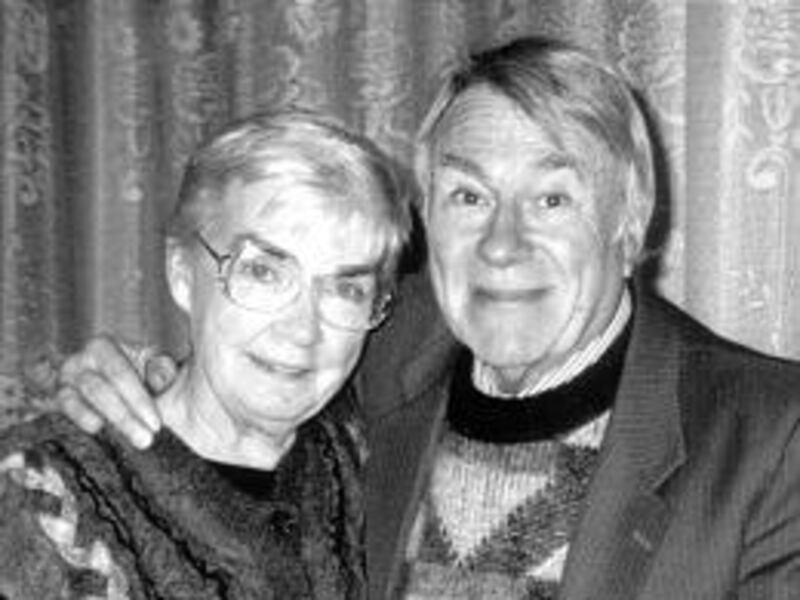
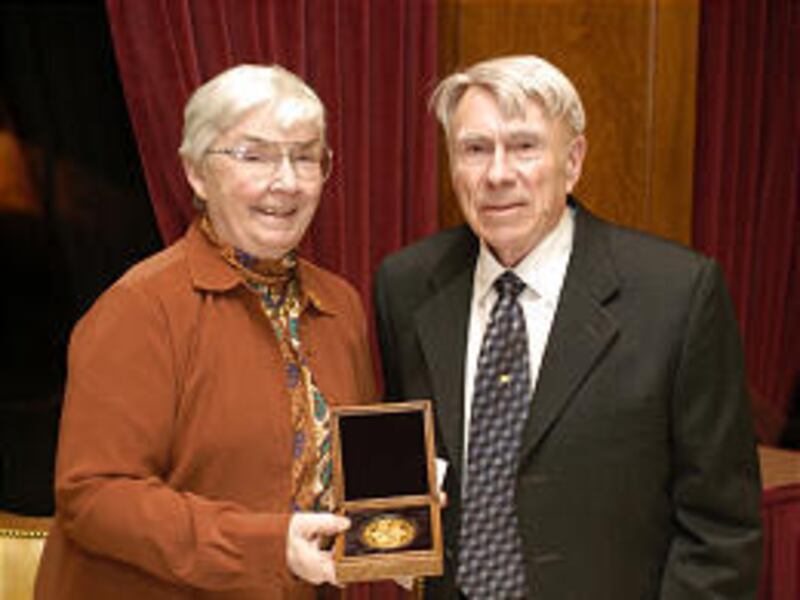
But this year, for the first time in nearly 100 years, the Gold Medal went to a couple again — Salt Lake residents Don and Mary Hausen.
Don is the mineralogist. He could have qualified for the award on his own, says Marc LeVier, director of metallurgical service at the Newmont Mining Corporation research facility in Denver. LeVier calls Don the father of process mineralogy, because of his laboratory research and what he did to aid in the extraction of minerals.
Over the course of his career, Don published scores of papers. Early on, he discovered two new (and similar) minerals: schoderite and metaschorderite.
In spite of Don's professional accomplishments, LeVier says he lobbied hard for the Gold Medal award to go to Mary Hausen, too. LeVier thinks the Hausens were able to accomplish what they did because they had each other.
Don and Mary Hausen met in Pocatello just after the end of World War II. She lived there. He had been with an Army MASH unit during the invasion of occupied Europe, and was back in the United States, going to school on the GI bill.
She was walking down the street when a young man approached and said, "Pardon me if I am intruding — and I am intruding." She thought he was bold and also great. "I liked him immediately," she recalls. They married in October 1946. They had their first child in November 1947.
Mary says, "I was raised in an era where you married your husband and that was your life." There was no discussion of whether or not you would like to move to this place or that place. "He was the breadwinner. I supported the person who supported the rest of the family." As it turned out, she says, he is also a wonderful husband.
And so they moved to Oregon, where he got his master's degree, and then on to a half-dozen different places while he worked on dams and mines and drill rigs and flooding problems. Their second child was born in Omaha, Neb., their third in Mississippi, their fourth in Colorado.
It was in Colorado, in 1960, that a friend called them in the middle of the night and asked them to take in a child. The friend worked in the child welfare department and the child's mother was suicidal.
That was the beginning of another aspect of their life's work. The Hausens took in children — sometimes for a few weeks, sometimes until the children were grown.
Don was working for Newmont Mining when the family moved to rural Connecticut in 1964, taking four foster children with them. They continued to be an emergency receiving home for abused and neglected children. Once, they took in a family of seven siblings, all under the age of 8. "At that point," Mary recalls, "we had 17 children in our home."
Mary assigned each older child one of the younger ones to look after. She was already used to cooking huge meals. Now she just upped the output again.
She also telephoned the church down the street, some Protestant denomination, as she recalls. She had a knack for asking for help. "You don't do this sort of thing alone," Mary says. "The church sent me two women a day, just to love and hold those children. Some of the women ended up adopting some of the children."
In the midst of having dozens of children coming and going through their home, Don continued to write technical papers and got a doctorate in mineralogy from Columbia. There was a photo of him in the local paper the day he graduated. He and Mary are surrounded by children.
"Don is an auditory learner," Mary says. "He needed noise and confusion around him." He concentrated all the better for the chaos in the background.
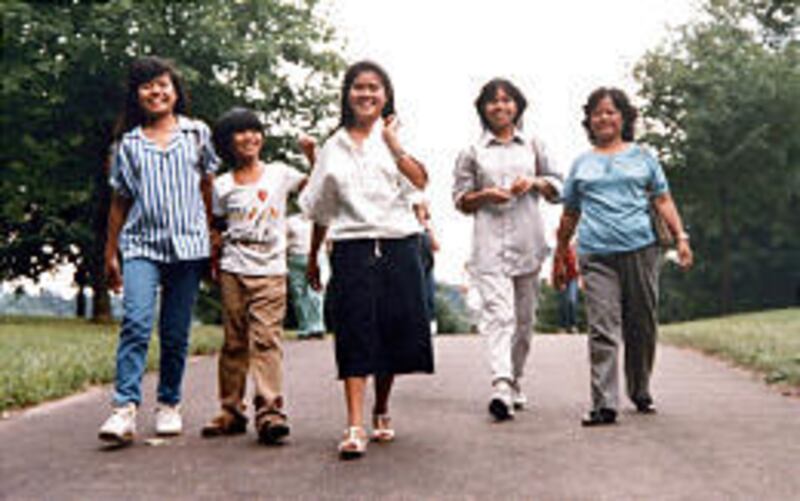
As more refugees began to settle in Connecticut, the Hausens started with Literacy Volunteers of America. About this time, as Mary describes it, two young Laotian brothers came to their house for dinner and ended up staying for seven years.
On learning that the boys' mother and sister were in a closed refugee camp in Thailand, the Hausens began lobbying Thailand and the United States to be allowed to go in and bring the two women out. (If the women were sent back to Laos, they were sure to be killed, just as the boys' father had been.)
In the end, with the help of a Thai mineralogist who was a friend of Don's, the Hausens were allowed into the camp. They interviewed 35 people who lived there and brought their stories out. Soon thereafter, the United States agreed to take 8,000 refugees from the camp, and the mother and sister of the Hausens' houseguests were the first to be released.
As for Marc LeVier, he met Don Hausen at a mining convention. A mutual friend invited them both to dinner and LeVier was in awe of Don's knowledge — and of his kindness. "He just pulled you into his fold," LeVier says.
In the 1980s, Newmont moved some of its operations to Utah. Don was the chief mineralogist. Eventually, LeVier became his boss.
Of course, Mary moved her operations to Utah, as well. At this stage in her life, with children grown, Mary was devoting more and more time to helping new immigrants. Regularly she came to LeVier to ask for Newmont's help in buying a home for a refugee family. Eventually, the family would make the mortgage payments. Meanwhile, the Hausens and other Newmont employees would become their extended family, helping them get settled and learn their way around Salt Lake City.
"When Don and Mary decided they needed to make a difference in someone's life, then they did it," LeVier says. "When Don made up his mind, that was it." And Mary, well, she was just as dogged. Several times LeVier made up his own mind that the company had done enough. Yet whenever Mary came to his office with a proposal, he found himself giving in.
In February the Hausens were given the Gold Medal award. Don was celebrated for being able to extract value from the Earth and, along with his wife of 57 years, he was celebrated for his ability to see and bring forth the value inherent in human beings.
E-mail: susan@desnews.com