

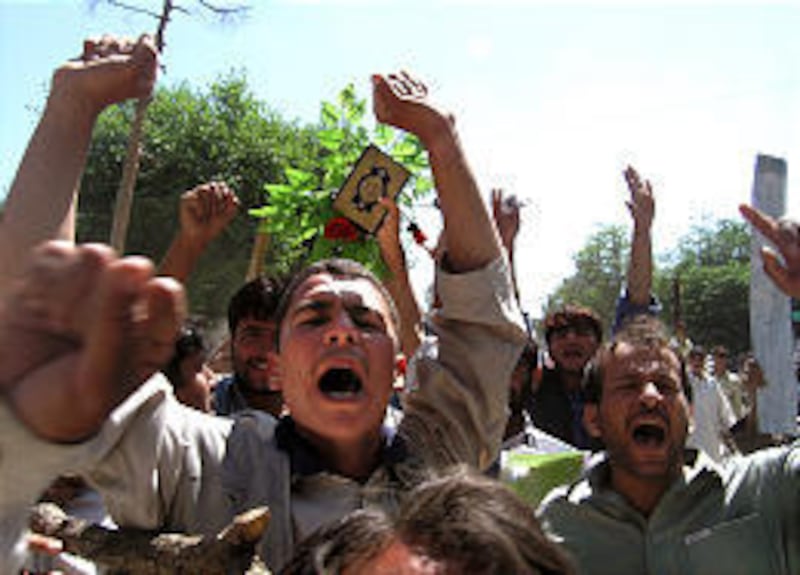
GHAZNI, Afghanistan — The mullah drove back and forth past Del Agha's shop in a taxi Thursday, blaring his message through a megaphone: "Our religion and our Quran have been abused! We should all demonstrate after Friday prayers!"
Agha recalled being skeptical of the May 9 report in Newsweek that the mullah was referring to, which claimed that interrogators at the U.S. military prison in Guantanamo Bay, Cuba, had placed copies of the Quran in bathrooms and flushed one down a toilet.
But the 47-year-old dried-goods seller decided to join the demonstration anyway in this small city in eastern Afghanistan.
"Just as we listen to our religious leaders when they call us to pray in the mosque," Agha explained, "we have to follow them when they make other decisions for us."
Besides, he added, the mullah had said the demonstration should be peaceful. Agha said he never imagined that some of the thousands who converged before the provincial governor's residence Friday would start throwing stones, that one policeman and three civilians would be killed, and that this city would be added to the long list of Afghan towns and cities that have erupted in violent anti-American protests.
On Saturday, Agha was back in his one-room stall, squatting amid burlap sacks as he tried, like Afghans and foreigners across the country, to make sense of what has proved the most serious venting of anti-American sentiment since U.S. troops and Afghan militias ousted the Taliban movement in late 2001.
"Others took advantage of our demonstration," said Agha, who wears his beard long in the style of a conservative Muslim. "Definitely al-Qaida has benefited because this has damaged the trust that we people had in our government."
But Agha was not convinced that the clash with the police was orchestrated by the Taliban or al-Qaida. Rather, he said, it seemed to have been more the result of inexperience by demonstrators and police.
"Both the government and the people are still getting to understand the rights we have under democracy," he said.
A city that sprawls out from under the shadow of an ancient mud-walled fort, Ghazni was once firmly under the control of the Taliban.
The governor of the province, Asadullah Khaled, said he believed the vast of the majority of the crowd on Friday consisted of Ghazni residents who wanted to peacefully express their anger over the alleged desecration of Islam's holy book.
"When I saw them, I went to talk to them to explain that if this happened it was just one stupid American who did this, not the whole government," Khaled said, but about 200 instigators drowned out his words with jeers and began hurling stones. "Taliban and some neighboring countries were behind this."
Khaled said he spent much of Saturday smoothing things over with mullahs whose intentions were originally peaceful and issuing search warrants for those he believes may have had ulterior motives for organizing the protest. "There was one mullah who was saying, 'You should defend your Holy Koran, and even if you lose your life you should be proud of this,"' Khaled said.
Several people interviewed in Ghazni expressed similar dismay at such speeches.
"Everything that is wrong in this country is because of the mullahs," complained Ghulam Dastagir, who sells birds near one of the mosques from which protesters flooded the streets Friday. "They are receiving money from people who don't want Afghanistan to be a peaceful and developed country."
Bismallah, a 50-year-old tailor who, like many Afghans uses only one name, pointed out that citizens of most other Muslim nations did not hold protests about the reported abuse. "We should have waited for proof," he said. "Instead we have presented ourselves to the world as a stupid people."
But Javed Ahmed, a shoe-seller, had the opposite reaction.
"When I first head the news" of the first protests in Afghanistan, in Jalalabad on Tuesday, he said he thought: "'What has happened? Have we Muslims become too weak that others are interfering with our religion?"
On Saturday, police in green uniforms and blue jackets patrolled the streets, strolling past several damaged buildings.
Yet while the buildings seemed to reflect deep-seated anger, even those who said they participated in the protest expressed positive views of the thousands of foreigners living and working in Afghanistan.
Agha, the dried-goods seller, said that he was initially concerned that the start of U.S. military operations in 2001 meant the Americans intended to occupy Afghanistan, then he changed his mind after it became clear that a large contingent of other countries would be sending troops under U.N. auspices.
He said he is grateful for the billions of dollars in aid that foreign donors have pumped into Afghanistan but was disappointed in the amount of development it has bought.
"I thought that after 3 1/2 years we would be much farther ahead," he said.