

SAN JOSE DE CHIQUITOS, Bolivia — In this remote town in eastern Bolivia, an unlikely monument rises majestic above the simple red tile-roofed houses — the lonely survivor of a glorious past.
Little has changed here since the San Jose de Chiquitos temple was built 250 years ago. Hot, quiet and devoid of most modern conveniences, the village looks lost in time, at the end of the world.
But a glimmer of hope is making a difference: Colonial art specialists and architects are working to bring back some of the temple's ancient glory — although at an exasperatingly slow pace.
The name of the town doesn't do the temple justice. "Chiquitos" means small in Spanish, and the structure is magnificent — the first built by the Jesuits as part of a massive evangelization campaign that ensured the freedom of tens of thousands of native Indians who otherwise would have become "encomiendas" — or slaves of the Spanish conquistadors.
But its glory remains almost hidden by its relatively remote location — although the town of San Jose de Chiquitos is accessible by train from the city of Santa Cruz, which has an airport with connections from Bolivia's capital, La Paz.
And it's a pleasure to see the temple after spending hours in a candlelit room at the local posada with no air conditioning — Chiquitos has no electricity between 2 and 7 a.m.
Its brown stone-covered facade and three-story tower rising from the flat horizon, the monument stands on a neat, green plaza like an undiscovered gem, waiting for colonial art lovers and seekers of architectural treasures.
But time, neglect and vandalism have taken a heavy toll. Doors, walls, arches, paintings, statues, altars — all cry for care.
The restoration team, funded by the federal and local government, expects to complete its job in a couple of years.
"The main altar should be ready in a few more months. The rest, perhaps by 2007," said chief architect Marcelo Vargas.
That would be a record pace for the geologically slow restoration, which has dragged on for 20 years.
UNESCO, the United Nations Educational, Scientific and Cultural Organization, declared Chiquitos and six other temples as world cultural heritage sites. That should have entitled the temple for aid from the government and financial institutions — but the restoration team this year only has $15,000, left over from a contribution by an environmental state agency.
The temple is one of 33 "missions" the Jesuits built to protect the Indians. The missions were autonomous, self-sufficient towns in the jungle and prairies over a vast area that today is part of Argentina, Brazil, Paraguay, Uruguay and Bolivia.
Experts say the missions were the first "industrial" settlements in the New World. The Jesuits taught the Guarani Indians handicrafts, sculpture, woodcarving and how to make and play musical instruments. The villages flourished as centers of culture and arts that were rare in the hemisphere.
"They led an anthropological revolution. The natives leapfrogged from the stone age to the zenith of human knowledge of that time," said Elio Montenegro Banegas, a professor at the local Geography and History Center. "Chiquitos was also the only mission with outside walls built in stone. In 75 years, by 1767, the Jesuits built what Chiquitos is still today."
And it's one of the last remaining missions. Many simply disappeared, along with the Guarani groups that succumbed to the invasion of settlers after the Jesuits left.
The Chiquitos temple survived thanks to Chiquitanos, as the people of the town are known. The Chiquitanos did not allow major changes to the temple because, even now, they consider it the symbol of their past.
"Generation after generation, they were alert to prevent changes in the look of the church. Priests wanted to change the temple and even reconstruct it. But the population was always against it. Chiquitanos maintained it the best they could," said architect Vargas.
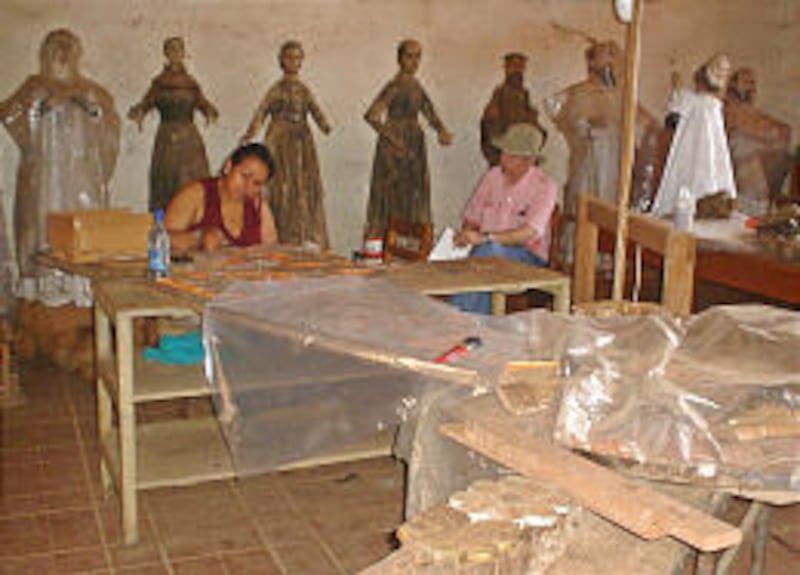
Slowly, patiently, the restoration team labors to undo damage of nature and restore the temple to its former glory. Dozens of pieces of carved wood and painting frames lie strewn in the workshops.
"Humidity always played havoc with the temple," mumbles Lizbeth Cordova, as she patiently plasters mica layers on the carved wooden slab of one of the side altars. "Mica gives the appearance of silver. It was what the metal workers used most to build some of the temple's ornaments."
Other parts of the altar will be covered with layers of 22 karat gold imported from Germany and Spain, she said.
When the Jesuits were expelled by the Spanish king, they submitted a list of 120 paintings of the life and passion of Jesus Christ and silver ornaments weighing some 3,700 pounds, Montenegro said. Most of those riches have disappeared.
But there have been unexpected windfalls. Restoration experts discovered original paintings concealed under a layer of plain wall paint, and the original art eventually will be uncovered and restored.
"Those are well-preserved paintings that can be recovered, and then we will admire their splendor," said Vargas, the chief architect. "The fact that somebody recklessly painted the walls, was a blessing in disguise."