

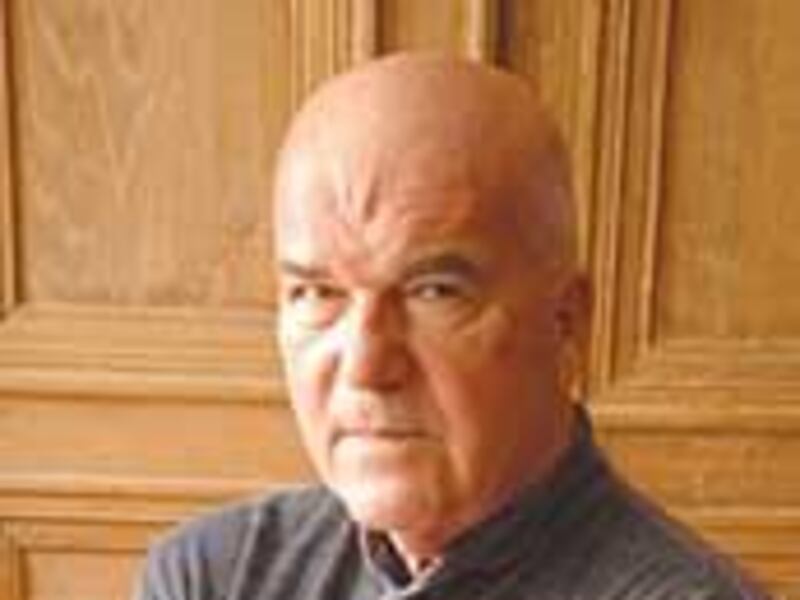
Easily the most mysterious thing about Harry Mathews is that he is not famous. Maybe because he has been an American in Paris for so long.
A Harvard-educated novelist of 75, Matthews grew up on New York's upper east side. He moved to France in 1952. He inherited enough money to allow him to live like a man of leisure and to create suspicion due to his odd comings and goings.
He has written a lot of poetry and several books of criticism — plus 11 charming, unique novels, among them "Cigarettes," "The Conversions," "Singular Pleasures" and "The Sinking of the Odradek Stadium."
His most recent is "My Life in CIA: A Chronicle of 1973," a book that has become very popular among thinkers and poets both in Europe and the United States.
Matthews writes everything with wonderfully understated, playful wit, and seems perfectly satisfied with his understated, playful reputation. He calls "My Life in CIA" an autobiographical novel focusing on the year 1973. It was a year marked by Watergate, the end of the Vietnam War and the coup in Chile.
He wrote it because virtually all of his French friends thought he was a spy. His debonair style leaped out at people, and he seemed always to be involved with exotic women. He also had lots of free time.
But the spy label bothered him. Finally, some Chilean friends proposed that instead of denying he was CIA, why didn't he pretend to be a spy and even do strange things that would confirm the suspicion? The result was Mathews' bizarre year of 1973, in which his comings and goings became even more mysterious — on purpose.
"I was naive enough to take it very personally, whereas sensible people might have just shrugged it off," Mathews said by phone from his Paris home. "In those days, a male abroad from America was always suspected of being an agent. Many people think the book itself is just another cover."
Rather, said Mathews, the book amounts to "a wishful fantasy. I say everything in the book is true and everything in the book is false. That is my 'literary theory.' Everything in the book might have happened, but it is obvious to every reader that some things are rather implausible, and I leave it to the reader to decide what is truth and what is fiction. While autobiographical, it is a novel."
During the course of "My Life in CIA," (allegedly, no real CIA agent ever calls it the CIA), Mathews creates a job for himself. "I had to invent some kind of cover, so I invented this ludicrous, fictitious travel-council agency with a Polish woman as president and I being the only member, thus the responsible party. I was like a talking guide book, not someone who made reservations. Once, I gave a lecture to dyslexic travelers telling them to take only trains whose departure times are the same backward or forward, i.e., 01:10, 12:21, 23:32, etc."
Mathews also belongs to OULIPO, the workshop for Potential Literature, a group founded in 1960 by two Frenchmen with the intention of engaging in literary experimentation. They had both mathematical and poetic talents, "so they tried to determine if and how mathematical structures could be used in literary works. The most conspicuous example is my friend, Georges Perec, who wrote a novel, "La Disparition," without ever using the letter 'e.' "
Matthews' principal interest in this kind of writing is that "it looks as though it is imposing shackles and yet it is very liberating."
At one point in the book Mathews infiltrates a communist organization only to be ejected because he is a member of OULIPO, This angers him, because he thinks the only basis for throwing him out should be because he is a spy. Asked if the book should be taken as tongue-in-cheek, Mathews said, "It is not a hoax in any way. I consider it a serious book, even though many parts of it are very funny."
His first love is writing, and he writes "incessantly, until I get it as perfect as I can. My style is very concentrated and simple — compact. Without the subtleties, I wouldn't be who I am. It's part of the way I think. Not turning up the lights bright when you make a funny point is effective, I think."
Mathews has kept no journal of his life, yet he considers his memory to be vivid about personal things. "But I couldn't remember the movies I saw, for instance, so I did research on what was going on during the year 1973."
Is he really a CIA agent? Would the CIA be distressed that he has written this book — whether he is CIA or not? "I don't think the CIA cares one way or another about me. It would be ironic if they did. The only claims I ever made were attributed by other people or made up by me. I was not CIA at any time. Now I don't care any more what people think. I apply the advice of a friend who said, 'No secret agent can say he is one because then he is not secret and no longer viable.' "
In the meantime, Mathews lives "in Key West, Fla., from November to May, then France the rest of the time — with stopovers in New York. It's a wonderful life. I can't sing the praises of Key West too loudly. It's an extraordinary place in many ways."
What about his alleged exotic adventures with women? "I don't make the contacts I expect with women, or when I do the relationship is never drawn to its ultimate fulfilment — and, after all, the book is dedicated to the woman who has been my wife for the last 30 years (French novelist Marie Chaix)."
Mathews plans to write some more poetry, and more fiction. "I plan to write another fictional account of something. When I imagine the place and time and situation, which has not happened yet. Although it may come to me after I hang up."
E-mail: dennis@desnews.com