

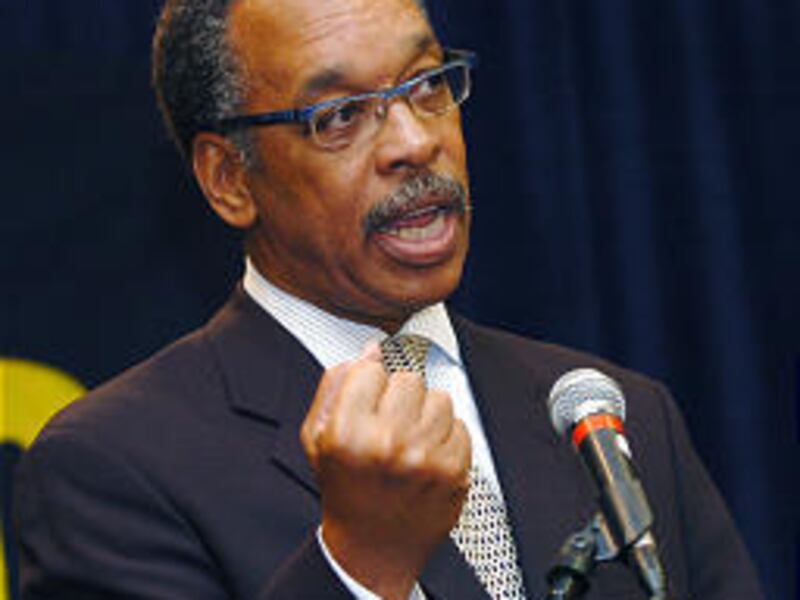
ATLANTA — Turning to a businessman to lead one of the nation's seminal civil rights groups, the NAACP's board of directors announced Saturday that Bruce S. Gordon, a retired Verizon executive, will be its next president.
"Civil rights leaders throughout this country did what they did and died, so my generation has full responsibility to walk in the doors those brave people opened," Gordon said after the board voted. "It's fabulous, exciting, humbling."
Gordon was selected by a large majority of the board to succeed Kweisi Mfume, former U.S. representative and a candidate for Senate in Maryland who resigned abruptly in December. Several months later, a report surfaced that his personal relationships with NAACP staffers had contributed to widespread mismanagement at national headquarters in Baltimore. One staff member threatened to sue.
Jeanetta Williams, president of the Salt Lake City branch of the National Association for the Advancement of Colored People, said Gordon's "corporate-oriented" background will spark a focus on discrimination in the workplace.
"One of the things that's going to be coming out of his leadership will be the ability to do greater outreach into the different communities and talk about discrimination and employment and the glass ceiling of minorities," said Williams, who served on the NAACP's board between 1996 and 2002. "We're happy that he's on board and addressing all of those and other civil rights issues."
Williams said another of Gordon's efforts will be to increase the NAACP's membership numbers.
"We are a membership-driven organization," she said. "The NAACP is not only an organization for African Americans. We want people to know that if they are black, white, red or yellow they can be members. We say that the National Association for the Advancement of Colored People comes in all colors."
In Salt Lake City, Williams estimated there are between 600 and 800 members.
Described as a top-notch leader and consensus-builder, Gordon, 59, began his career in 1968 as a management trainee at Bell of Pennsylvania. For 35 years, amid massive upheaval in the telecommunications industry, he helped the company navigate the string of mergers that led it to become Verizon Communications Inc. When he retired in December 2003, he was chief of Verizon's biggest division — retail markets.
Gordon's corporate background "means that he is accustomed to working within a system in which merit and achievement count the most," Julian Bond, chairman of the group's board of directors, said in an interview. "That was attractive to us. Not to say that the NAACP didn't have that. But with every step we've taken . . . we wanted to move up. And we think he's going to bring us a quantitative move up."
Gordon said his first priorities will be to improve the organization's finances — its expenses have exceeded its income for the last two years, tax documents show — by working to build an endowment, increasing membership and pushing for more efficiency in operations.
His civil rights goals include working toward greater economic equality, he said.
"People of color need to change and balance the trade deficit that exists between people of color and the rest of society," Gordon said.
He also said he was looking forward to building a stronger relationship with the Bush administration.
"I believe there has to be some common ground that can be established between the White House and the NAACP that serves the mutual interests of both of those parties," he said. "So I expect going forward to find a way to forge that relationship."
Relations between the NAACP and Bush administration have been strained. Bond has condemned the administration's policies on education, the economy and the war in Iraq and urged high black voter turnout to defeat Bush for re-election last year. And Mfume once described Bush's black supporters as "ventriloquists' dummies."
Contributing: Aaron Falk