

AMSTERDAM, Netherlands — Before he put paint to canvas, Vincent van Gogh worked with pencil and ink, training himself in perspective, composition and the human form.
Now known for the vibrant colors of his paintings, Van Gogh continued sketching throughout his brief career, producing masterpieces of draughtsmanship that rank among his great works.
The Van Gogh Museum now has more than 100 of the artist's 1,200 surviving drawings on exhibition, showing the development of his craftsmanship from 1880 over 10 years of work.
"For the first three years he hardly did any painting," curator Sjraar van Heugten said. "Most of these drawings were simply for himself. They were experiments in perspective and trying his hand at anatomy. He practiced a lot. He was totally self-taught."
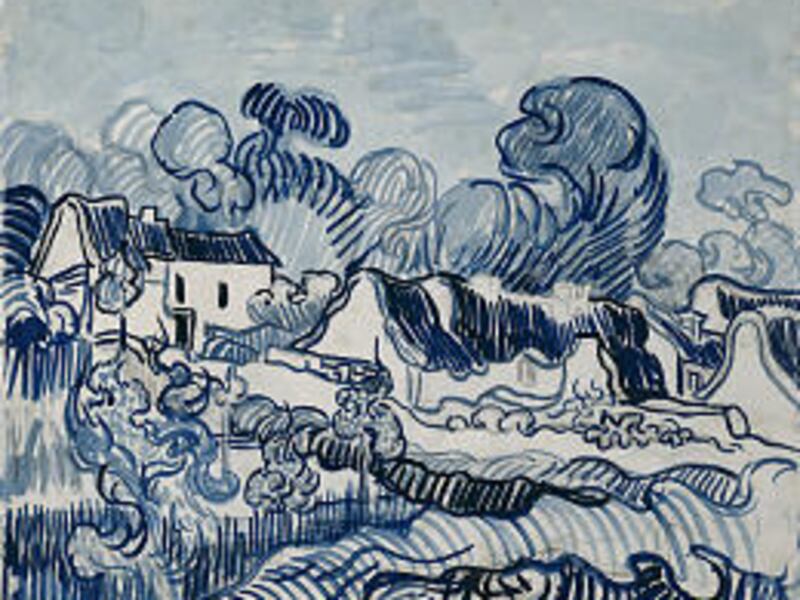
Arranged chronologically, the early black-and-white studies of figures and landscapes evolve over the years into his now familiar impressionist style, with a rhythm of short, rapid strokes, swirls or jabs of a reed pen.
The exhibit draws on more than 50 museums and private collections, showing works that are rarely seen in public because of their sensitivity to light. It includes the only four sketchbooks that remain from the dozens Van Gogh used like notebooks to jot down ideas.
The exhibit stays in Amsterdam until Sept. 18, when it moves to the Metropolitan Museum of Art in New York.
Van Gogh, who decided at age 27 to become an artist, moved back and forth between paint and pen, abandoning one or the other for weeks or months before returning to it. He would learn from each medium and apply it to the other.
"His drawings were equally important to him. He put a lot of effort into them," van Heugten said.
He liked to use damp paper for his work with pencils, black crayon and ink, and the wrinkles are still evident.
On one drawing of a man sitting on a straight-backed wooden chair, slumped with his elbows on his knees and holding his fists to his eyes, Van Gogh poured milk over the paper to soften the texture.
He had a natural talent for landscape, but he struggled with people, van Heugten said.
Van Gogh made a lithograph of his painting "The Potato Eaters," which was panned by his friends for being flat, stiff and emotionless. Though outraged at the criticism, the next drawings show him trying to bring more life to his figures.
Often he would use the same theme for a painting and a drawing. The museum brought one of its most well-known paintings, "The Harvest," from its standing collection to show side-by-side with an elaborate sketch of the same scene, followed by a simple sketch that he mailed to friends to show them what he was working on.
The final drawings in the exhibition, using variations of blue, show no signs of despair or depression. Van Gogh suffered from what is now believed to be a form of epilepsy and was despondent over his continued dependency on his brother. He shot himself on July 27, 1890, and died two days later.