

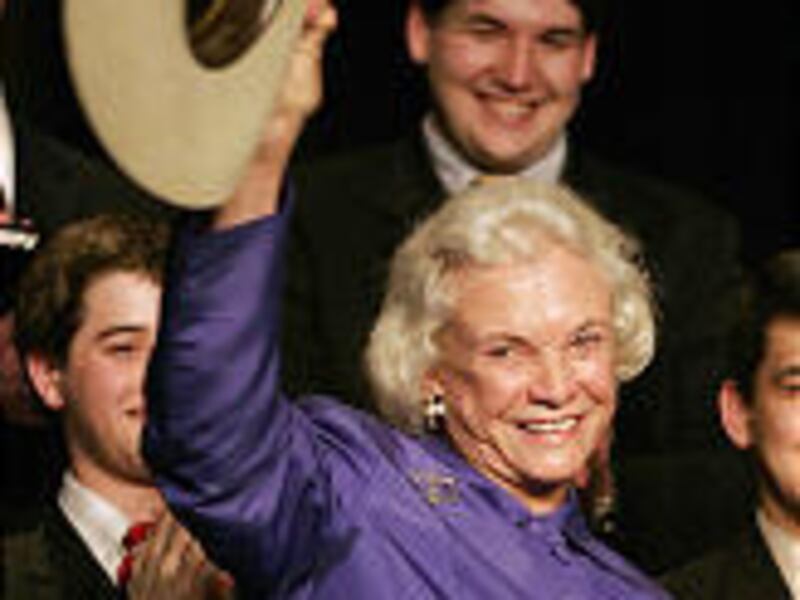
WASHINGTON — Long before she arrived in 1981 as the first woman ever to serve in the august chambers of the Supreme Court, she had learned to ride horses, had plinked bottles with a .22-caliber rifle and had tended sick cows on her father's ranch in the rough-and-tumble Arizona desert. She had been an Army lawyer in Germany, launched her own law firm in an Arizona strip mall and served in that state's legislature.
Chosen by President Reagan as his first appointment to the court, Sandra Day O'Connor was seen as the shining hope of the nation's newly resurgent conservatives, who counted on her to end 40 years of judicial activism by liberal justices.
But it was neither gender nor conservative ideology that turned out to shape the pivotal role O'Connor played in nearly a quarter century on the Supreme Court. What did that was her life.
"Each of us brings to our job, whatever it is, our lifetime of experience and our values," she once said.
And as she resigned unexpectedly Friday, both her record and interviews with friends and professional associates made clear that it was O'Connor's life experiences before she got to Washington that produced her pragmatic, common-sense approach to even the most abstruse or politically charged issue.
"What distinguishes her and is the mark of a great judge is that she is both dispassionate and compassionate," said Stanley Panikowski, who clerked for her in 2000 and 2001 and is now with the law firm of Piper Rudnick Gray and Cary.
How O'Connor looked at the world was reflected in the emphasis she put on family, which she extended to include even the children of her law clerks, whom she often referred to as her "grandclerks." Indeed, many who know her said her resignation was linked to the ill health of her husband, John O'Connor.
"They share the kind of charisma, spark and love of adventure," Panikowski said. "It's clear that as passionate as she is about the law, the family is the greatest passion."
Life on the Lazy B
O'Connor started out life on a parched stretch of land along the Arizona-New Mexico border that her grandfather had named the Lazy B Ranch, "lazy" being branding-iron parlance for a "B" lying on its side.
The ranch, 250-square-miles that abutted the Gila River, was so remote that O'Connor has likened it to living in a whole separate country. The Episcopal church the family belonged to was a three-hour round trip away, and the journey was not made often, she confessed in an autobiographical memoir, "Lazy B." The family did, however, make weekly pilgrimages to the town of Duncan, Ariz.
For the most part, life was contained in the small universe of home, the prickly expanse of the ranch, the cowboys who helped out, and members of the family.
Her father, Harry, known by the initials DA — taken from the faltering attempts of O'Connor's younger sister to spell "Daddy" — was an old-fashioned patriarch, a patient but exacting renaissance rancher who had taught himself to build a house and repair everything from a run-down car to a cow's broken leg.
A staunch conservative who disliked Franklin D. Roosevelt and his New Deal, DA passed on to his children distrust of federal interference in state affairs. He treated O'Connor and her brother and sister like little adults, doled out praise sparingly, and expected them to work hard, whether at school or at the repair of a creaky screen door.
O'Connor's mother, Ada Mae — or "MO" as she was called as a result of another spelling difficulty — was a tiny, energetic woman who married into the harsh ranch life despite her own mother's disapproval. In "Lazy B," O'Connor described her mother making ice cream to counter the withering summer heat.
Though her mother joined fully in the hard work of the ranch, O'Connor remembered her as always seeming well-dressed — and recalled her avidly poring through the latest copies of Vogue, the New Yorker and The Los Angeles Times when they arrived at the Lazy B.
Beyond the careful order of home, the ranch taught self-reliance and pragmatism. The harsh terrain was riddled with rattlesnakes and scorpions. O'Connor learned to solve problems with the tools at hand, as help was often far off.
Riding the ranch with her father and his crew of leathery, hard-drinking cowboys gave O'Connor a familiarity with a man's world that few young women in the 1940s experienced.
Stanford and beyond
DA and MO sent O'Connor to school in El Paso, Texas, where she lived with her maternal grandparents. While she said she missed the ranch terribly, she did well enough to enter Stanford University at age 16. From there, she went to Stanford's law school, where she met William H. Rehnquist, who finished first in her graduating class. She also met her husband there, when they were asked to edit a Law Review article together.
That led to 40 consecutive dates and an invitation for John to visit the ranch.
John and Sandra were married in December 1952.
O'Connor had graduated from law school the previous June. Though she finished third in her class, she had trouble finding a job, which she attributed to gender, and filled in working without pay as a deputy county attorney in San Mateo, Calif., until a paying job came open.
Meantime, John was drafted and eventually sent to Germany. She went, too, and landed a job lawyering for the military.
Return to Arizona
Afterward, the couple settled in Arizona, where they began practicing law and getting involved in Republican politics. O'Connor set up private practice in a strip mall for a few years, then took a five-year hiatus to be a stay-at-home mother for their three boys.
She went to work as an assistant state attorney general and soon afterward was appointed to the state Senate. The following year, in 1970, she won the seat in her own right and went on to become the first female state majority leader in the country.
She was serving on the Arizona state court of appeals when Reagan nominated her for the Supreme Court.
At the court, the then 51-year-old O'Connor distinguished herself by her relative youth and energy, as well as her warmth.
"We'd run into her in the halls. We had lunch with her. She was more friendly than some of them," says Pamela Karlan, a Stanford law professor who clerked for Justice Harry Blackmun. "She's a genuinely very outgoing person. You can see why she was a successful politician before she was a judge."
The taste for the strenuous life that began with the Lazy B extended to Washington and even to the court. O'Connor has been a scratch golfer and an avid tennis player. For at least the past 20 years, she has reserved the last week of July for vacation with seven women friends from Arizona, "The Mobile Party Unit" — get-togethers that started with three sets of tennis in the morning, often followed by golf or long rides on horseback in the afternoon.
Contributing: Times staff writers Steven Bodzin, Joel Havemann and Warren Vieth