

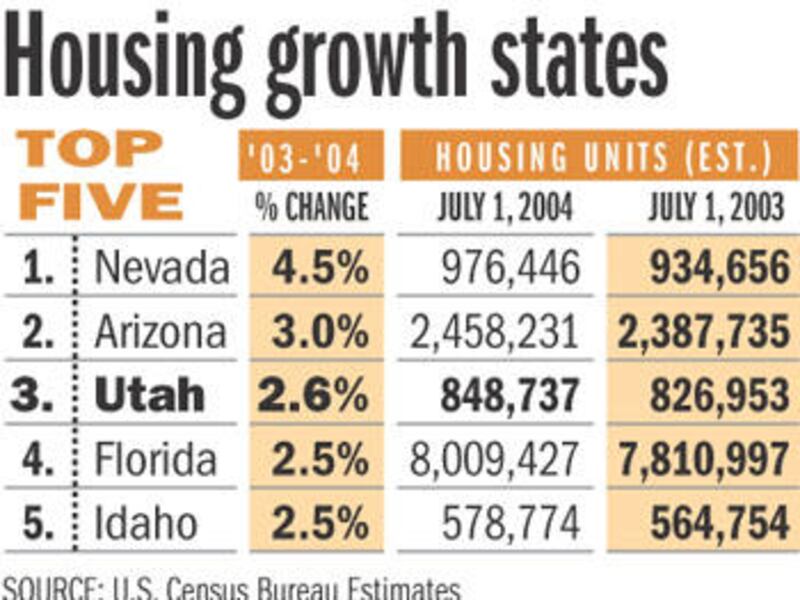
Utah's estimated one-year housing growth of 2.6 percent outpaced nearly every other state, according to new estimates released today by the U.S. Census Bureau.
Only two states, Nevada and Arizona, grew at a faster pace than Utah, according to the estimates that cover housing unit growth from July 1, 2003, to July 1, 2004.
Utah gained an estimated 21,784 housing units from July 1, 2003, to July 1, 2004, growing from 826,953 to 848,737, according to the census report.
Washington County, meanwhile, was ranked 16th nationally, adding an estimated 2,639 housing units. The county's housing grew by about 6.2 percent to an estimated 44,909 units on July 1, 2004.
Utah's ranking is "a little surprising," said Robert Spendlove, manager of demographic and economic analysis for the Governor's Office of Planning and Budget.
"Our population growth, according to the Census Bureau, is not third," Spendlove said. Utah's population grew 1.6 percent for the same period — a rank of seventh in the nation.
Spendlove said the census estimates indicate that Utah has strong growth in secondary housing, such as condos or cabins.
The new data are consistent with several other areas of Utah's economy, Spendlove said.
The value of total permit-authorized construction in the state hit an all-time high of $4.9 billion in 2004, up 6.3 percent over the prior year, he said. Of that, residential construction comprised $3.4 billion — also a record high.
And from June 2004 to 2005, construction employment rose by 9.1 percent, adding 6,900 jobs to Utah's economy, Spendlove said. Overall, construction accounts for about 7 percent of Utah's economy, he said.
Chris Hart, president of the Homebuilders Association of Utah, said he's seeing "explosive growth," in southern Utah, which he says is driven by low interest rates and a large retirement population.
Realtors in the area are busy, to be sure, but so are construction crews.
"We've got half a dozen major developments either already moving dirt or in the process of being platted," said Vardell Curtis, Washington County Board of Realtors. "Resales are extremely strong, but so is new construction."
This "double-edged sword," as Curtis called the current level of growth, means more than good paychecks for those who work with real estate. It also means the cost of housing and the land it stands on is getting very pricey.
Curtis worries that California cash buyers may be artificially inflating the housing market, which could create a housing bubble.
"But let's don't discount greed in all of this," he added. "Some people are selling for more than their asking price."
Washington County Economic Development Director Scott Hirschi, who works to attract new businesses to southwest Utah, said he believes Washington County's growth is more likely a boom, not a bubble.
"The 6.2 percent in housing starts is, ironically, the same as the average population growth rate that Washington County has experienced for the last 35 years," said Hirschi. "Consistency is good since it makes it easier to plan and prepare, but it would be better if we were in the 2 to 3 percent range. The higher percentage of growth is more difficult to manage."
Hirschi cautioned that the current rate of growth has its negative side effects including less affordable housing for a growing work force. He also predicted that housing starts for the same period this year will be even higher, "probably in the 7 1/2 to 8 percent range."
"It's not a good thing, in my opinion," he said. "We'd be better off if we were slowing down a little bit."
Utah was one of four Western states among the nation's top five growth states.
Nevada added an estimated 41,790 housing units, a growth rate of 4.5 percent; and Arizona grew by 3 percent to an estimated 70,496. Florida and Idaho ranked fourth and fifth, respectively, each with 2.5 percent growth.
"The West has traditionally been a place with more land, areas to build," Spendlove said, noting that real estate remains relatively less expensive than some other markets such as Southern California.
"In Nevada housing and real estate prices are going up dramatically, but they're still seeing strong housing and population growth," Spendlove said.
While many of the 10 fastest-growing counties were in the Southeast, Madison County, Idaho, ranked second in growth. Loudoun, Va., and Pinal, Ariz., also made the top 10.
The biggest numerical gainers were Maricopa County, which includes Phoenix, Ariz., and gained 45,000 homes. It was followed by Harris, Texas, which gained 38,000 units, and Clark County, Nev., which gained 35,000 units, for a growth rate of 5.5 percent.
The estimates are based on Census 2000 counts carried forward by administrative records such as building permits. Housing units can be single-family units such as houses or multifamily units such as duplexes or apartments. Group quarters, such as dormitories, prisons and nursing homes, aren't included.