

An ethereal, surreal experience.
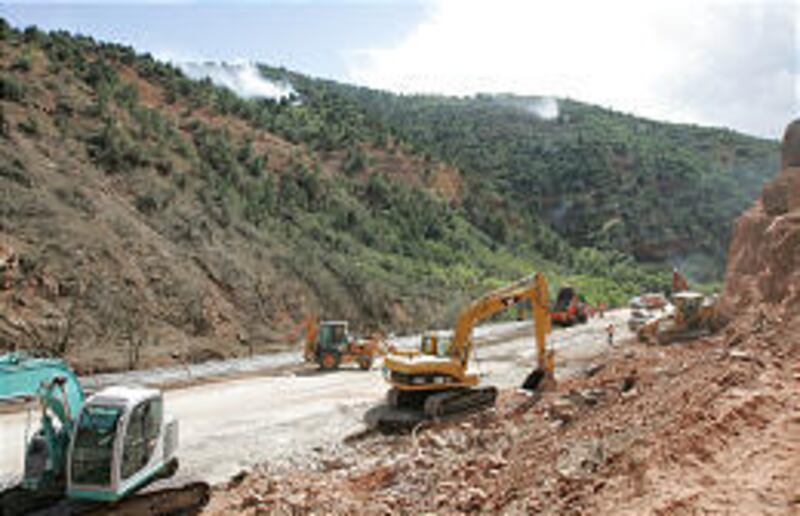
That's how some of the victims from Wednesday's explosion in Spanish Fork Canyon described it after high end explosives blasted a 70-foot-wide, 30-foot-deep crater in the ground.
J.D. Herbert said the shock wave "consumed my entire body."
Troy Lysfjord, who was about 75 yards away, called the tingling but forceful sensation "impressive."
Dr. Charles Wight at the University of Utah's Center for Simulation of Accidental Fires and Explosions says while the victims all lived to tell about their experiences, the internal vibrations described by someone like Lysfjord probably involved a thin line between life and death.
The U. center takes data from accidents and laboratory experiments and produces computer models of fires and explosions.
"The pressure generated (from a blast like this) may be 240,000 times the atmospheric pressure," Wight said. "It's a much more violent event."
Lysfjord may feel especially uncomfortable today, knowing he and a few others may have been standing on a very precarious threshold as that shock wave passed through their bodies. Humans, who are very fragile, can tolerate only a fairly low overpressure or shock wave, Wight said.
"What those shock waves tend to do is disrupt their internal organs — and that's the way people normally die in detonation accidents," Wight said. Since industry specs say the safe distance for those caught in Spanish Fork Canyon Wednesday should have been at least 2,500 feet, victims 70 to 75 feet away may have survived only by sheer luck.
"The blast dug a hole, and so a lot of that energy went up instead of out along the surface of the road," Wight said.
"This is a very stable, but highly flammable explosive," said Lt. Ken Peay of Utah Highway Patrol, which is investigating the accident.
The blast was so powerful that Utah Department of Transportation workers found the semi's steering wheel and chunks of asphalt 200 yards away.
The remainder of the semi was twisted into flaming shards that rained down on the area around the blast zone and started about 200 small fires.
Nile Easton, a spokesman for UDOT, said the blast "obliterated" 12 concrete barriers on the side of the highway.
"We can't find anything left from those barriers," he said. "They weigh 1,500 pounds each and they're reinforced with steel. A semi can hit these at full speed and they won't budge."
Some experts say the 35,500 pounds of explosives in Spanish Fork Canyon contained almost eight times the blasting power of the 1995 bombing in Oklahoma City.
Peay said the cost of the repairs, which also affected a fiber-optic cable owned by CentraCom and a stretch of Union Pacific railroad, would likely come out of the insurance policy of R&R Trucking, which owned the truck. A spokesman for R&R could not be reached.
Contributing: Sara Israelsen, Laura Hancock
E-mail: jtwitchell@desnews.com