

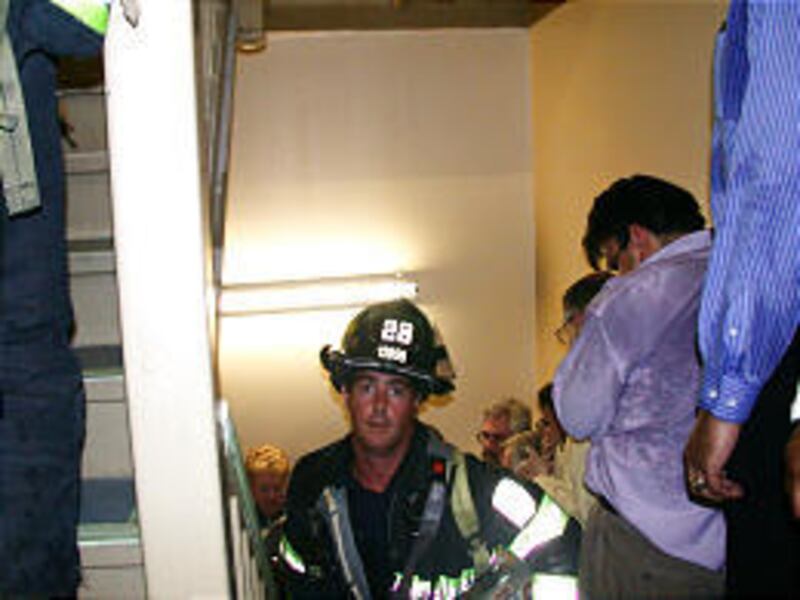
NEW YORK — They were trudging up the stairs of the north tower, weighed down with gear and pausing every four floors to catch their breath. They had no idea the south tower had been hit.
"It was single file, civilians going down and firemen going up," firefighter Marcel Claes recalled. "The civilians were orderly and blessing us and helping the injured down."
At the 35th floor, on his knees and talking with other firefighters about how best to get equipment up the tower, Claes and his brethren felt a rumble — like an earthquake or a train going through your living room, he said.
It was then, as the south tower of the World Trade Center was collapsing in a giant cloud of rubble, that he heard the voice of a chief from another battalion: "Drop everything, and get out."
The story was just one that emerged Friday as the Fire Department released 12,000 pages of oral histories recorded by firefighters who responded to the trade center attack and lost 343 of their brethren. It is the most detailed portrait yet of the horror and chaos of Sept. 11, 2001.
There were stories of firefighters' dramatic attempts to rescue civilians, of their decisions to evacuate on orders or their decisions to stay in the towers, of their sheer terror when the towers fell.
And they came in chilling detail. Firefighter Maureen McArdle-Schulman recalled hearing someone yell before the collapses that something was falling from the towers. She said she thought it might have been desks.
When she realized it was bodies — people jumping from the towers — she said she felt like she was intruding on a sacrament.
"They were choosing to die, and I was watching them and shouldn't have been," she said. "So me and another guy turned away and looked at a wall, and we could still hear them hit."
Some firefighters spoke of sharing a cell phone to call their wives and say goodbye — or of saying goodbye to each other. Timothy Brown recalled saying to fellow firefighter Terry Hatton, "I love you, brother. It might be the last time I see you."
At many points in their oral histories, firefighters were interrupted by the interviewers and asked to diagram or pinpoint on a map where they responded, and, in some cases, where they last saw members who were lost in the attack. The interviews began in early October 2001, weeks after the attack, when many victims were still listed as simply missing.
The oral histories were made public along with hours of Fire Department radio transmissions, their release compelled by a lawsuit filed three years ago by The New York Times and long contested by the city.
Some of the material had been released before, and the records released Friday were unlikely to fundamentally change the understanding of the attacks that day.
Still, the histories offered a poignant catalog of what the firefighters there experienced, and the radio transmissions added new texture to the historical record, beginning at 8:46 a.m. with an urgent but calm description of a plane crashing into the World Trade Center.
"The World Trade Center tower Number One is on fire!" one firefighter radioed.
As the depth of the crisis became clear, the voices on the radios thickened with panic.
"Send every available ambulance, everything you got to the World Trade Center," a firefighter calls from Engine 1. "Now!"
The firefighters became national icons, hailed as heroes for rushing into the burning towers as others scrambled to get out. But the transcripts also reveal their fear.
Lt. Brian Becker described exhausted firefighters lying on the floor with their masks off about 30 stories up when they were startled by a loud explosion. They thought their tower was collapsing.
"Looking up, guys were diving into the stairway, and then it was like — everybody was very scared by then. I'm talking the firemen, and then we were very worried about what was going on. We didn't know, but apparently that was the other building falling."
Family members of lost firefighters pored over the records Friday, some tearing up at descriptions and sounds of the attack and the response. At an office building in midtown Manhattan, a half-dozen family members and two fire officers bent over laptops to examine the material.
"It's very emotional. It's very difficult," said Sally Regenhard, mother of 28-year-old Christian Regenhard, who died along with most of his company's firefighters. "But it's no harder than knowing every day that my son is gone."
A group of victims' families who have become advocates for reforming building codes and emergency response hoped the records would challenge the notion that many firefighters in the north tower heard, but chose to ignore, an evacuation order issued after the south tower collapsed.
Some city officials, including former Mayor Rudolph Giuliani, have suggested some firefighters ignored the mayday call in acts of heroism. But the group of families has sought to lay blame on the city, saying it gave firefighters faulty radios.
Thomas Piambino said he never heard any radio communication telling him to get out of the tower — "absolutely nothing," he recalled. He and others near him left before the tower fell, but he said he wasn't sure why.
"I can't pinpoint anything," he said. "It was just — I don't know what it was. It was just the culmination of intuition or what. I just decided it was time to go."
Lt. Warren Smith recalled leading other firefighters up the north tower to the 31st floor when they received an order to evacuate. The building came down about a minute after he was outside.
He later tried to radio missing colleagues. The communications systems were working better, he said.
"At this point, the radio was pretty open because there weren't a lot of survivors, really," he said.
In many cases, the difference between living and dying was a matter of turning left when another firefighter went right, or stopping to go back and retrieve a piece of forgotten equipment.
"All these things contributed, I think, to our survival," Becker said. "Every little, every second made a difference."
The New York Times and families of Sept. 11 victims sued the city in 2002 to release the records, which were collected by the Fire Department in the days after the collapse of the twin towers.
The city withheld them, claiming the release would violate firefighters' privacy and jeopardize the prosecution of Zacarias Moussaoui, who ultimately pleaded guilty to conspiring with the Sept. 11 hijackers.
In March, the state's highest court ordered the city to release the oral histories and radio transmissions but said the city could edit out potentially painful and embarrassing portions.
The Fire Department, in a statement, said it hoped the release of the records would not cause firefighters and their families additional pain.
"The Department believes that the materials being released today . . . will serve to further confirm the bravery and courage of our members who responded to the World Trade Center," the statement said.
Contributing: Erin McClam, Frank Eltman, Tom Hays, Verena Dobnik, Jennifer Bogar.