
"Parley P. Pratt's Great Escape" is not your normal Mormon musical, according to Pam Blackwell.
When most people think of LDS Church history — especially those periods when Joseph Smith and other church leaders were in jail — they don't normally associate it with popular music. But Blackwell has managed to employ it in telling the story of Parley P. Pratt's imprisonment during 1838-39.
"I decided I wanted Gladys Knight meets Sting," Blackwell said. "That was my musical sound."
The playwright, lyricist and producer of the play, Blackwell said she has also brought in the musical styles of Broadway, 1960s protest songs and even a cha-cha. "It has its somber overtones, but I couldn't stand to do another somber, sad church history tale, partly because Parley Pratt had a great sense of humor and was always buoyant and upbeat and ebullient."
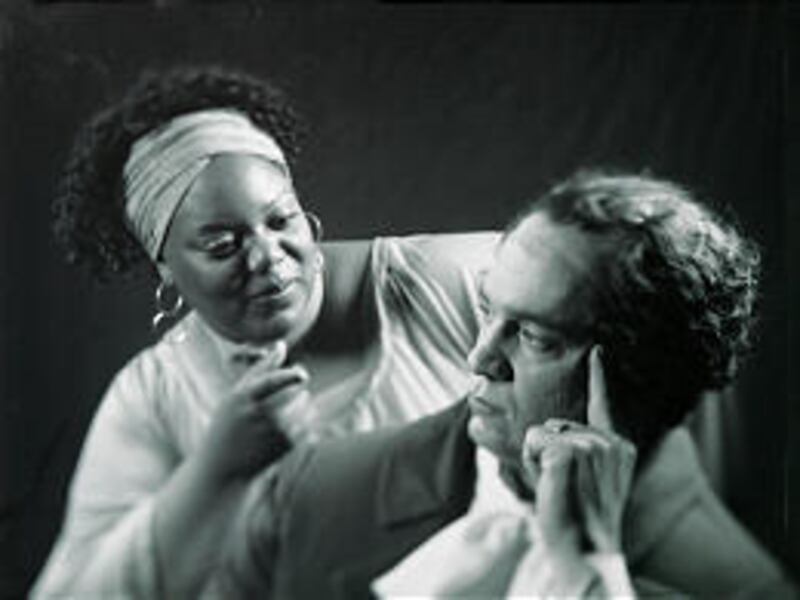
The story is faithfully told from Pratt's autobiography, but Blackwell said she has added a muse, or "a black gospel singer, Sister Soul," to assist Pratt in digging deep down into his own soul during his imprisonment.
On the surface, the title refers to Pratt's escape from prison. But Blackwell said it has other levels. "Parley's famous for this bulldog story, and people who know Parley Pratt know the bulldog story. It's about how he outwitted a bulldog."
Beyond the two physical escapes, Blackwell said the title also refers to Pratt's escape from the outer, physical world to the spiritual realm of deep soul-searching — something that Joseph Smith said is what happened when he was incarcerated in Liberty Jail.
The play, Blackwell said, is mostly dialogue, with 13 original songs scattered throughout. And while she likes the play, it's the songs that she feels are most compelling. "Unlike most musicals, where there are two or three songs that people kind of go away remembering, everybody who has come to see it and has listened to the CD has said that there are any number of stand-alone songs in this piece.
Blackwell said she approached Kelly Eisenhour, who used to sing backup with Gladys Knight, to write the gospel music, and John Fluker, Knight's current pianist/backup singer, to do some writing, too. "It's as close to Gladys as I could get. I couldn't be more happy. And it's authentic, it really is."
Brett Raymond — the artist Blackwell felt most nearly approached Sting — wrote three songs, and the '60s protest song was written by Randy Gillespie, who actually wrote protest songs in the '60s.
Two of the songs that Blackwell feels are particularly memorable are "Joseph Take Me With You," which is Pratt's testimony about Joseph Smith, and "Thy Healing Hands," which is about a blessing of healing that Pratt was given. "There are some really moving, uplifting songs that are 'testimony-building songs."
Blackwell is also excited about the lead performers in the musical. Randy Porter, who plays Pratt, "has a great gravelly kind of voice and has a range that's probably twice what Sting has. He is a wonderful, kinetic performer, and he makes a perfect Parley because Parley was always this sort of ebullient, 'up' kind of guy."
And Angela Winston, who sings the part of Sister Soul, is perfect for her role, according to Blackwell, adding that even though Winston has never acted before, she fits so well that the lines are already in character for her.
When all the pieces are put together, Blackwell said, the play is "a joyful, soulful celebration of one believing man, Parley P. Pratt."
If you go . . .
What: "Parley P. Pratt's Great Escape"
When: Tuesday-Friday, 8 p.m.
Where: DeJong Concert Hall, Brigham Young University, Provo
How much: $9
Web: www.parleysgreatescape.com
E-mail: rcline@desnews.com