


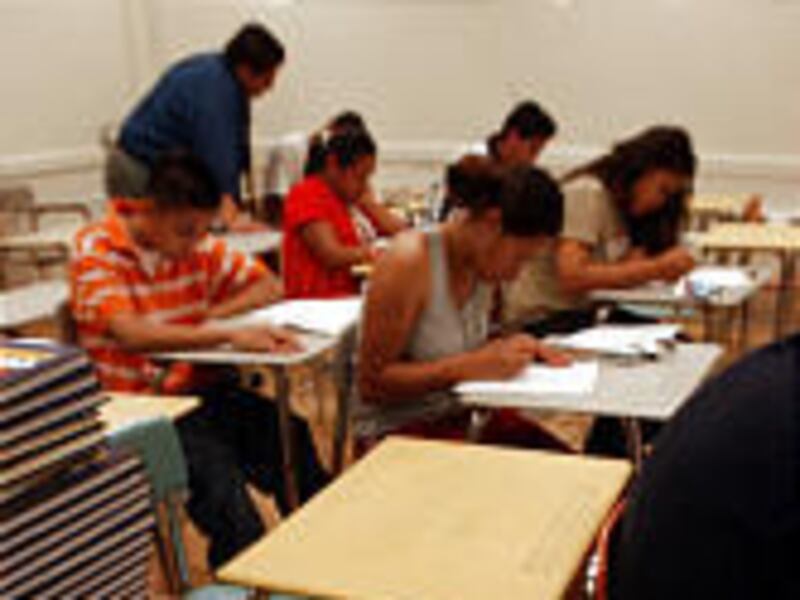
Thousands of high school seniors are at risk of not receiving a basic diploma at graduation, but few are taking summer classes to prepare for the Utah Basic Skills Competency Test.
That worries school officials, who say they have done all they can — some are going door to door — to entice students to class. Some believe the urgency will set in when school starts.
"I think sometimes students look at it in the sense that, 'I have four more times to take it,' ' said Steven Hirase, Murray District assistant superintendent who oversees curriculum. "I just think . . . the students that are seniors this year know they've only got two more opportunities to take it. It's definitely crunch time for them."
But at least one Utah senior has stopped banking on summer remediation at her school. It's not due to lax attitude, her dad says, but emotional crises caused by what he calls an unfair test.
The UBSCT is Utah's only high-stakes test. By law, students must pass its reading, writing and math portions in order to get a regular high school diploma. Otherwise, they might get an alternative diploma or certificate of completion.
The test aims to give the diploma more credibility and indicate schools are churning out students skilled enough for the workforce.
State education chiefs, who have no foolproof way to track test scores over time (student IDs are coming in the fall, they say), report 3 percent of some 35,700 incoming seniors still haven't passed UBSCT's reading test. Another 17 percent haven't passed math, and 10 percent haven't passed writing after three chances to take the tests.
A Deseret Morning News examination, however, found the numbers of seniors needing help could be closer to 10 percent in reading, 26 percent in math and 17 percent in writing — or greater.
That doesn't count the junior class, where 7 to 8 percent of students never took the test, and 11 percent of those who did failed reading, 28 percent failed math and 22 percent failed writing last spring, according to the state.
Thousands of students need to hone skills measured by the test. But the Legislature filled none of the state school board's $6 million request to help them.
State Superintendent of Public Instruction Patti Harrington, in a spring e-mail, urged school leaders to tailor next fall's course offerings to help students pass the test. She urged school community councils to focus attention and school trust lands funds on student achievement. And she promised to keep lobbying for money.
Districts are working with what they have, shuffling programs and money to offer UBSCT help in the summer, or in day and night classes this fall. Some, including Alpine and Granite, are addressing student deficiencies at the junior high level.
"Our goal would be to spare kids the experience of failure," said Linda Mariotti, Granite assistant superintendent of instructional services.
Earlier this summer, the State Office of Education gave around $100,000 to 10 school districts — Salt Lake, Jordan, Logan, Provo, Murray, Box Elder, Sevier, San Juan, Weber and South Sanpete — for an experimental study to find the best way to help students. Results, to be analyzed by Murray School District, also could show lawmakers the impact that remediation funding would have in school districts, state curriculum and instruction director Brett Moulding said.
"This is not just a process to get more kids passing the UBSCT in these 10 districts," Moulding said. "We want to explore different strategies, find innovative practices and look at the impacts."
Murray District is investing in a computerized tutoring program at Creekside High, an alternative school. Box Elder has paid top district math and English instructors a little extra to teach remedial courses.
West Jordan High is offering juniors math and reading/writing classes that start in the summer and end the week before the October exam. Students might earn a quarter's worth of credit for their efforts.
Salt Lake District put its $10,000 into UBSCT summer prep classes at West High — the only school in the district where students showed interest.
Julie Brooks, director of West High's remediation program, sent 200 letters to parents of students who need the help. She made home visits, enlisted an interpreter and made follow-up calls, mainly to help parents understand the test's importance.
"Parents were very diligent in getting their kids here once they knew why," Brooks said. "Some just didn't understand that you had to have this to graduate — but once you sit down and explained that to them they realized their kids needed to be here."
Still, just 50 students showed up. And Brooks is piling on perks to keep them in class.
"It's constant tracking — I give them movie passes, bus passes to get here and I even bring them breakfast each morning," she said.
Other districts report one-on-one meetings with students, calling and mailing letters home, with similar results.
Of 300 West Jordan juniors mailed a notice about the summer courses, just 15 showed up for math, said JoDene Arakelian, a math teacher who oversees the efforts. Language arts classes had about the same number of students. Around 185 students showed up to Granite District's help class last June. That's out of 2,151 seniors alone who still have to pass one or more UBSCT sections, the district has reported.
Last year, some Jordan schools canceled UBSCT summer classes for lack of interest.
"We don't force kids into night school or remediation; we encourage it and we offer it," said David Stoddard, executive director of Riverton area schools. "I wish more would take advantage."
With such high stakes, why wouldn't they?
Maybe they're getting help through the Electronic High School. It offers a free UBSCT prep courses at www.ehs.uen.org; 1,043 students have taken it since September 2004, principal Richard Siddoway said.
Or, theorize education leaders: Maybe the teenagers are procrastinating. They think everything will turn out OK. They don't understand the seriousness of the test. Their jobs conflict with summer school times. They've been injured, sick or juggling family emergencies.
But one Utah father says none of those apply to his daughter.
He says the girl, who maintains a 3.6 GPA and is active in school activities, has tried the math test three times. The class offered at her school last year didn't help. She's embarrassed, developed severe test anxiety and questioned whether to keep trying.
"We're at a point where it's easier to pull all her teeth out with no deadening than (make her) take classes with kids who are two or three years younger than her," said the father, who requested anonymity to protect his child.
The girl is getting private tutoring.
Perhaps others will do the same.
But some school bosses hope most find their way into prep classes offered when school starts this fall, both during the day, at night and in the weeks leading up to the test.
West Jordan High seniors don't have much choice: the 100 or so still failing math were automatically enrolled in a help class, Arakelian said.
"We will just keep dreaming up new ideas to meet their needs," Mariotti said. "We do want them to graduate."
E-mail: jtcook@desnews.com, terickson@desnews.com