

BEVERLY HILLS, Calif. — You've never seen Rome like this, although the makers of the HBO series "Rome" want you to know that Rome actually was like this.
"Most Roman dramas, I think, to a degree are historical pastiche," said executive producer/writer Bruno Heller. "They take elements from a lot of different periods so they're not really being specific. We wanted to do this in the same way you would do a show, say, about America today. We have to be very specific about what was going on and not just make it a kind of melange of Americana.
"This is a pre-imperial period. It's Republic. It's about the people of Rome, so it was very important to get the fine detail right so that you felt that you were in a real world and not in a costume drama."
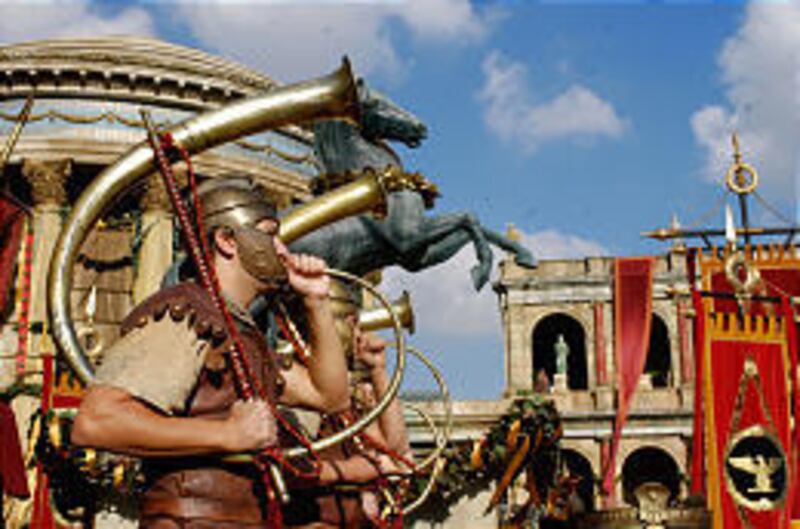
Thus the massive production surrounding the series, which shot from March 2004 through July of this year on the largest standing set in the world — five acres of back lot and six soundstages in Rome — as well as other locations throughout history. With a primary cast of dozens and thousands of extras, "Rome" is on a scale rarely seen on either the large or small screen.
Set in the year 52 B.C., the plot centers on the machinations surrounding Gaius Julius Caesar's return to Rome after eight years away conquering Gaul. And the Rome that we see isn't a city of cool white marble, as is so often portrayed on film — it's a metropolis of a million people that's colorful, dirty, crowded, loud and suffering from a serious chasm between the rich and the poor.
"It was very important to us to get the facts right, but more important the spirit of the times — to be very precise about this moment in history," Heller said. "It was a moment that's pivotal in Western history. If things hadn't turned out the way they did at that particular point, the world that we live in now would be very different."
The internecine warfare is almost incomprehensible as Caesar (Ciaran Hinds), Pompey Magnus (Kenneth Cranham), Atia of the Julii (Polly Walker), Mark Antony (James Purefoy), Marcus Junius Brutus (Tobias Menzies), Servilia of the Junii (Lindsay Duncan), Gaius Octavian (Max Pirkis), Octavia (Kerry Condon), Porcius Cato (Karl Johnson), Marcus Tullius Cicero (David Bamber), Timon (Lee Boardman), Quintus Pompey (Rick Warden) and others plot and connive and back stab and maneuver.
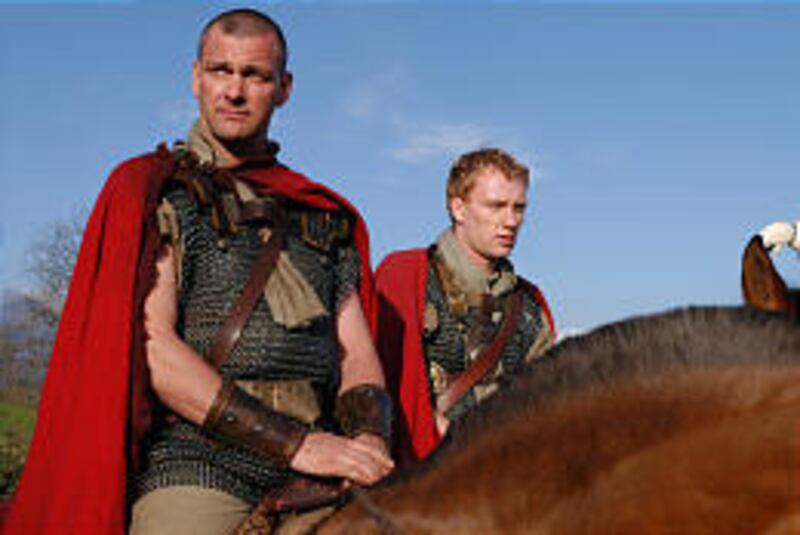
"Rome" is at its best when it focuses on two fictional characters — soldiers Lucius Vorenus (Kevin McKidd) and Titus Pullo (Ray Stevenson), who are thrown together in the premiere when they are ordered to search for Caesar's stolen standard, a gold eagle that's the unifying symbol for his legions.
"From my point of view, it was two people that were thrown together in a friendship in spite of themselves — in one sense flip sides of the same coin," Stevenson said. "Their weaknesses are sort of complemented by the strengths of the other one and vice-versa. They don't accept this. They don't recognize it. But it's the subtext of their relationship."
"They're kind of thrown together by fate, by chance, but somewhere along the line they start to stick," McKidd said.
It isn't altogether successful, but Heller designed the series "so that when you see Caesar, it's through other people's eyes. It's how the people around him see him, because, to a degree, a character like Caesar is always unknowable. Large figures like that — larger-than-life men who were as great as he was — are not as good dramatic characters in a way because he's a thing in itself. He's the center of gravity around which the other characters revolve."
And Vorenus and Pullo are more "average" Romans caught up in the maelstrom.
"Everything that's around them is being turned into quicksand," Stevenson said. "The whole fabric of their lives and the structure of their society is completely mixing around. And, in that, they formed a kind of interdependency."
"These two guys . . . keep finding themselves accidentally at the epicenter of tumultuous events and immense change, so they're kind of clinging to each other," McKidd said. "But, actually, they don't like each other initially."
The world portrayed in "Rome" is exceptionally violent and crude. This is, after all, an HBO production, so it's the TV equivalent of an R-rated movie that includes nudity, sex and barbaric violence. Which, we're assured, is authentic to the times.
"I wouldn't use the word 'accurate' about it, I'd use the world 'authentic' about it," said Jonathan Stamp, who was the historical consultant on the series. "It's not a documentary about what happened. . . . There are places, during the course of the show, where Bruno has deliberately, for a specific, dramatic reason, chosen to tell a slightly different story.
"It's historical fiction, but we have attempted to make the world, the background, the detail of that world as authentic as we possibly can."
If you watch
What: "Rome"
When: Premieres Sunday at 10 p.m. and a new episode will air each Sunday at 10 p.m. through Nov. 13. Beginning Sept. 4, the previous week's episode will repeat Sundays at 9 p.m. — in addition to multiple repeats at multiple times on multiple HBO channels.
Channel: HBO
E-mail: pierce@desnews.com