


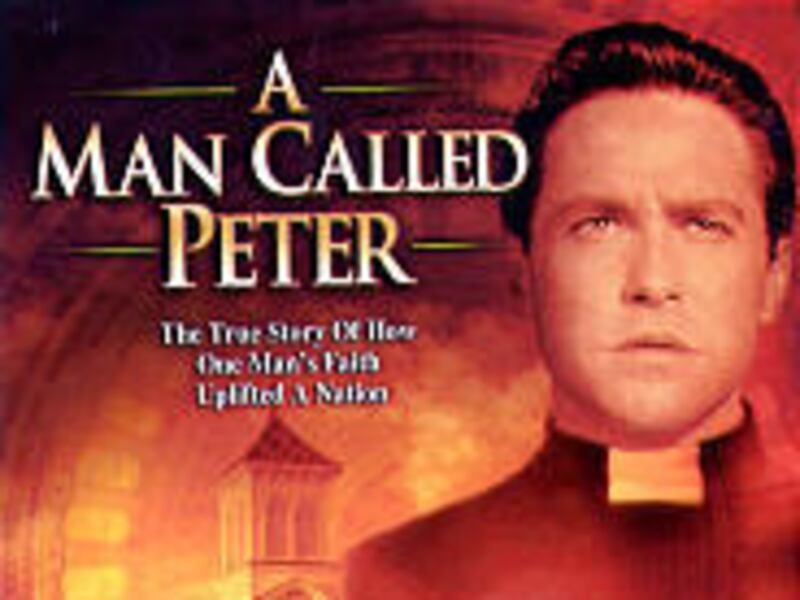
The recent release on DVD of a beloved 50-year-old movie reminds us of a time when no one complained if religion and politics mingled. And when Hollywood embraced stories about people of faith.
"A Man Called Peter" (Fox, 1955, not rated, $14.99) is exciting news for those looking for something out of the ordinary.
During the 1955 April General Conference of The Church of Jesus Christ of Latter-day Saints, then-President David O. McKay stood at the podium and gave an unprecedented invitation:
"All stake presidents, bishops, and their wives are invited to attend a special preview showing of the new motion picture, 'A Man Called Peter,' (the) deeply spiritual story of Dr. Peter Marshall . . . (it) is well-worth seeing and has a message of spirituality most timely for the nation at this time."
Utah moviegoers embraced the film wholeheartedly when it opened at Salt Lake's Capitol Theatre, where it played for five weeks (in an era when a two or three-week first-run was considered successful).
Based on Catherine Marshall's best-selling novel, it is the true story of a Scottish immigrant who chose to serve God as a minister, eventually coming to Washington, D.C., in 1937 as the pastor of the historical New York Avenue Presbyterian Church, the church that Abraham Lincoln had worshipped at.
"For years, the United States Senate was inspired by the prayers and public utterances of its chaplain, Dr. Peter Marshall," wrote Elder Mark E. Peterson in his 1969 book, "The Way to Peace — A Covenant Nation." "He knew the meaning of true Americanism and constantly pointed the way to the ultimate goal of this nation."
Six of Dr. Marshall's senate prayers, offered from 1947-49, are included in the film, and they are as pertinent today as when they were delivered almost 60 years ago. Here are two examples:
"Teach us that freedom may be seen, not as the right to do as we please, but as the opportunity to do what is right."
"Help us, Our Father, to show other nations an America to imitate — an America that loves fair play, honest dealing, straight talk, real freedom and faith in God. Help us to make this God's own country by living like God's own people. Amen."
Remarkably, the decision to include large sections of Peter Marshall's sermons in the film was made by producer Samuel G. Engel who reasoned: "You wouldn't make the (Al) Jolson story without songs and Peter Marshall was first, last, and always a preacher. Preaching was the music of his life." Mr. Engel went on to say, "But, of course, you realize this is daring. It's never been done."
Daring indeed! For some 31 minutes, better than 25 percent of the film's 119 minutes, is comprised of clear thinking, inspiring sermons, delivered with a wonderful Scottish accent by actor Richard Todd as Peter, in a performance that can only be described as "inspired."
"These sermons are things of beauty . . . " was the way that trade paper Variety expressed it.
Even The New York Times reviewer acknowledged that it " . . . is a surprising and extraordinary film. . . . It is asking a lot of an actor to stand up and preach whole sermons — or capsule versions of sermons — and make them sound real and eloquent. . . . (Todd) does it with a clarity and a vibrancy that makes one hang intently on his words."
Todd isn't the only one who gets to sermonize. Early in the film, when Catherine Wood — the future Mrs. Marshall (beautifully played by Jean Peters) — is a senior attending Agnes Scott in Atlanta, she is chosen to speak at a youth rally.
She makes a great impression (not only on the unruly crowd but also on Dr. Marshall) as she talks of what it means to be a "girl." She speaks of the emancipation of women, beginning when the Savior " . . . accorded woman a dignity she had never known before and crowned her with such glory that down through the ages she was revered, protected and loved. . . . " (When the film was released, hundreds of requests poured into the Fox studios from young women all over the world requesting copies of Catherine's youth-rally speech.)
In one of the film's key scenes, Dr. Marshall is invited to speak to the midshipmen at the Navel Academy. At the last moment he is inspired to change his prepared sermon, and he speaks on death and immortality. This sermon includes a true story of Kenneth, a young lad who is dying of an incurable disease and who asks the profound questions weighing on his little heart: "Mother, what is it like to die? Mother, does it hurt?"
The mother's answer to her child is as moving and inspired as Dr. Marshall's decision to speak to the servicemen on such a sobering subject on what turned out to be Pearl Harbor Sunday — Dec. 7, 1941.
"A Man Called Peter" is more then just sermons, however. It is a film full of great joy, the wonderful story of a young woman and a minister finding each other and falling in love, leading to a union that Peter recognizes to be God's "grandest plan." It is the story of a man with great faith in God and the courage to act upon his beliefs.
Shortly after the film opened in New York City at the Roxy Theatre, an advertisement was taken out, which asked: "When did anything like this ever happen in New York before? Every review a rave! Not one word of adverse criticism!" Then followed rave-review excerpts from several major publications.
No one captured the essence of this film better then did Howard Pearson, writing for the Deseret News: "Every once in a while a motion picture comes along that is more than a movie. It is a touching human experience."
Though the film was released on VHS in 1990, this new DVD marks the first time it has been made available in its original widescreen CinemaScope format. And it was for its cinematography that the film was nominated for an Oscar — though Todd's performance and Eleanore Griffin's screenplay should also have been considered.
There is a marvelous bonus feature included on the DVD — a rare audio recording of an Easter sermon given by Dr. Marshall in 1944, which runs almost 26 minutes.
E-mail: VisUnita@msn.com