

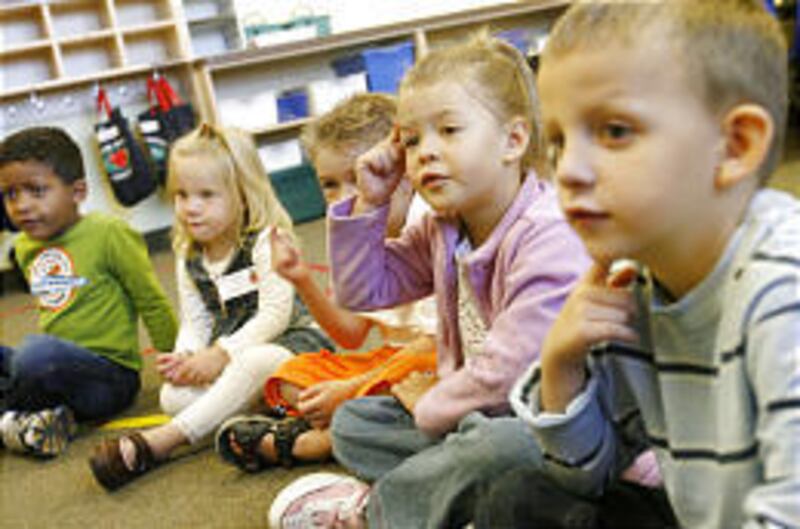

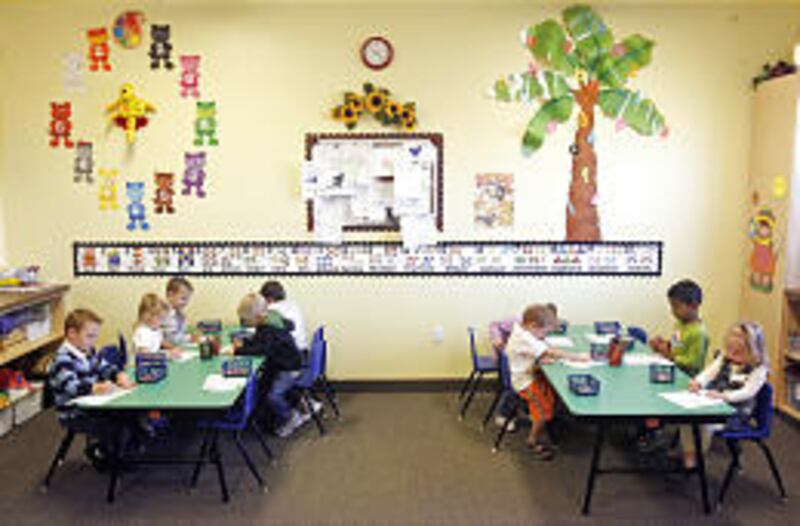
LEHI — Nine 4-year-olds sit in a half-circle, facing their teacher, who leads them in song.
"I know the letter 'h' says 'ha, ha, ha,"' they sing with teacher Whitney Harken, accompanied by a CD.
The preschoolers are learning the alphabet, and by the end of the school year, 98 percent of them will read on a first-grade level, according to research on their curriculum, Frontline Phonics.
Researchers at the University of Oregon and the International Education Institute in Kennewick, Wash., found Frontline Phonics effective in teaching 4-year-old children to read. School districts in almost a dozen states use the curriculum. Parents can order instructional kits at www.frontlinephonics.com.
Frontline Phonics deviates from typical kindergarten reading programs, because children learn early to blend together consonants and vowels: Only three weeks after children begin Frontline Phonics, they begin blending letters m, a, p, s, t. "Typically, in public school, the children will learn a letter a week (in kindergarten)," said Cheryl Lant, who has developed the program with her husband and teachers at their Learning Dynamics preschools in Utah County over the past 24 years. "By the end of the year, sometimes they learn a little blending. By first grade, they're supposed to know how to read."
The Lants published children's books that accompany the phonics curriculum, starting with, "Pam," which includes one word per page, and progressing on to the more difficult "Pam Has a Hat."
Gay Evans, a kindergarten teacher in the Sulphur Springs School District outside of Los Angeles, which has used Frontline Phonics for about four years, believes it is effective because it is fun.
"I think probably the key component that makes it more successful in my opinion would be the songs they have with them, the books they have for the kids, the readers are brightly colored," she said.
The Lants asked researchers at the University of Oregon to review Frontline Phonics after the researchers had published a study stating that children were not learning to read because of ineffective teaching techniques, such as not providing interesting stories and not teaching letter-sound correspondence. The researchers approved Frontline Phonics in 2003.
An International Education Institute researcher tested random students at Learning Dynamics and in kindergartens in the Kennewick School District. He found that students at only one of the five elementary schools read on average better than the preschoolers.
Jeri Blackwell's three children have used the program — two who are now in elementary school and one who is attending a Learning Dynamics Preschool.
"I think it's great," Blackwell said. "My two oldest ones went into kindergarten reading. They're several grade levels above (other children). The comprehension level is great. They have great confidence in reading."
The program requires her to read with the preschooler each night about five to 10 minutes. The parents and children read the books such as "Pam" that are part of the phonics program, she said.
Perhaps the greatest gain was the children's love of reading, Blackwell said.
"I remember it really got me wanting to read everything," said Hailey Blackwell, 11, a fifth-grader at Saratoga Shores Elementary. "Anything I could get my hands on, I wanted to read."
Hailey said she often has a book in her hands. Now, it's Cornelia Funke's "Inkspell."
E-mail: lhancock@desnews.com