

In Salt Lake City there are Tibetans but no Tibetan doctors — that is, not just no doctors from Tibet but no doctors who understand "wind in the heart."
So not long ago the Utah Tibetan Association pooled its resources and invited Dr. Kelsang Wangyal to visit. And on a recent weekend, Wangyal sat in a conference room in the basement of Salt Lake City's main library doing medical checkups.
His Holiness the Dalai Lama himself once advised Wangyal to study traditional Tibetan medicine, which he dutifully did at the Tibetan Medical and Astrological Institute in Dharamsala, India. He also trained with the Dalai Lama's senior physician. Now he practices in Oakland, Calif.
Wangyal is also a Buddhist monk, having studied at a monastery in the capital of Tibet before fleeing the country. Now 41, he is a gentle man who practices medicine in a sleeveless saffron top and maroon robe. He doesn't wear a stethoscope or disposable gloves. No need, either, for X-rays and ultrasounds and vials for drawing blood.
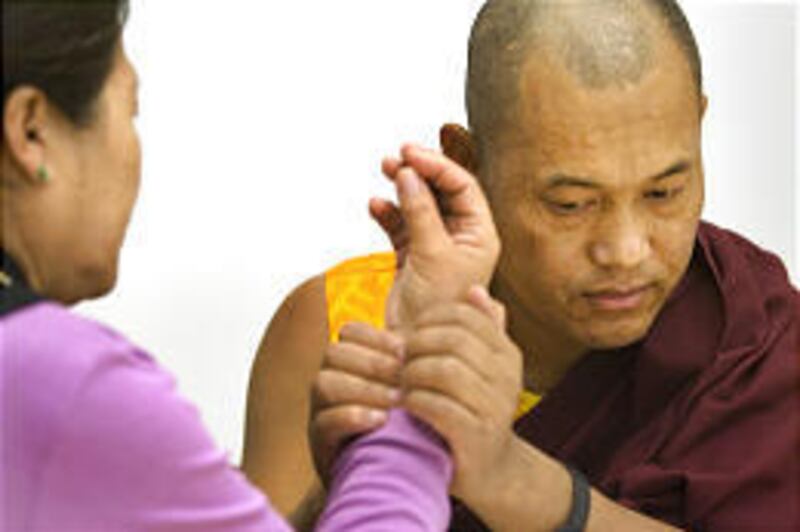
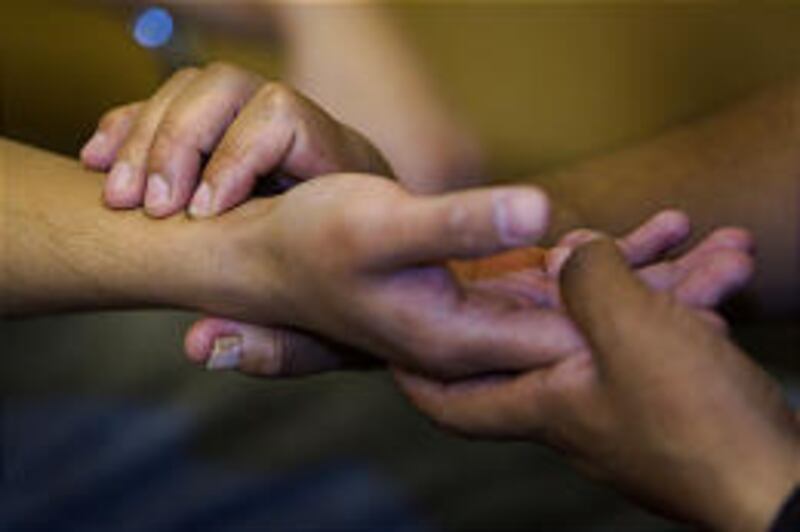
One after another, several dozen members of Utah's Tibetan community sat down with the doctor. Without any preliminary chitchat, he picked up the patient's arm (right first if the patient was a woman, left first for a man) and placed three fingers on the wrist.
Then he closed his eyes for quite a few seconds while he felt the pulse — not just the usual heart thump-thump that Western doctors take but a dozen different pulses that, according to Tibetan medicine, correspond to every part of the body. Then he picked up the other wrist and repeated the procedure. Then he looked at the patient's tongue.
And that was pretty much it, except for a few questions about symptoms. Then the doctor gave his diagnosis.
"The bottom of your intestines are very cold," he told one woman. "There is wind in your heart."
In Western terms, this was translated as hypertension.
Several people were in the library conference room, but no one cared about the health-care privacy act.
"We all suffer," explained one man about the lack of privacy. "You suffer from the left side. I from the right side. But it's all the same."
According to traditional Tibetan medicine, there are three energies, collectively known as the nyipa sum, that control and sustain the body. The first, loosely translated as "wind," involves circulation — not just the blood but food through the digestive tract and thoughts in our minds. The second system is translated as "bile" and involves metabolism and emotions such as anger. The third, phlegm, provides the body's lubrication.
Like other practices of Eastern traditional medicine, Tibetan medicine believes illness results from an imbalance of energies and that healing the body requires treating these imbalances with herbs, diet and energy therapies.
This holistic approach is appealing to Westerners as well. In fact, Wangyal said his California practice is made up largely of non-Tibetans and that most of his American patients are doctors.
Several non-Tibetans made appointments with Wangyal during his Salt Lake visit, including Cynthia Boshard, director of community health partnerships for Intermountain Healthcare. Boshard said the doctor affirmed several things that were true about her health, albeit in different terms than she was used to.
"He said I had 'heat' in my lungs," says Boshard, who notes that she has asthma. He also told her there was "cold" in her abdomen, contributing to digestion problems. Too many raw vegetables and fruits could be to blame, he said.
Raw salads are the bane of many an American's health, according to Wangyal, because they are difficult to digest. Americans also eat too many sweets and don't eat meat in moderation, he said.
Treatments in Tibetan medicine include changes in diet — Wangyal told one Tibetan woman to avoid cold drinks, cauliflower and pickles — plus herbal medicines and heat. Wangyal had a tiny cloth bag that smelled like cloves and two copper instruments used to apply heat to affected areas. These heat treatments would never be applied on a Saturday, though, the doctor said. Tibetan medicine believes that each day has its own "nature" and that some are less auspicious for healing.
The Tibetan community, according to Utah Tibetan Association executive member Tsering Gyaltsen, hopes to bring Wangyal back to Salt Lake City if the demand is high enough. The association also hopes to someday build a Tibetan center where it can host events such at this.
E-mail: jarvik@desnews.com