

WASHINGTON — Suspicions about massive identity theft prompted U.S. Immigration and Customs Enforcement officials to raid Swift & Co. plants in Utah and five other states, Homeland Security Secretary Michael Chertoff said Wednesday.
ICE made 145 arrests Tuesday in Utah as part of a total of 1,282 arrests made in what Chertoff called "Operation Wagon Train: the largest work-site enforcement to date." Arrests also were made in Texas, Colorado, Nebraska, Minnesota and Iowa.
Utah had the highest number of criminal arrests of illegal aliens, with 31 out of a total of 65 such arrests made in the six states. The remaining 114 arrests in Utah were for administrative matters related to their immigration status, according to ICE. The investigation is ongoing.
Those under administrative arrest had no proper documentation to work in the United States, while those with criminal charges are accused of illegal activity such as forgery, on top of not having proper visas to work here, according to the department.
No charges have been filed against Swift & Co., a beef and pork processing company that employs more than 1,000 people at its Cache County plant, according to the Department of Workforce Services.
Calls to Swift and Co. were referred to Vice President Sean Mucus, who did not return phone calls for comment Wednesday.
The company is one of 12,526 using the federal Basic Pilot program to verify employment eligibility at 45,930 sites nationwide. Chertoff said that by participating in the pilot program, the company did attempt to avoid hiring illegal workers.
In a statement Wednesday, Swift said it was able to resume operations at all six facilities after the raids but at reduced levels. The company said it expects no adverse long-term impacts to its operations.
Anti-illegal immigration activist Alex Segura, who heads the Utah Minuteman Project, was disappointed that Swift doesn't face charges. He said it's unlikely that Swift had no idea of the legal status of the employees. He said the raid indicates a need to mandate the program and to legislate better oversight.
"The program itself and the intent is a good thing," Segura said. "But I think (companies) will read what's happened to sign up for Basic Pilot to attempt to shield themselves."
Swift had filed a request for a court injunction on Nov. 28 to stop the raid. The company had learned about it in advance but was ordered not to inform workers. A federal judge dismissed the injunction request Dec. 7, allowing the raid to proceed.
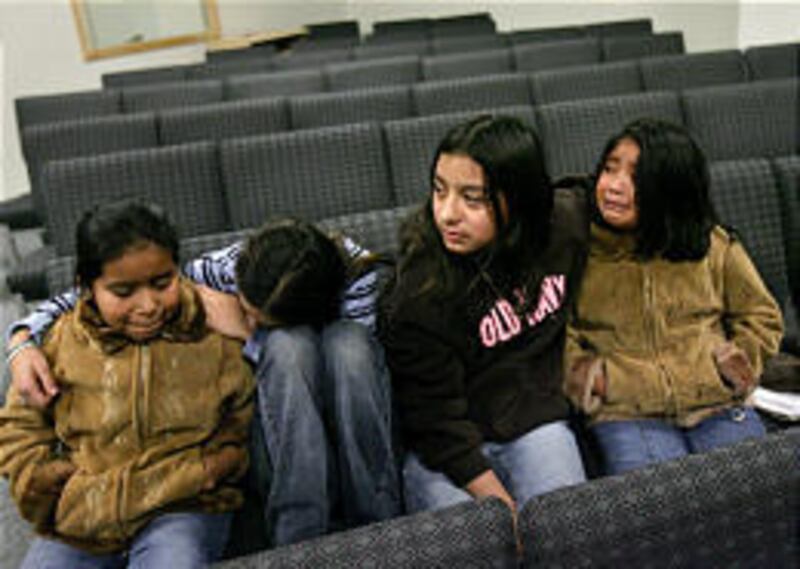
A day after his wife was arrested in the Hyrum raid at Swift & Co., Tony Ivarra hadn't heard about her. The couple has a 9-year-old daughter.
"I don't know how she is, I don't know anything," he said in Spanish at a community informational meeting, which was conducted mostly in Spanish, for families affected by Tuesday's raid.
Nearly 200 people attended the meeting Wednesday night at Iglesia de Dios (Church of God) Ebenezer in Hyrum. Some had had brief conversations with friends or family members. Others had not received any word.
Religious leaders, community advocates and representatives of government agencies answered questions.
Alex McBean, an attorney with Utah Legal Services, warned those present about scam artists who might try to contact them and give them false hope. "There are very, very few cases that have hope to avoid deportation," he said.
One plant worker, Nelson Moran, was separated from his cousin at the plant Tuesday.
"No one was allowed to leave for several hours while people were asked for their papers," he said. Moran is hopeful that his cousin, Wilton, will avoid deportation. However, he shook his head as he said in Spanish, "It's not good."
Leo Bravo, director of the Multicultural Center of Cache Valley, said that the arrests had left many broken families and his Logan center will be open 24 hours a day to help those in need. Families and friends took in children who were left stranded when their parents were arrested.
In Washington, ICE director Julie L. Myers said the investigation started last February, based on tips to the agency's hotline and discoveries by agents that some Swift employees might be illegal immigrants using fraudulent information to get a job.
"The use of fraudulent documents has been a significant problem," Myers said. About 30 percent of employment-verification documents were suspect, Myers said. How workers obtained the identity information is unclear.
Cache County Attorney N. George Daines, who was in Washington on Wednesday to represent cooperation between local officials and the federal government, said 58 criminal cases have been filed with four felony charges: three counts of forgery and one count of identity theft. Of the 58, as of Wednesday afternoon, 30 suspects had been picked up and were in the county jail. The remaining arrests still needed to be processed, he said.
Daines predicted that convictions would probably be easy to obtain because the federal investigation into the alleged identity theft and forgery had produced affidavits outlining all the evidence needed for the trials.
"It's a slam dunk," Daines said. "They have done all the investigating. We can easily file the charges."
Those arrested face 60 to 90 days in jail and eventual deportation. Daines said an immigrant convicted of four felonies would not be able to re-enter the United States.
According to one of the affidavits, a Swift worker used documents containing the personal data of someone who was actually in jail in Illinois
Investigators also said that in October, ICE agents took photos of vehicle license plates in the Hyrum plant's parking lot to check registrations. The agents discovered that 23 Swift employees had two different sets of identification documents, one to work at the plant and another for their drivers' licenses.
Chertoff said Congress needs to revise Social Security rules to catch if a number is used more than once or if a number is being used by more than one person.
Swift had been using a basic program that checks to see if the Social Security numbers used by applicants are real. In the past, using fake Social Security numbers had been the problem, but now illegal immigrants are using real Social Security numbers. A number checks out to be real, but the system does not determine that it belongs to someone else.
Chertoff said while the departments waits for Congress to revise the rules or develop a temporary worker program, these raids are one way the government can stop illegal immigration and the corresponding identify theft.
E-mail: suzanne@desnews.com; dbulkeley@desnews.com