


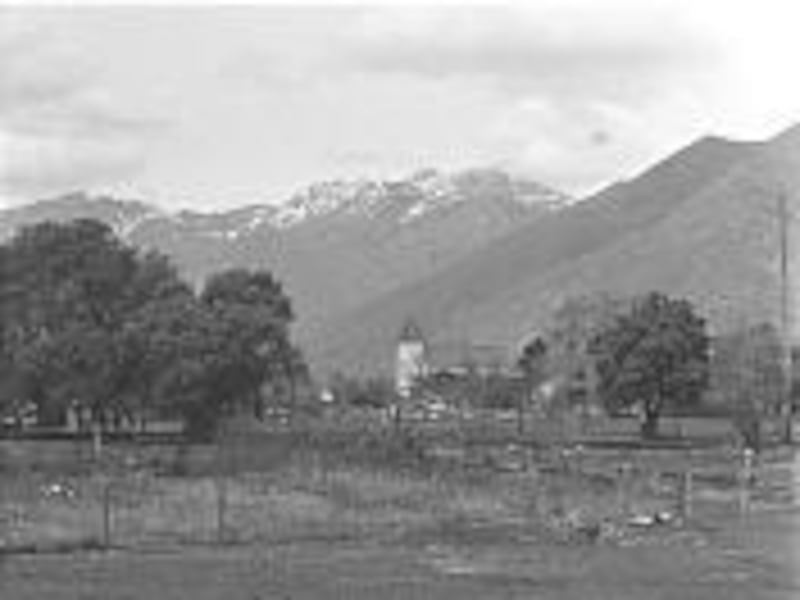
Tucked away in the southeast corner of suburban Salt Lake County is a small community nearly as old as any town in Utah.
The community of Granite, which includes areas of both Sandy and unincorporated Salt Lake County, is an area with character unlike the new municipalities cropping up all across the West. Granite has a combination of longtime residents and more recent arrivals who are drawn to the area for its mountain views, comfortable homes and sense of neighborhood.
This year marks a new century in the life of one of Granite's landmarks, often referred to as the Old White Chapel, on the northeast corner of 9800 South and 3100 East. Although it hasn't been used as a house of worship for 40 years, the church building is a reminder that Granite has history extending far beyond the suburban expansion that began roughly 30 years ago. The history of the Granite Chapel, completed in 1905, is inseparable from that of the people who made the community of Granite what it is today.
Today the community has a broad cross-section of houses ranging from simple country homes, reminiscent of more frugal times, to large, modern mega-homes. But the character of this former agricultural community remains intact.
Early in its history, Granite was a town of mining and saloons. When the mines became depleted, those left in Granite were those who intended to stay as permanent residents, and for the most part they were LDS farmers.
And many of these people wanted a permanent house of worship. They had rotated among houses of church members for meetings before a small chapel was built. But with a great need for more suitable accommodations, the decision was made to build the Granite Chapel.
Construction was completed in 1905, but the building was not dedicated until it was fully paid for, some 40 years later. That leads to the inevitable comparisons to the Salt Lake Temple, which itself took about 40 years to build.
The Granite Chapel was, by rights, a church meetinghouse, but, by fact, a community center for decades. Particularly during the difficult years of the Great Depression, the people in Granite gathered at the chapel to watch stage shows performed by their neighbors, see movies and attend dances. Most of these events were held in the lower level of the building, where space was available for such events.
During the Depression, an English immigrant, Alex Brand, was the caretaker of the church. He lived in a house immediately north of the building. Brand was, like many Granite residents at the time, a man of many occupations. He was a farmer, store owner and custodian.
Brand grew dewberries and hired local kids to pick the berries, which were used by Brand and others to make pies to sell to hungry Works Progress Administration workers, who were constructing New Deal public works projects in the area.
As a store owner, Brand did not keep regular hours. In today's terminology, he opened when he felt like it, for as long as he chose to stay open. Granite Elementary School was across the street, and Brand would open during recess. He was a popular man among the children and well-respected by the community.
Brand and his wife had no children, so the community became their family.
As caretaker of the church building, Brand took immense pride in his duties. For example, according to Robert Whitmore, who grew up in the area, "Brand kept the furnace room as clean as some keep a living room." Whitmore's father, James Montgomery Whitmore, was the principal and a teacher at Granite Elementary and bishop of the congregation for several years.
James Whitmore was so impressed with Brand's work that he wrote a letter to LDS Church President Heber J. Grant, who in turn wrote a letter to Brand commending him for his dedication to his work.
For many years the building had hard, uncomfortable, old-style wooden benches that were freestanding and made a lot of noise against the concrete floor whenever someone shifted a bench. It was not until the early 1940s that the benches were finally screwed to the floor.
Over time, those who met in the chapel needed more space, and an expansion became necessary. As one looks at the building, it is easy to see what was original construction and what was added later.
At the time of construction in 1905, the building exterior was a light reddish brick. It was painted many years later as it became clear that the bricks were not withstanding weather conditions.
As the community slowly grew, the church members outgrew the building. Judy Barney grew up attending church services in the Granite Chapel and recalls the overflow seating arrangement. "There was no place to sit, so the kids sat in the windowsills." When the new church building was constructed two blocks north of the old building in 1965, use of the Granite Chapel ceased.
The property was purchased by Utah sculptor Avard Fairbanks, who used the building as a studio and museum. But maintaining a large old structure proved difficult for an aging artist, both physically and financially. After Fairbanks' death, the building and grounds fell into such disrepair that by the late 1980s demolition was considered, along with a variety of other proposals to develop the property for its real estate potential.
The property and building were rescued from the wrecking ball by Fairbanks' son, Grant Fairbanks, a plastic surgeon and artist.
Although it may frequently seem unused, the Granite Chapel is actively used as a studio by Grant Fairbanks. Among other things, some of his father's works are being restored there.
One of the challenges in restoring a building now listed on the National Historic Register is to remain true to the original building design. The building is constructed to last, with granite rock incorporated in many parts of the building, a rugged foundation and solid masonry and beams. However, it needs cosmetic work to make the exterior beauty match the structural integrity.
The seating capacity is 125, with a stage area that allows a variety of uses, along with studio and storage space.
Grant Fairbanks typically opens the building to the public in the summer and near Halloween and on other occasions when he has time.
Grant Fairbanks envisions a day when the building can be used again as a center of a community to provide opportunities for cultural activities such as recitals, string quartets, art exhibits and more. The seating capacity is greater than what is typically available in a library or most public spaces, yet small enough to create a level of intimacy not possible in larger venues.
So how does one pursue a project of this magnitude?
Naturally, it hinges on money. Grant Fairbanks says he has invested heavily in the Old White Chapel, but the word "investment" is misleading. The investment is in heritage, culture and opportunity rather than in cash returns or real property price appreciation.
Grant Fairbanks says that while contributions have been graciously offered by some, he has borne most of the cost. And simply stated, it's a money pit. He says he has resisted most proposals to create a nonprofit entity for fear of losing the ability to determine the direction of his father's only remaining studio.
He'd love to have some legal help in figuring out a way to create a nonprofit organization of some sort to allow people to make tax-deductible contributions. Because of liability issues he resists volunteer labor, but he is delighted to have financial and other forms of help. For more information, call his office at 268-8838.