

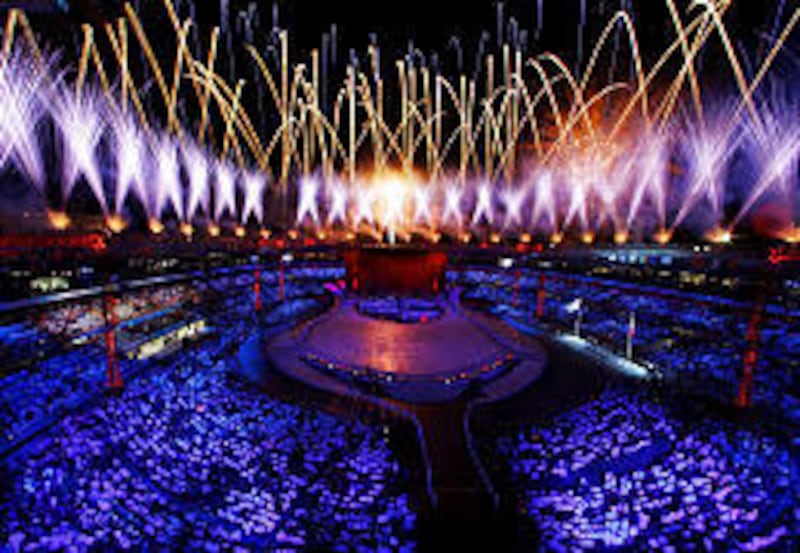
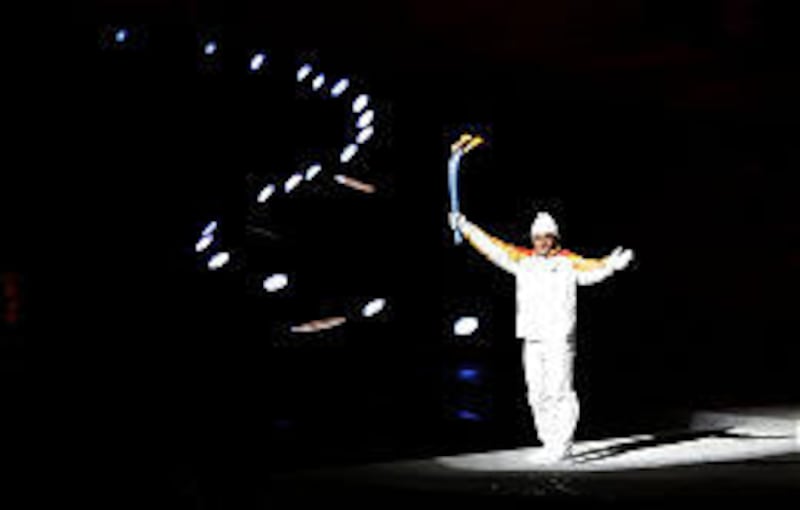
TORINO, Italy — The Olympic flame burned bright above the Stadio Olimpico, ignited by the torch borne into the stadium by Alberto Tomba, Italy's former version of American skier Bode Miller.
Below in the stadium, a sea of spectators wearing white pullover ponchos designed to give the feel of a snow-covered field sat chilled and ready for the end of Friday night's three-hour-long opening ceremony.
But there was still a huge black curtain hung across the stage and a sense that there was something else, something not yet said, just one more thing that would stamp these Olympics definitely Italian.
Slowly the black panels of "the greatest curtain ever sewn" parted, and there standing center stage, in a long black robe and wearing his signature tux, stood the most Italian of Italians, Luciano Pavarotti.
That the organizers would use the famous tenor might have been an attempt to make clear the message that these are the Games of a country steeped in culture and history.
Because while the show was dazzling, and followed a theme that moved from a celebration of the Olympic Games to a history and celebration of Italian culture, a sort of Dante to Space Age complete with a bright red Formula One race car spinning 360s on stage, it left many wondering exactly what they had just watched.
It didn't help that right there before the Olympic flag was carried in, Yoko Ono, John Lennon's widow, was presented to give a speech on peace.
Yoko Ono?!
No matter.
As Olympic openings go, Torino's lived up to the promise of any opening ceremony. It was colorful and entertaining, a majestic introduction of the 2,500 athletes from around the world who will spend the next two weeks competing in this Northern Italian city nestled against the Alps.
"This was amazing!" U.S. short track speedskater Anthony Lobello, of Tallahassee, Fla., said of his first opening ceremony experience. "This was more than I ever imagined the opening ceremonies to be. It's greater than portrayed on television."
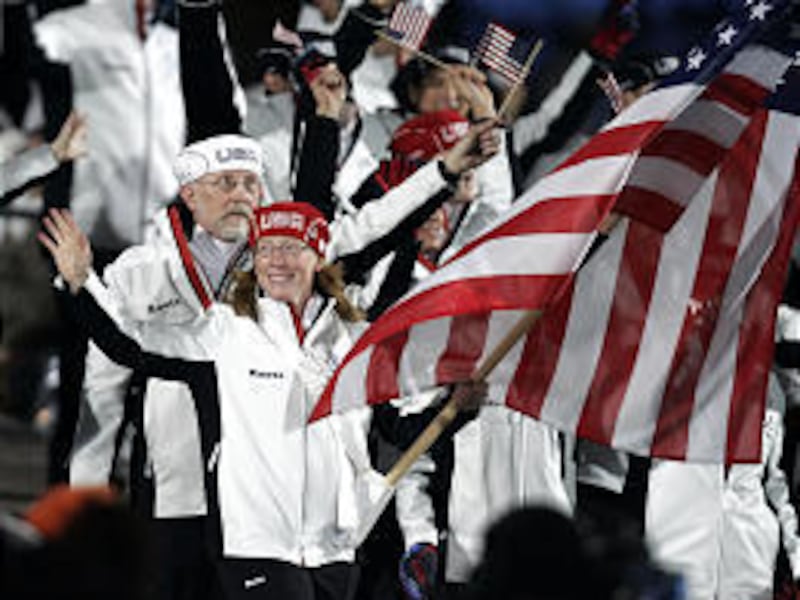
Lobello was one of more than 200 Americans who were led into the stadium by five-time Olympic speedskater Chris Witty of West Allis, Wis., who ushered the white leather jacket, red beret-wearing U.S. athletes into the stadium as the flag bearer.
"Torino is the third Games in which I marched in the opening ceremonies, and it'll be most meaningful," she said.
It was a ceremony fitting the beginning of an Olympics, awarded to a city many have criticized as being unworthy. It was proof that given enough time and money, Italy's ailing industrial center is as good a place as any.
Torino has been getting buried for weeks, likened to Detroit, and portrayed as a city mired in economic depression, not exactly a place that would be found on the 10 best cities to visit in Europe. At first glance it's an image that's understandable. The automobile industry here has been as hard-hit as it has in the United States. Many of the gigantic buildings that once housed a flourishing industry are either vacant or transformed.
But the city is under reconstruction, literally. Towering cranes that sit over the iron shells of new offices and apartment buildings clutter the skyline. They are everywhere
In the northern neighborhoods of the city, there is so much construction that a fine gray dust covers everything.
Every morning residents of the surrounding neighborhoods sweep their sidewalks or wash away the dust with water sprayed from hoses.They seem unaware that the Olympics have finally arrived, but once reminded, are happy to be host to the world.Downtown is decked in Olympic regalia, bright red banners that proclaim the motto of their games: "Passion Lives Here."
There is nothing wrong with Torino. No reason for this city not to host the 2006 Winter Olympics. It has character, urban character. It isn't Lillehammer, Salt Lake City or Nagano. But those scenes are only a bus ride away, in the Italian Alps, whose snow-covered peaks frame the Torino skyline.
And Friday night, Torino celebrated the opening of its games, and did it in all-out Italian fashion.
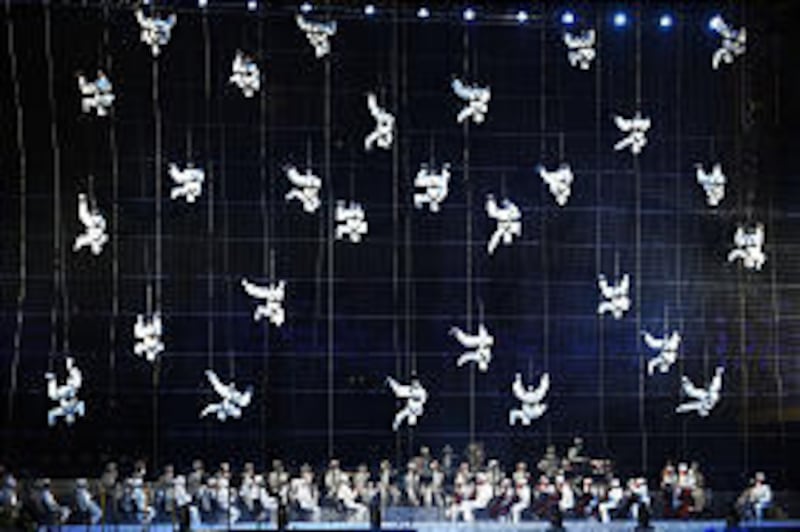
The opening was majestic and colorful from the beginning to the end. Opening ceremonies by tradition, at least by modern tradition, are elaborately choreographed affairs with hundreds of performers — in this case, young volunteers who at one point formed a giant skier that undulated across the stage, breathing hot breath in the cold air.
Skaters with flaming red helmets rollerbladed across the stage. There were fireworks and acrobatics, and symbolism galore.
The overall theme said this is Italy; we have contributed to the world from the days of Dante, whose passages were read by Ulysses, through the opera of the Middle Ages and Pavarotti.
There were also statements on the culture of today. In his speech to the Olympians, IOC president Jacques Rogge called for a clean and competitive games, one that will serve as inspiration to the young of the world, with an added shot at the use of performance enhancers. "Please compete in a spirit of fair play, mutual understanding and respect and, above all, compete cleanly by refusing to dope."
So now it is on to the Games and the real reason the Olympics are watched around the world — the athletes. "It's amazing how much dedication it took for these athletes to get here," said Dixie Baver, mother of short track speedskater Allison Baver, of Sinking Springs, Pa. "I'm just so proud of everyone."