

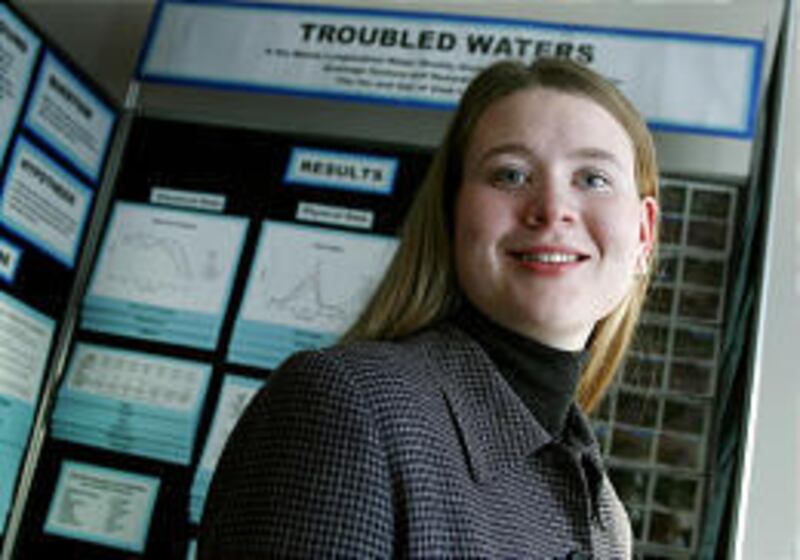

For good reason, the Intel Science Talent Search is nicknamed the "junior Nobel Prize" — and this year, a Utahn is a finalist. According to contest organizers, this is the first time a candidate from Utah has reached that stage since 1994.
She is Shannon Babb, an 18-year-old resident of Highland, Utah County, in her last year at American Fork High School. When she became a semifinalist, she won $1,000 in scholarship money and an equal amount for her school. Reaching the finalist stage means she raked in $5,000 more in scholarships, a laptop computer and a trip to Washington, D.C., March 7-14.
There, she will compete as one of 40 student presenting their projects; this includes a poster session for members of Congress. Scholarship prize money ranges from $100,000 for the top winner, through awards of lesser amounts until the seventh- through tenth-prize winners' $20,000 each.
But it's not about the prize money. It isn't even about winning another contest for the young researcher, who already has a four-year, full-tuition presidential scholarship and numerous other awards.
It's about helping the ecosystem, says her mother, Anita Babb, and about inspiring even younger people to get involved.
Her latest project monitored the health of the Spanish Fork River. As the Intel Science Talent Search Web site, sciserv.org/sts/65sts/Babb.asp, notes, "For six months, Shannon collected water samples, measured several chemical and physical parameters, tested for E. coli (bacteria), and collected macroinvertebrates at seven sites.
"Her data indicated that all seven sites exceeded Utah EPA guidelines for cold-water fisheries at some point during the study."
"I found there's a lot of pollution that was directly linked to man, but it would be relatively inexpensive to do remediation work on it," Shannon Babb said in a telephone interview.
Asked how she carried out the river study, she said the first step was to "wake up at 4 a.m.," then go to the river to measure factors including dissolved oxygen, phosphorus, nitrates, alkalinity or acidity, and how turbid the water was. She checked stream width, depth and flow, and checked the vegetation.
She caught aquatic bugs. Some varieties like stoneflies and mayflies indicate good water quality, creatures like crane flies tend to show up in average water, and some types are found in poor-quality water.
Aquatic pill bugs may "indicate there's really bad pollution" because they live in water with low dissolved oxygen and have somewhat armored skin. They can live in water that is too base or acidic for other species, "and they seem to like turbidity," she said.
"When all you catch is the pill bugs and you never find a mayfly in that area of the river, then you start to look at the chemical and physical characteristics to find out why," she said. "It may not be that it's polluted, but there's a good chance it is."
Most of the pollution she found is non-source, meaning runoff from streets or lawns. Fertilizer makes its way into the river, and the nitrates and phosphates "can wipe out an ecosystem," she said.
Asked for some solutions, she quickly said, "Replant the riparian zone."
In stretches of the Spanish Fork, the natural vegetation has been ripped out and the river channelized because of development, she said. "Dredging out the natural stream structure . . . destroys all habitats in there. There are a number of ways to encourage habitats to return."
Another answer may be to set up filtration systems to clean out storm drain runoff, she said. "Right now, it's going directly into the river" from some sites.
Anita Babb said that when her daughter was in eighth grade, Nancy Mesner — an extension specialist at Utah State University, Logan, who specializes in watershed and water quality issues — taught the girl and others about monitoring water quality during a two-day workshop. She signed up people who wanted to carry out such projects.
Since eighth grade, Shannon Babb has been "working on a project every year, and they've just gotten bigger and bigger," she said. Her daughter wants to help others realize how important these issues are so they can help make changes.
Last week, the high school senior visited an elementary school and told a first-grade class about the importance of protecting water quality. The students "were so excited," Anita Babb said.
"They want to make a difference," Shannon Babb said. "They just have to be told how."
E-mail: bau@desnews.com