



CESANA PARIOL, ITALY — The first time Shauna Rohbock rode 80 mph in a bobsled, she hopped out at the bottom of the track and said, "I've got to have one of these."
Then, when they told her she could win an Olympic medal in a bobsled, she decided she had to have one of those, too.
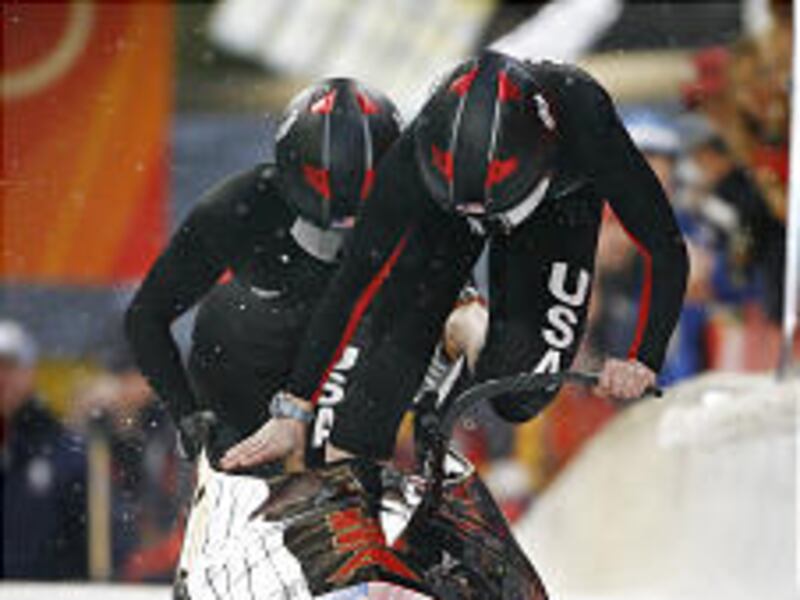
Tuesday night at the Torino Olympics, the Orem native hopped out of her USA-1 bobsled and collected that medal, a silver one, after driving down the Cesana Pariol track faster than anyone except Germany's Sandra Kiriasis, who proved uncatchable in racing away to the gold medal.
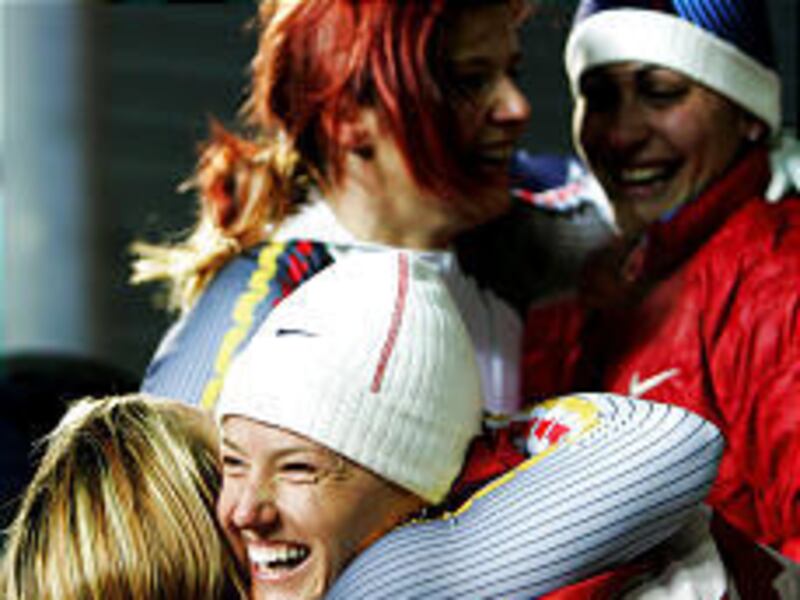
It hardly mattered to the 28-year-old Rohbock, who banged the sides of her shiny black sled at the end of her final run — with the German sled still to run — and threw both arms into the air before hugging her brakewoman, Valerie Fleming.
No matter what Germany did next, an Olympic medal was assured.
"All night long, when I couldn't sleep, I just kept hoping that I'd see a '1' when we finished," Rohbock said, "and then I saw it. There really are no words to describe that feeling."
The combined time for Rohbock and Fleming after two days and four runs down the technically demanding 19-curve Olympic track was 3:50.69. With a final run of 57.71, Kiriasis and her brakewoman, Anja Schneiderheinze, recorded a 3:49.98 to slide past them for the gold. Coming in third and collecting the bronze medal, to a most popular reception, was the Italian team of Gerda Weissensteiner and Jennifer Isacco with a time of 3:51.01, .32 behind the Americans.
The USA-2 sled driven by Jean Prahm and pushed by Vonetta Flowers finished in sixth place at 3:51.78.
Rohbock and Fleming started the day in third place but moved into second after their first run and stayed there.
"I couldn't have asked for better runs, really," Rohbock said. "I feel like I couldn't have done any better."
With her final run of 57.89 seconds she accomplished something she'd dreamed about most of her life.
"When I was little I was watching the Olympics on TV; I don't know which ones," she said, "and my mom tells me I looked up and said, 'I'm going to those.' "
For years, she figured she'd be going as a soccer player. And for good reason. A high school star at Mountain View High School in Orem, she moved on to Brigham Young University and became a three-year collegiate soccer All-American, scoring a school-record 95 goals and setting numerous NCAA records in her 90-game career.
In her spare time, she participated in track and field, where she was also a three-time All-American for BYU in the heptathlon — and that's how she got introduced to bobsled.
In her senior season in the spring of 1999, in the run-up to the 2002 Salt Lake Olympics, the U.S. bobsled federation was searching for track athletes who might make good pushers. When they contacted Craig Poole, the woman's track coach at BYU, he reportedly said, "Shauna's the only one crazy enough to do it."
Soon, Shauna was at the Utah Olympic Park where she took her initial 80 mph ride down the bob run, which she compared at the time to "getting in a trash can and being shoved off a cliff."
At the bottom, Bonny Warner, a veteran U.S. bobsledder, waited for the telltale signs that quickly eliminate would-be bobsledders, no matter how athletic: fear or dizziness.
But right after Rohbock said, "I've got to have one of these," the next thing she said was, "Can I have another run?"
A bobsledder was born, and with college behind her, Rohbock quickly became one of America's strongest pushers and was recruited onto Jill Bakken's sled, which she pushed for nearly three years.
Then, just two weeks before the Salt Lake 2002 Games, Rohbock was ailing with a slight hamstring pull and Bakken decided to have a pushoff between Rohbock and Vonetta Flowers, another track athlete turned bobsledder.
Flowers won the pushoff by four/hundredths of a second, and Bakken replaced Rohbock with Flowers.
At the Salt Lake Games that were held in virtually her own back yard, Rohbock's only participation was as a forerunner.
Bakken and Flowers, meanwhile, made history by winning the first-ever Olympic women's bobsled gold medal — ahead of a German sled driven by a woman named Sandra Prokoff, who would later marry and become Sandra Kiriasis.
Determined to carry no hard feelings — and to make sure no one thought anything like that might be brewing — when the Bakken-Flowers sled skidded to a stop, Rohbock hurdled the rail and was the first person to run out and congratulate the new gold medalists.
"There was no bitterness then and there's no bitterness now," Rohbock said last night when one of the first people to congratulate her was Vonetta Flowers. "Jill did what she had to do."
But the experience left Rohbock with the feeling that no longer did she want anyone else determining her future.
"I wanted to be in control," she said. "I wanted to be the driver."
It's easy to connect the dots between then and now. Rohbock took to driving like she's taken to everything else she's tried athletically and soon was passing the top American drivers, Bakken and Prahm, to get command of the top U.S. sled coming into the Torino Games.
But there were some significant detours. For one thing, she hadn't gotten soccer out of her system so for two years, in 2002 and 2003, besides doing bobsled she also played professional soccer with the San Diego Spirit of the Women's United Soccer Association and even played one game, against Ukraine, for the U.S. national soccer team.
She might yet be juggling bobsled and soccer if the WUSA hadn't disbanded after the 2003 season.
The other detour was more dangerous.
Soon after taking up bobsledding and discovering that it isn't cheap, Rohbock joined the U.S. Army and signed up for the Army's World Class Athlete Program to help defray expenses.
But that plan nearly backfired when, in December of 2003, she was at a World Cup meet in Lake Placid, N.Y., and got word that her outfit, the Utah National Guard 115th Engineering Group, was being deployed to Iraq.
Protests that she was supposed to serve her country by being the best athlete she could be fell on deaf ears. Before she got a chance to compete, she flew home to Utah and reported to Camp Williams for two weeks in the Soldier Readiness Program prior to being shipped off for a year in Iraq.
"My bags were packed and I thought that was it for bobsled," she said. "But then they asked if I had any injuries and I said I thought I might have torn my rotator cuff."
X-rays on her shoulder proved she was right.
"It was a non-deployable injury," Rohbock said. "I couldn't go.
"But I could still compete," she said. "It's not like I had to lift the bobsled over my head."
In Italy last night, two winters and one Olympic medal since that dark day in December when it almost all went south to Baghdad, she said, "I think every athlete has to face something like that in their life. Usually it's a serious injury or something. For me it was facing going to Iraq.
"I hope I'm providing some inspiration for the soldiers by doing this," she added.
But talking about the past soon enough led back to the present, and America's newest silver medalist spoke long and enthusiastically about the thrill of victory and the good night's sleep she expected it to bring.
"Oh my gosh," she said, remembering how hard sleep had come Monday at the halfway point of the biggest athletic meet of her life. "Last night took forever."
But before that, she wanted to find a telephone and call her parents, Chuck and Myrna, who hadn't made the trip to the Italian Alps and who she knew would be waiting to hear from her back in Orem.
"I haven't called them yet," she said, "I know we'll all start crying."
And for an excellent cause.
Lee Benson's column will run daily during the Torino Olympics. You can e-mail him at benson@desnews.com.