

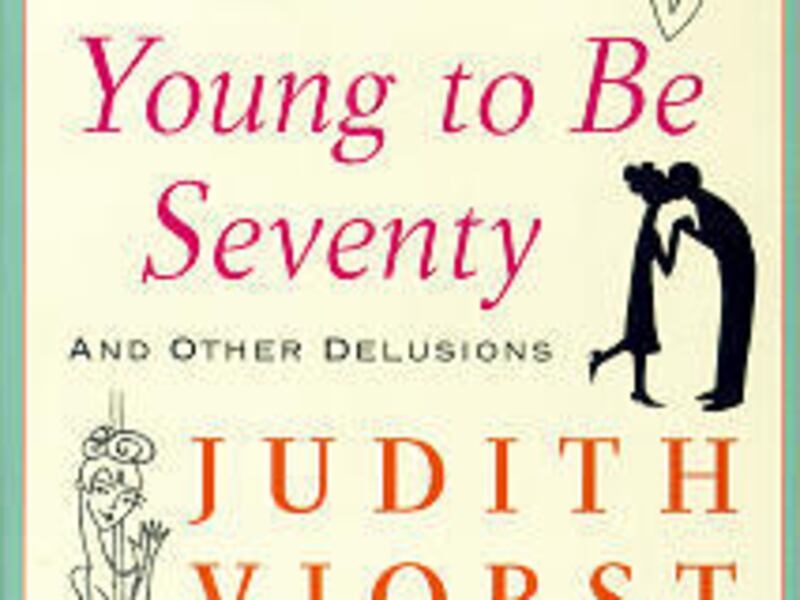
I'M TOO YOUNG TO BE SEVENTY AND OTHER DELUSIONS, by Judith Viorst, Free Press, 79 pages, $16.
Here we go again. Judith Viorst, the delightful satirist who started writing about the decades of life when she was in her 30s, has done it again. She has written about the 70s — and incredibly, she has reached that venerable decade herself.
Her first book, "When Did I Stop Being 20 and Other Injustices," was so well-received that it led to "It's Hard To Be Hip Over 30 and Other Tragedies of Married Life." As she aged, she wrote "How Did I Get To Be 40 and Other Atrocities," followed by "Forever 50 and Other Negotiations."
Although she hesitated to go on, she went for it anyway with "Suddenly Sixty and Other Shocks of Later Life." Finally, she has written this latest one, "I'm Too Young To Be 70 and Other Delusions."
Each of these "decade" books is written in satirical verse, often with a pattern of four short sentences, followed by three longer ones and climaxing with another shorter punchline. They are most effective read aloud with proper pauses and emphasis.
In one poem she expresses her dismay that her husband does not enjoy the opera as much as she does — to put it mildly. He "sighs heavily and tap-tap-taps the armrest with one finger, And crosses, uncrosses, recrosses his navy blue legs."
Even though he applauds at the end, his sighs are louder, "Because he'd prefer to be taking the car for inspection, Because he'd prefer to be caught in rush-hour traffic, Because he'd prefer to be having a prostate exam."
She is more worried that because he has suffered through the opera, she will have to "spend an equivalent evening sitting beside him Listening to a lecture on Gulf Security in Bahrain or someplace like Bahrain, Which I have nothing against Except I'd prefer to be doing our tax returns, Except I'd prefer to be caught in rush-hour traffic, Except I'd prefer to be having a mammogram."
Probably the most entertaining poem in this collection is one telling her husband, "If I Should Die Before I Wake, Here's the Wife You Next Should Take": "Let her be loving and gentle and easy to be with. Let her have great mental health, also trust funds galore. Let her hold views that you practically always agree with. Let her be so damn good-natured she's almost a bore."
Other characteristics: She should be able to play Scrabble and chess, to do tax returns better than "do witty" — "enjoy football plenty and sex a lot less." She could "be friends with the grandkids, but never their nana. Let her provide dust-free baseboards and Internet skills. Let her be more like Elizabeth than like Diana."
Some other wonderful poems are "They May Be Middle Aged, But They're Still My Children," "A Letter to My Sons About Mother's Day," "What Do We Tell The Children?" and "Role Reversal." The latter ends with, "We see ourselves as quite intact, Despite some losses physical and mental. So though we know no harm is meant, We've come to mightily resent Our children's tendency to act parental."
It should be noted that Viorst has also written serious books about relationships such as "Necessary Losses" — and children's books, the most famous being "Alexander and the Terrible, Horrible, No Good, Very Bad Day."
E-mail: dennis@desnews.com