

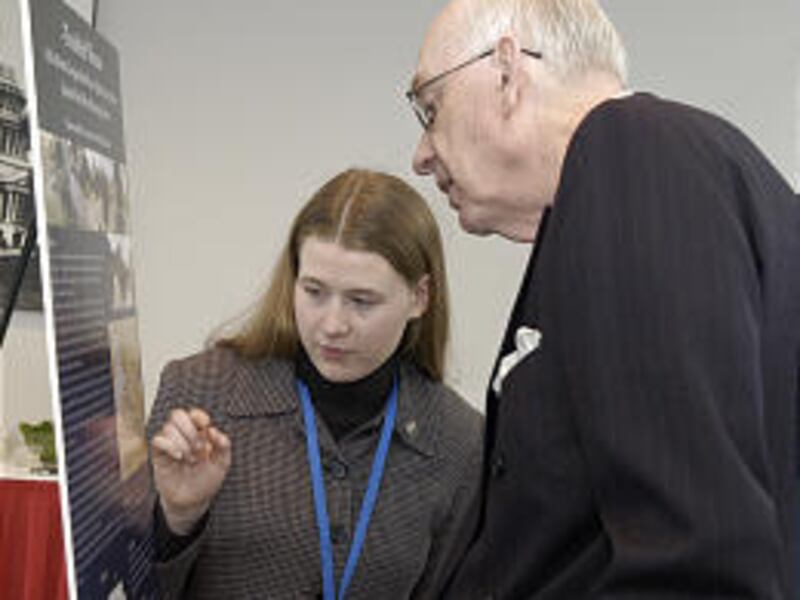

Shannon Babb, an 18-year-old from Highland who is a senior at American Fork High School, has won the Intel Science Talent Search, contest officials announced Tuesday.
The announcement came at an awards banquet in the Ronald Reagan Building in Washington, D.C., attended by about 700 contestants, their families, scientists and other dignitaries.
First place in what is often termed the "Junior Nobel Prize" competition carries enormous prestige and a $100,000 scholarship. That is in addition to Babb's earlier Intel winnings for herself and her school, garnered when she advanced to the semifinalist and finalist stages. Utah's last previous Intel finalist reached that level in 1994.
Speaking by telephone with the Deseret Morning News shortly after the announcement, Babb said that when she learned she had won, she felt "absolute shock."
"At first they announced 'American Fork High School,' and I was the only person (competing) who was from American Fork High School, so all of a sudden, it was like, 'Whoa, did I just hear that, American Fork?' Then they followed with my name, so yes, I did.
"So I kind of stumbled to the front. Apparently, I looked very shocked."
During a six-month study, Babb sampled water quality and checked the health of the ecosystem of the Spanish Fork River, waking at 4 a.m. each day for the project. Her entry was judged best among those of 1,558 students who competed, representing 486 high schools in 44 states, the District of Columbia, Puerto Rico, the U.S. Virgin Islands and an overseas school, according to Intel.
Officials said six previous winners went on to become Nobel laureates, three received the National Medal of Science, and 10 are fellows of the MacArthur Foundation.
Intel saluted Babb's "rare ability to combine research and remediation in environmental science." Contest officials noted Babb began researching water quality at age 13, and analyzed the chemical and physical properties along the river drainage system.
"She concluded that humans, through urban and agricultural factors, have a negative effect on the water quality of the river," according to an Intel press release. "She believes the water quality problem can be resolved with a combination of restructuring and educating the public that household chemicals should not be poured down storm drains."
Altogether, Intel awarded prizes totaling $530,000 to competitors, including a $75,000 scholarship for second-place winner Yi Sun of The Harker School in San Jose, Calif., cited for discovering new geometric properties of random walks, and a $50,000 scholarship to Yuan "Chelsea" Zhang of Montgomery Blair High School in Rockville, Md., for her third-place entry researching the molecular genetic mechanisms behind heart disease.
The fourth- through sixth-place awards brought $25,000 scholarships; for seventh through tenth places, the prizes were $20,000 scholarships. The remaining 30 finalists, according to Intel, will receive a $5,000 scholarship. Each finalist also won a notebook computer.
In the past week, the 40 finalists went through interviews by a judging panel headed by Dr. Andrew Yeager of the Arizona Cancer Center, who is also a professor of medicine and pediatrics at the University of Arizona.
Babb was accompanied to Washington by her mother, Anita Babb. At the announcement, her mom "just came up and gave me a really big hug and kind of cried a little, because this really was not expected," the younger Babb said, adding that she cried, too.
Babb had presented her project to the head of the Environmental Protection Agency and to members of Congress. During a breakfast in the Senate Office Building, members of Congress wandered around displays of the projects, talking with the students.
"Sen. Bob Bennett (R-Utah) came by," she said.
After the award was announced, she was able to meet John Glenn, the astronaut and former senator.
"I was still somewhat hyperventilating," she said.
Babb said that when she gets home she has to "finish up the fourth phase" of her project, involving studies of the Diamond Fork River. She needs to crunch some data, she said.
Babb is no stranger to contest awards. She has already won a four-year, full-tuition presidential scholarship. Last year, she was one of 10 national winners of the Gloria Barron Prize for Young Heroes, and she won a $3,500 scholarship through the Discover Card Tribute Award Scholarship program.
What will she do with the accumulated scholarships?
"I am going to get a doctorate," she said. "I'm not quite sure which field I'll choose, but I am going to go all the way to the top."
Now, she said, she knows she will be able to finance it.
"I can go to pretty much any college that I want to for my grad work," Babb said.
Meanwhile, she added, she will pursue her bachelor's degree at Utah State University, Logan, majoring in watershed and earth science.
During the judging, a panel asked many questions, some of which were not about the immediate project.
"I had two judges ask me about salmon farming," Babb said.
The reason, she noted, was that "they want some questions that are a little bit related to your field, but they want to see how far your knowledge goes."
Later, during judging with the display boards contestants had put together, the questions asked were about "what you were really comfortable with," she said.
The final step was to await the result.
Intel has sponsored the contest since 1988, but the contest has been recognizing top young scientists since 1942. It is administered by a group called Science Search.
"Science Service is the nonprofit organization which has administered the Science Talent Search since its inception in 1942," Intel's press release stated.
Its goal is "to advance the understanding and appreciation of science."
E-mail: bau@desnews.com