

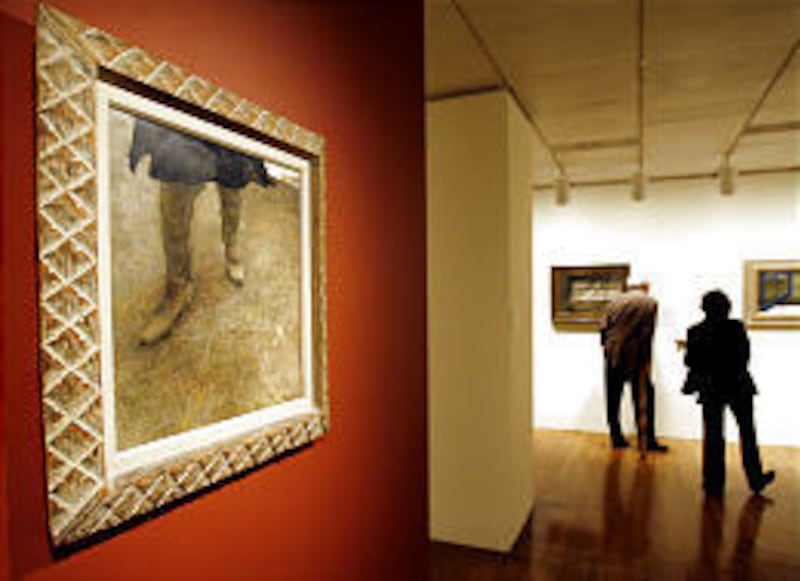
PHILADELPHIA — There is more than meets the eye in the paintings of Andrew Wyeth.
Scenes of rushing rivers, fishing boats, farmhouses and fields appear straightforward and serene but are imbued with metaphors and symbols exploring darker themes of death, isolation, desire and loss.
"Andrew Wyeth: Memory and Magic," which opened Wednesday and runs through July 16 at the Philadelphia Museum of Art, displays more than 100 works spanning the 89-year-old Pennsylvania native's seven-decade career. The show features portraits, still lifes and landscapes, including pieces from the artist's own collection.
"They seem like simple subjects at first glance, but you want to keep looking because of the complicated layers of emotions," curator Kathy Foster said. "Even if you don't know the stories behind them, you can feel the emotional power. That's why they resonate with people."
Some of his works have become icons, from the handicapped woman crawling toward her farmhouse in "Christina's World" (1948) — a scene sometimes re-enacted by camera-snapping tourists at the site in Cushing, Maine — to the secret "Helga pictures" (1971-1985) that stunned the art world when Wyeth revealed them in 1986.
Some art critics, however, condemn Wyeth's paintings as narrow, maudlin, even kitschy. One famously referred to the Helga series as resembling "pious deodorant ads." Others argue that rural American life and people are reduced to cliches in his work, and even that Wyeth's famed reclusiveness is an affectation.
Foster has a suggestion to those who might dismiss Wyeth's work: Look more closely.
"Wyeth is someone everyone thinks they know. He's typically miscategorized by his critics and underestimated by his admirers," she said. "The conventional wisdom about Andy Wyeth is that he's a realist, but realism is only the beginning."
Wyeth was born on July 12, 1917, in Chadds Ford. He was educated at home; his art training came solely from his father, popular illustrator N.C. Wyeth.
The younger Wyeth was 19 when he had his first solo exhibition at the Philadelphia Art Alliance. He gained national prominence in New York's Museum of Modern Art's 1943 show, "American Realists and Magic Realists.'
The painting "Winter, 1946" addresses the death of the elder Wyeth, whose car was struck at a Chadds Ford train crossing in 1945, and marks Andrew Wyeth's turning point into darker themes.
If you go . . .
What: Andrew Wyeth: Memory and Magic
Where: Philadelphia Museum of Art, 26th Street and the Benjamin Franklin Parkway.
When: Through July 16.
Gallery hours: Tuesday, Wednesday and Thursday 10 a.m.-5 p.m.; Friday 10 a.m.-8:45 p.m.; Saturday and Sunday 10 a.m.-5 p.m., plus selected late weekend and Monday hours.
How much: Timed tickets, which cost $10 to $20 plus a $3-per-ticket service fee, can be ordered at 215-235-7469.
Phone: 215-235-7469
Web: www.philamuseum.org